

01. QFLP in context: what it is and its development in China
Since its initial launch in Shanghai in 2010, the Qualified Foreign Limited Partner ("QFLP") regime has been one of the key routes for foreign investors to deploy capital into China's onshore private equity and venture capital markets.
Under a typical QFLP structure, the QFLP Fund is managed by a domestic fund manager, with the foreign investor or the QFLP investing foreign currencies. Such foreign currency investment would be converted into RMB following the applicable foreign exchange rules. The QFLP Fund may also raise money from the domestic limited partners.
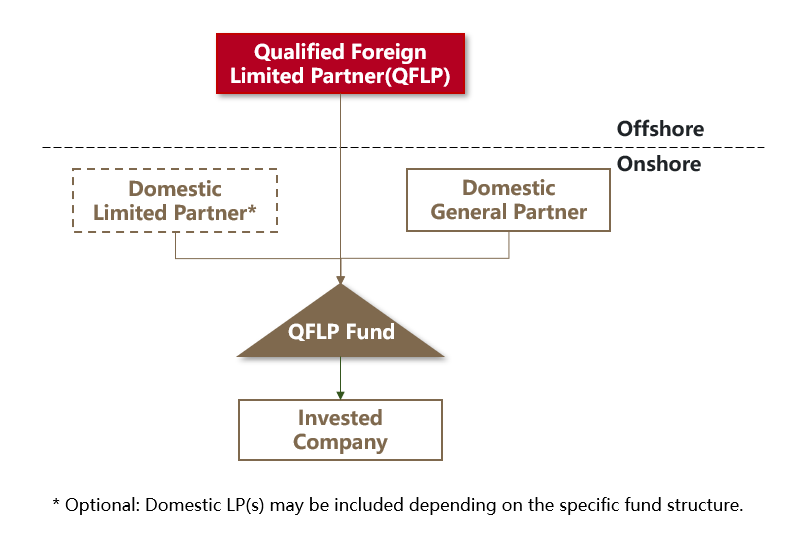
Figure: Typical QFLP structure
Over the past decade, the QFLP regime has expanded well beyond Shanghai. According to a recent report on China's financial liberalization, by early 2024 QFLP programs had been launched in close to 100 pilot areas nationwide. In Shanghai alone, by the end of 2020 more than 70 institutions had participated in the QFLP program, investing nearly RMB 40 billion across sectors such as biopharmaceuticals, environmental protection, information technology, etc.
Commercially, the QFLP regime has been attractive because of (i) its ability to obtain relatively large foreign-exchange quotas at the QFLP Fund level by reducing transaction-by-transaction inbound investment approvals, (ii) the regulatory framework designed to facilitate cross-border private equity investment in a more efficient manner, and (iii) the predictable and favorable tax treatment primarily at 10% enterprise income tax ("EIT") for QFLP and a tax commitment approach, rather than completing a complexed tax filing as a precondition, to remit cash abroad.
02. The relevant PRC tax rules on QFLP
From a PRC domestic tax law perspective, a non-resident enterprise is subject to different tax treatments depending on whether such enterprise has an office or a premise of business in China (in Chinese: "机构、场所", or "Premise") and whether its income is effectively connected with that Premise:
a)A non-resident enterprise without a Premise in China is generally taxed via a withholding scheme on its China-sourced income, at 10% EIT.
b)A non-resident enterprise with a Premise in China is subject to 25% EIT on the taxable income attributable to that Premise, on an annual basis, with quarterly tax filing and an annual filing adjustment, which is similar to the EIT filing requirement of an onshore PRC company.
The concept of the Premise under domestic tax rules is similar to the permanent establishment ("PE") concept in a tax treaty context as introduced below, but with a broader and less clear definition.
From a tax treaty perspective, taking the China - Singapore double tax treaty as an example, a PE means a fixed place of business through which the business of an enterprise is wholly or partly carried on, which is often referred to as a fixed place PE. The tax treaty also includes service PE, agency PE and construction PE concepts, which are generally in line with the international tax rules and practices.
As introduced, part of the commercial success of the QFLP regime is attributable to the favorable tax treatment available to QFLP. Historically, in most of the pilot areas, the tax authorities have allowed QFLP to apply the withholding approach with 10% EIT.
03. What is changing in the tax administration of QFLP
In recent practice, however, we have observed changes in tax administration affecting QFLP. From the central State Taxation Administration ("STA") level to the local tax authorities, tax officials consider that the QFLP has the Premise from a domestic tax law perspective or constituting the PE from a tax treaty perspective, and therefore the QFLP shall be subject to 25% EIT. Such a new approach would be effective from the beginning of 2026 nationwide.
We understand such a new tax administration approach is purely an oral instruction from the STA to the local levels of tax authorities without updated tax rules in written form. It appears to reflect an official interpretation on the existing tax rules governing the QFLP, although in practice such rules have been considered not entirely clear.
In the absence of further official explanation, our understanding is that it seems the underlying logic is that the domestic QFLP Fund is regarded as a fixed place of business of the QFLP, and therefore the QFLP has a close connection on a commercial level with China. However, as the business operations and commercial arrangements of each QFLP Fund would be different from one to another, we consider such unified instruction on the QFLP tax administration would be controversial in practice.
This shift in the tax administration of the QFLP would entail three concrete consequences:
a)Tax rate increase. The QFLP is taxed at 25% EIT on taxable income attributable to its Chinese Premise or PE, instead of at 10% following the withholding approach.
b)Change of computation method. The tax base moves from a "per exit" model (for example, 10% on the capital gain of each share transfer of the portfolio company) to an annual net-profit calculation.
c)Refiling of prior years. The tax authorities may request the QFLP to re-file EIT returns for prior years on the basis that it should have been treated as having a Premise or PE all along.
04. Transitional mechanics: deemed profit ratio and refiling of EIT returns
1. Deemed profit ratio as a transitional tool
Although the new approach is intended to be effective from the beginning of 2026, we have observed some tax authorities require the QFLP to complete the tax registration as early as possible to prepare for the tax filing next year, and even require the QFLP to refile the EIT returns for the historical periods following the new approach.
To manage the tax burden increase in historical years, the tax authorities may propose a deemed profit ratio calculation with a 40% applicable profit rate. Applying such a deemed profit ratio together with the EIT rate at 25%, the effective tax rate might be similar to 10% (40% × 25%). The final result would be subject to the specific circumstances of each QFLP.
The proposal of the deemed profit ratio is to mitigate the tax differences of the historical approach, i.e., withholding at 10% EIT, and the new approach, i.e., the business profit method at 25% EIT. We recommend the QFLP to discuss carefully with the tax authorities, as the details in the refiling may result in additional tax costs.
2. Why refiling can lead to additional tax payable – the timing difference
Even following the deemed profit ratio approach, the effective tax costs might be the same as the old approach, but the timing of tax payable can also result in additional cash tax. Under the withholding method, EIT is normally collected when the relevant capital gain is paid to the QFLP or becomes payable to the QFLP. However, for a QFLP with a Premise or PE in China, EIT is computed on an accrual basis without considering the payment schedule.
In a QFLP Fund context, it is common for a QFLP Fund to realize capital gain at the fund level in one year, but to distribute cash to the QFLP in another year under the fund waterfall and reserve policy. If the tax authorities require refiling on an accrual basis for historical years, the tax payable may be accelerated irrespective of the distribution being made. Therefore, the QFLP may encounter cash tax burden earlier than expected.
05. Tax treaty context: determination of PE, legal remedies and FTC challenges
1.The determination of PE in the tax treaty shall be more prudent
Under China's domestic tax law and regulation, the definition of the Premise is similar to the concept of the PE but is broader and less clear. For instance, the Premise related to a fixed place of business operations in domestic rules is similar to the concept of a fixed place PE in the tax treaty. However, the service PE in a domestic context could be stricter than that in a service PE concept in the tax treaty, without counting the days of the service team coming to China.
Though the STA may have more authority to interpret domestic tax law and regulation, we understand many QFLPs are tax residents of the home countries and therefore may qualify to enjoy the preferential tax treatments under the tax treaty, bearing in mind that where the tax treaty and the domestic tax law are inconsistent, the tax treaty shall prevail.
The PE concept under the tax treaty shall be prudently reviewed following the tax treaty articles and the domestic law interpretation of the application of the tax treaty. We recommend the QFLP to revisit the commercial arrangements related to the QFLP Fund and to identify if there is any PE risk. Such risk assessment is largely fact-based. For instance, some QFLPs may simply act as a financial investor without participating in any aspect of the operation and investment activities of the QFLP Fund. Other QFLPs may reserve certain rights, i.e., vetoes on important investment matters, China-based teams involved in the investment process, to some extent taking part in the business operations of the QFLP Fund. In the latter example, such QFLP shall carefully analyze whether it may expose to PE risk in China.
We recommend the QFLP to analyze the application of each of the PE concepts, i.e., fixed place PE, service PE, agency PE and construction PE (less likely), with special attention on the fixed place PE. Documentation is important when discussing with the tax authority. For instance, the limited partnership agreement ("LPA") and any side letters may support the roles and responsibilities of the QFLP. The passport records of the relevant employees of the QFLP may show that the team does not come to China for more than 183 days in a 12-month period.
2. Strategic and legal procedural considerations
If the tax challenge of PE is initiated in the daily tax administration, the tax authority would usually require the QFLP to make a "voluntary" EIT filing. We draw your attention to the fact that such voluntary tax filing may deprive the taxpayer of the right to seek subsequent legal remedies, i.e., administrative review and litigation, from a domestic legal procedural point of view. Therefore, the QFLP shall be cautious when making such voluntary tax filing.
If the QFLP does not consider the PE position correctly reflects its operation, the QFLP may not do the voluntary EIT filing. Then the tax authority may start a formal tax administrative procedure, issuing relevant legal documents. In the conclusive legal documents, from a PRC domestic tax law perspective, the tax authority shall include the legal remedy measures for the taxpayer to understand. Usually, if the QFLP does not agree with the taxing method, the QFLP may start an administrative review process to argue against a higher-level tax authority. If the result of the administrative review is still not satisfactory, the QFLP may proceed with the litigation process to argue in court.
Since the new tax administrative measures on QFLP are supported by the STA, we foresee the difficulties to proceed on the aforementioned legal remedy procedures. Nevertheless, we remind the QFLP to be fully aware of its legal rights.
Besides domestic measures, from a tax treaty perspective, the QFLP may initiate a mutual agreement procedure ("MAP") following the rules in the tax treaty. The result would be subject to the bilateral discussion between the two competent tax authorities. However, as the recognition and taxation of PE is often significantly controversial, such a MAP process might not be an easy route to take.
3. FTC risk: the home country may not allow credit for the 25% EIT
The foreign tax credit ("FTC") issue related to PEs is usually a challenging topic, in particular in the context of the QFLP Fund. Where the home country competent tax authority of the QFLP does not agree with the PE position and consider the taxing under PE in China is not correct, the home country competent tax authority is more likely to deny the QFLP credit EIT paid in China in the home country tax filing.
The FTC challenge would result in double taxation. With the applicable PRC EIT at 25%, the total EIT burden of the QFLP may exceed 50% counting the home country EIT payable. Such a heavy tax burden would inevitably impede the QFLP development and give rise to disputes.
Theoretically the FTC might be eased by an effective MAP. However, as introduced, the QFLP shall be aware of the difficulties of MAP discussions.
06. Recommendations and next steps for QFLP
For existing QFLP investments, we recommend that the QFLP carefully revisits the commercial arrangements with the QFLP Fund and the fund manager, check if documentation is sufficient to support the roles and responsibilities of the QFLP, review the home country tax residency to understand whether the tax treaty is applicable, and discuss with a home country tax advisor about the potential FTC.
When challenged by the tax authority on the Premise or PE position, we recommend the QFLP to bear in mind the legal consequences and the subsequent legal remedies to strive for the best result.
For the foreign investors intending to invest in China, we recommend comparing the QFLP Fund structure with other investment options, from tax, foreign exchange, legal regulatory framework and other perspectives to make an informed and comprehensive decision.
Summary
The tax administrative change on the QFLP from a 10% withholding approach to 25% on business profit is significant for the relevant foreign investors. We suggest the QFLP to prudently review the application of the Premise or PE from both domestic tax rules and the tax treaty perspectives. Where the tax treaty is applicable, the PE position shall be carefully examined by the strict requirements in the tax treaty.
Where the QFLP intends to argue against the Premise or PE position, robust documentation should be prepared to support. Further, the QFLP shall be aware of the legal remedy procedures to protect its best interests.
We recommend the QFLP to assess the tax burden from both PRC tax and home country tax perspectives, calculate the potential impact on the return on investment from a risk assessment point of view, internally align the tax position after a prudent analysis, so as to face the new tax challenges in China.
Source:King & Wood Mallesons
Authors:
- Dong Gang(Tony), Partner, Regulatory & Compliance Group, tony.dong@cn.kwm.com; Areas of Practice:tax practice in China, and is specialized in PRC tax and business advisory practice
- Yu Yue (Jessie), Partner, Regulatory & Compliance Group, jessie.yu@cn.kwm.com; Areas of Practice:tax advisory, tax disputes resolution, transfer pricing and private wealth management
- Thank you to Shen Lin for his contribution to this article.