

1. Introduction
This paper focuses on the aforementioned five key regions, aiming to systematically analyze the special environments and core challenges faced by new energy project construction therein. It delves into the adaptability and limitations of different management models—such as EPC, BOT, IPP, and PPP—in specific regional contexts. By establishing a framework linking regional characteristics with model selection, this study provides scientific and operable strategic references for project decision-makers.
2. Analysis of Regional Characteristics of New Energy Projects
2.1 Resources and Natural Conditions
In terms of resource endowments, there are significant disparities in the potential for new energy development across regions, which directly determine their core development directions. The Middle East and North Africa lead the world in solar radiation intensity, with annual sunshine hours exceeding 3,000 hours, giving them a natural advantage in constructing large-scale centralized photovoltaic (PV) and concentrating solar power (CSP) plants. Parts of Central Asia (e.g., Kazakhstan, Kyrgyzstan) and Latin America (e.g., the Patagonian Plateau) possess world-class high-quality wind resources, where the annual average wind speed in key areas can reach over 6.5-7.5 meters per second, making them particularly suitable for developing large-scale wind power bases.Additionally, some islands in Southeast Asia are rich in geothermal resources, while certain countries in Central America and East Africa have prominent hydropower potential. These differentiated endowments form the resource foundation for regional new energy development.
However, superior resources are often accompanied by severe natural constraints, imposing special requirements on engineering design and equipment reliability. The intense sand and dust environment in the Middle East and North Africa demands that PV modules have strong dust resistance and self-cleaning capabilities, along with frequent maintenance to ensure power generation efficiency. Coastal and island projects (e.g., in Southeast Asia and the Caribbean) must address high salt spray corrosion and extreme typhoon weather, requiring enhanced anti-corrosion design for wind turbine towers and electrical equipment. In high-altitude areas (e.g., the Andes Mountains and the extension of the Qinghai-Tibet Plateau), low air pressure and extreme temperature differences pose unique technical challenges to the insulation performance of equipment and the thermal management of energy storage batteries. Resources and constraints are two sides of the same coin, jointly shaping the physical boundaries of regional new energy projects.
2.2 Policy and Regulatory Environment
In terms of policy and regulatory environment, governments across all regions generally prioritize new energy development as a national strategy. However, significant differences exist in their policy-driven logic, regulatory maturity, and stability, which directly impact the commercial viability and investment risks of projects. While both the Middle East and Latin America attach great importance to the development of the new energy industry, their policy systems differ significantly in core characteristics and implementation paths.The Middle East has established a "strategy-led + state-owned capital-dominated" policy framework centered on Saudi Arabia’s "Vision 2030" and the United Arab Emirates’ "Clean Energy Strategy." Leveraging the capital advantages of sovereign wealth funds, the region drives development through large-scale benchmark projects and attracts global resources with supporting policies such as land allocation and full tariff exemption, focusing on accelerating energy transition goals. In contrast, Latin America has formed a policy system rooted in market-oriented mechanisms. Major markets such as Brazil and Chileboast mature electricity auction systems and long-term Power Purchase Agreement (PPA) regimes, with legal frameworks aligned with international rules. However, the region faces prominent issues of policy discontinuity, as government transitions in some countries lead to compliance uncertainties. Meanwhile, various countries are improving legislation to incorporate emerging areas such as energy storage and distributed generation into regulatory incentives, further unlocking market potential.
In comparison, the policy environments in parts of Southeast Asia, Central Asia, and North Africa exhibit higher dynamism and implementation uncertainty. Although Southeast Asian countries are actively shifting from fixed feed-in tariffs to market-oriented mechanisms, the risk allocation in their PPA clauses (e.g., responsibility for grid curtailment, fuel cost pass-through) tends to favor local state-owned power companies. Frequent revisions to rules also increase long-term revenue risks for projects.[8] While Central Asia and North Africa have clear legislation and goals, factors such as policy transparency, approval efficiency, and strict localization requirements may create implicit barriers in practical implementation. Therefore, project success in these regions relies more on a deep understanding of local rules and flexible commercial structure design to mitigate fluctuations in policy execution.[9]
2.3 Market and Business Models
In the field of markets and business models for new energy projects, the core differences lie in the maturity of electricity market mechanisms and the degree of diversification of revenue models—both of which jointly determine the commercial logic and risk structure of projects. Some countries in Latin America and the Middle East have established highly market-oriented and professional electricity trading systems. In Latin American nations represented by Chile and Brazil, electricity markets are open and transparent. New energy projects primarily secure long-term, stable, and legally protected Power Purchase Agreements (PPAs) through public bidding, with clear market rules and explicit price signals. Middle Eastern countries such as the United Arab Emirates have achieved the world’s lowest photovoltaic electricity prices by designing sophisticated reverse auction mechanisms, where the core of their business model lies in economies of scale and capital efficiency.In contrast, electricity markets in regions like Southeast Asia and Central Asia are still dominated by a single or a handful of state-owned power purchasers. Trading mechanisms lack transparency, and electricity price formation is subject to significant administrative intervention. Consequently, the core commercial risks of projects shift from technical and management aspects to the credit and contractual relationships with governments and state-owned enterprises.
Mature markets have transcended the simple "power generation and sales" model and moved toward diversified and composite revenue structures. In the United States, Europe, and Australia, project revenue generally consists of three parts: wholesale market electricity prices, green certificate income, and revenue from auxiliary services such as frequency regulation provided to the power grid. Particularly in Latin America and Europe, the "corporate power purchase" (CPPA) model has developed rapidly. Large enterprises directly sign long-term PPAs with power generation companies to lock in green electricity supply and costs, which has become a key pillar for project financing.In emerging markets, however, business models remain relatively simplistic, mainly relying on fixed-tariff PPAs signed with governments or state-owned power companies. Notably, distributed business models represented by virtual power plants (VPPs) and community microgrids are beginning to demonstrate potential in off-grid or weak-grid regions of the Middle East and Southeast Asia—addressing specific needs and creating independent commercial closed loops.
2.4 Infrastructure and Supply Chains
In the field of new energy infrastructure and supply chains, the core differences lie in the professional differentiation of support systems and the global allocation pattern of resources and production capacity. Both jointly determine the implementation difficulty and cost structure of projects under different technical routes. Different forms of new energy rely on entirely distinct infrastructure networks, which directly shape their respective development paths. Taking hydrogen energy as an example, its infrastructure constitutes a brand-new and independent system covering large-scale hydrogen production, transportation via dedicated pipelines or high-pressure facilities, and terminal refueling. Characterized by huge investment requirements and absent standards, it is currently only suitable for point-like layout in specific industrial corridors or port areas. In contrast, the core challenge of the charging and swapping network for electric vehicles lies in its integration with existing urban power grids and land planning, with a focus on network density and intelligent dispatching capabilities. Meanwhile, regional geothermal heating heavily depends on the precise exploration of local thermal reservoirs and the construction of underground heat exchange networks, making cross-regional replication difficult. The high specificity of such infrastructure means that choosing a technical route is often equivalent to locking in a specific asset system and investment model.
Supply chain security has transcended traditional equipment manufacturing and delivery, evolving into a global competition for upstream critical mineral resources and core chemical materials. The current landscape presents an obvious "dual dependency": on one hand, the expansion of the photovoltaic and battery industries is extremely reliant on China’s dominant and efficient production capacity in silicon materials, battery cells, and lithium battery material processing; on the other hand, the mining and refining of global mineral resources such as lithium, cobalt, nickel, and platinum-group metals are concentrated in a handful of countries including Australia, Chile, the Democratic Republic of the Congo, and South Africa. This pattern leads to a high concentration of supply chain risks—any geopolitical volatility or changes in trade policies at any link will directly transmit to the equipment costs and delivery cycles of downstream projects. Therefore, supply chain management has evolved from a logistics optimization issue to a strategic resource layout and multi-source geopolitical risk management task that enterprises must address.
2.5 Financing and Risk Environment
As the industry matures, international capital no longer views "new energy" as a homogeneous asset class but rather makes strict distinctions based on technological maturity, clarity of business models, and predictability of cash flows. For "infrastructure-like" assets such as photovoltaic and onshore wind power, their stable cash flows guaranteed by long-term Power Purchase Agreements (PPAs) have attracted a large number of pension funds, insurance funds, and sovereign wealth funds seeking low-risk, long-term stable returns, resulting in smooth financing channels and declining costs. In contrast, financing for cutting-edge technologies such as hydrogen energy, long-duration energy storage, and marine energy is highly dependent on venture capital, government special funds, or equity investments from strategic investors, with high capital costs and limited scale. This "grading" in the capital market essentially sets distinct starting lines and financing ceilings for projects at different technological stages.
For mature projects, traditional project completion risks have been effectively mitigated through EPC general contracts and performance insurance, with the risk focus shifting to the entire project lifecycle. This is mainly reflected in three aspects: first, market risks—especially in regions with liberalized electricity markets, fluctuations in wholesale electricity prices have become the primary variable affecting returns, making the use of financial hedging tools crucial; second, offtaker credit risks—in emerging markets, payment defaults by governments or state-owned power companies are the primary concern; third, more complex policy risks—beyond simple subsidy reduction, these now include new constraints imposed by stricter ESG (Environmental, Social, and Governance) regulations, such as the EU’s Carbon Border Adjustment Mechanism (CBAM) requirements for green certification, or the surge in compliance costs caused by industrial chain "local content" regulations. Therefore, risk management has evolved from ensuring "whether the project can be completed" to comprehensively managing "whether it can maintain long-term compliance and economic viability over a 25-year cycle."
2.6 Socio-Cultural and Geopolitical Relations
New energy projects are often regarded as purely industrial or infrastructure endeavors, but their success first depends on obtaining a "social license" from the local community where the project is located. This involves far more than simple economic compensation, but rather touches on in-depth cultural, land use, and traditional rights issues. For example, in North America and Europe, onshore wind power or transmission line projects often become mired in long-term lawsuits or public protests due to community concerns over landscape aesthetics, noise pollution, or ecological protection (e.g., bird migration routes), leading to project abandonment. In regions such as Latin America and Southeast Asia, projects may encroach on the land ownership and traditional livelihoods of indigenous peoples or local communities; improper handling can trigger severe social conflicts. Therefore, social impact assessments prior to project development and continuous community engagement have transformed from optional "public relations activities" to mandatory risk management processes that determine project survival.
When a project crosses national borders, its nature elevates from a commercial investment to a carrier for inter-state energy cooperation and strategic interaction. This transformation means that the long-term stability of the project no longer depends solely on commercial contracts, but is deeply bound to the stability of bilateral relations between the investing and host countries, regional political dynamics, and the pattern of major power competition. For instance, a cross-border power grid or green hydrogen pipeline connecting multiple countries derives its greatest value from interconnection, but its fundamental risk lies in the fact that once tensions or conflicts arise between countries, this physical connection may become the first vulnerable link, resulting in interrupted investment or operational stagnation. Therefore, evaluating such projects must be conducted within a framework of state relations that transcends commercial cycles, spanning decades or even longer. Their feasibility essentially depends on the political will and capacity of relevant countries to maintain long-term cooperation.
3. Analysis of Adaptability of Overseas New Energy Project Management Modes
3.1 Central Asia
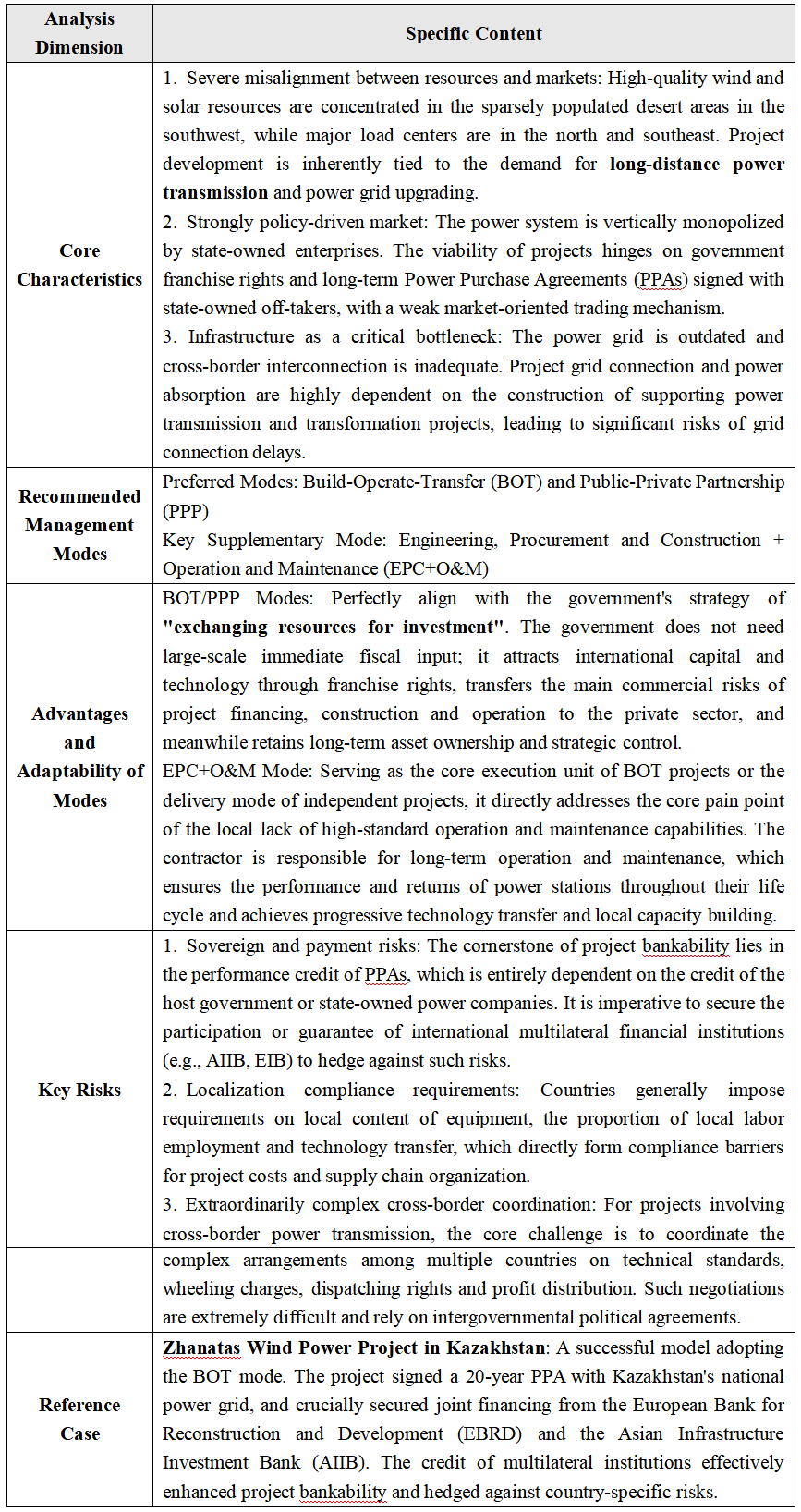
The core contradiction in new energy development in Central Asia (represented by Kazakhstan) lies in the huge gap between its "superior resource endowments" and "weak power grid and market foundations." Essentially, the selection of project management models for the region is a process of safely and efficiently converting resource potential into actual power supply with external capital and technology under a government-led framework.
3.2 Southeast Asia
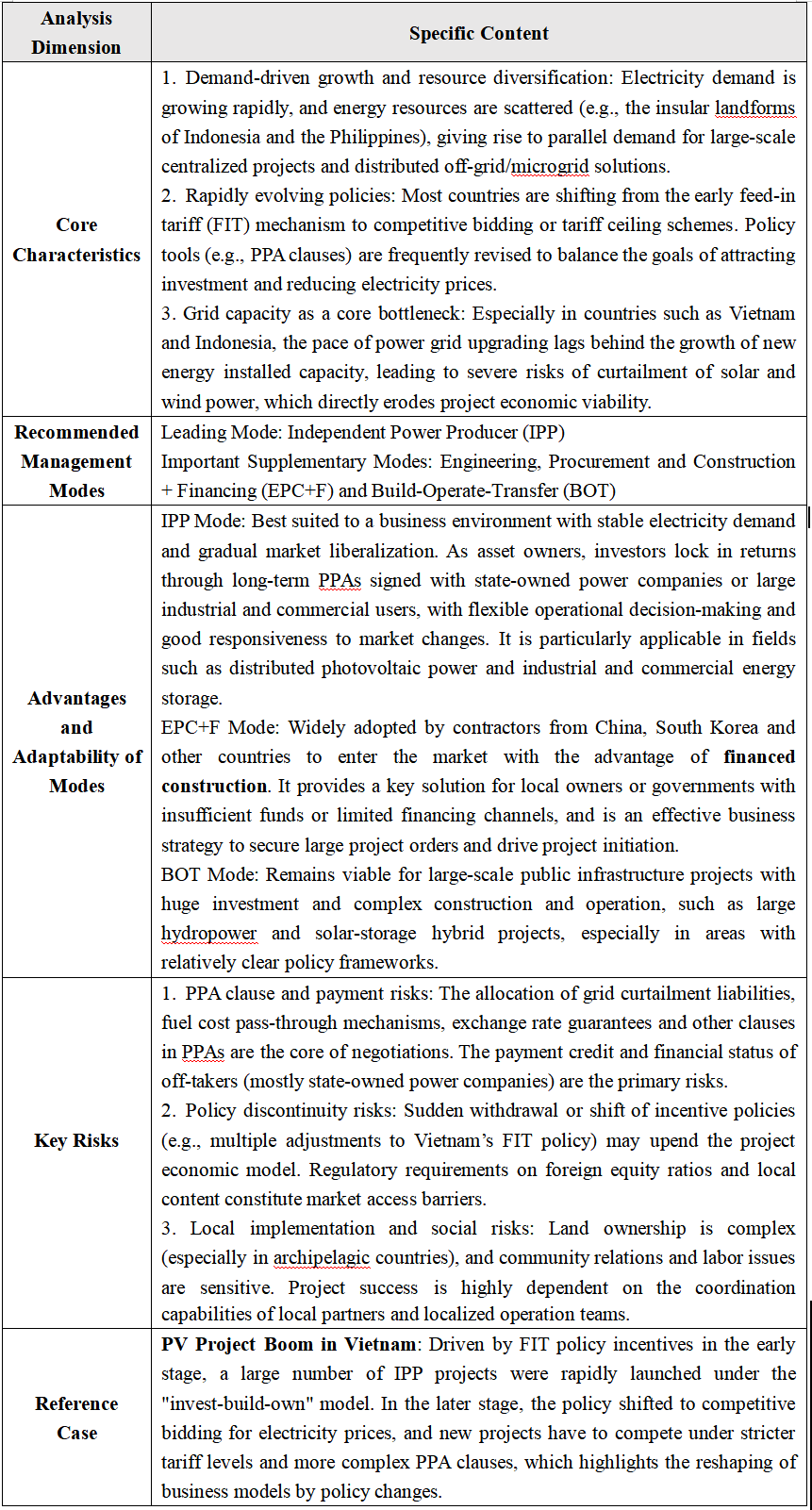
New energy development in Southeast Asia (represented by Vietnam and Indonesia) is undergoing a crucial transition from "policy incentive-driven" to "market and rigid demand-driven." The core of selecting its project management models lies in striking a complex balance between addressing the rapid growth in electricity demand, decentralized resource and load distribution, and a highly dynamic and diversified regulatory environment.
3.3 Middle East
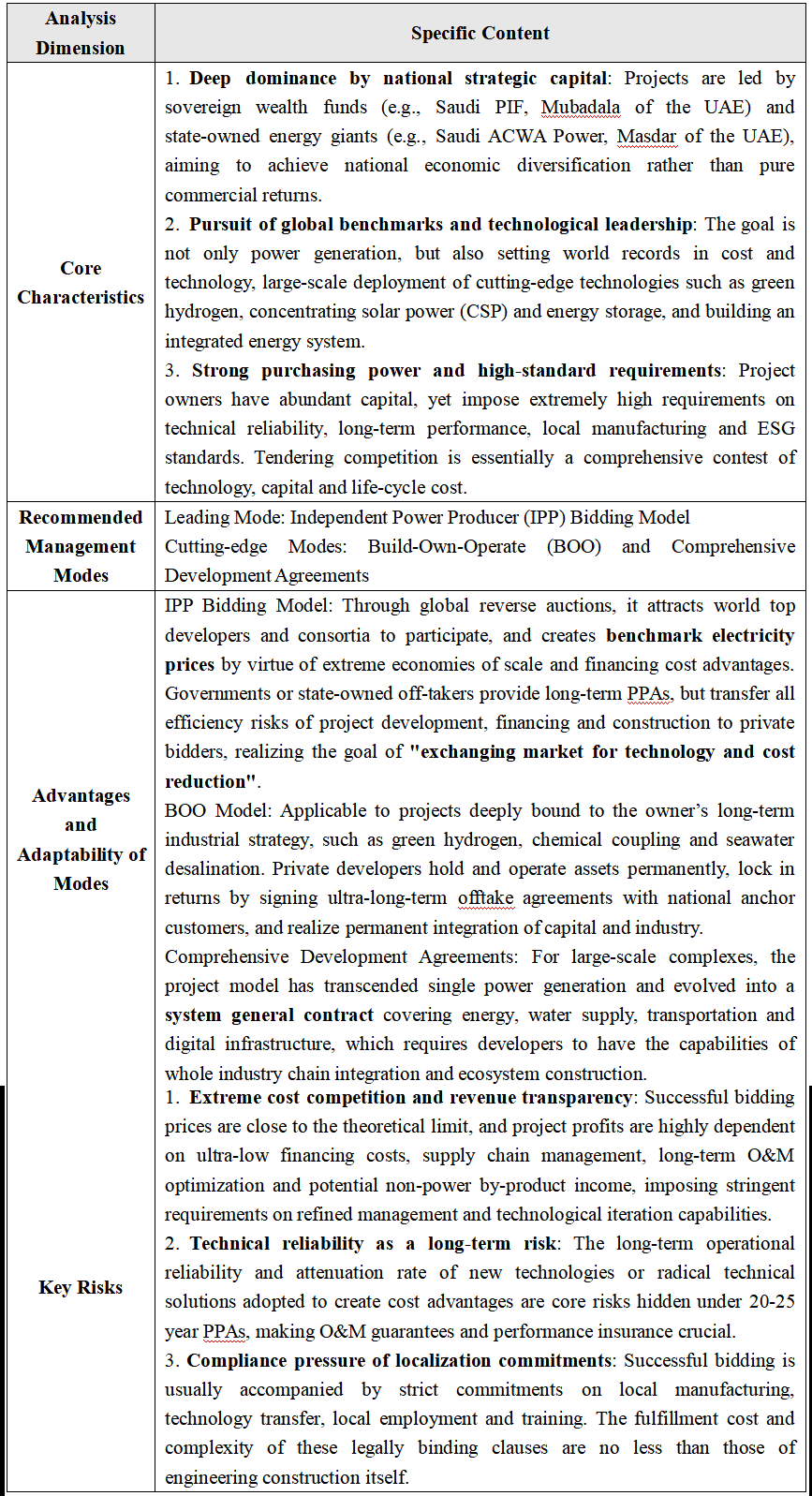
The Middle East (represented by Saudi Arabia and the United Arab Emirates) is leveraging its abundant capital and firm determination for transformation to advance from a "fossil fuel hub" in the global energy landscape to a "highland of new energy technology and capital." The core logic behind selecting its project management models lies in being driven by national strategies and sovereign capital, achieving technological leapfrogging and cost leadership through global competition and cooperation, and ultimately establishing its leading position in the future global energy system.
Reference:
[1]Global Energy Network Institute. Wind Energy in Turkmenistan [EB/OL]. [2026-01-21]. https://www.geni.org/globalenergy/library/renewable-energy-resources/world/asia/wind-asia/wind-turkmenistan.shtml.
[2]Saudipedia. National Renewable Energy Program [EB/OL]. [2026-01-21]. https://saudipedia.com/en/article/908/government-and-politics/national-renewable-energy-program.
[3]UAE Renewable Energy Strategy [EB/OL]. [2026-01-23].
https://www.moccae.gov.ae/en/about-us/irena/strategies
[4]Electric power auctions - Biomass[EB/OL]. [2026-01-23]. https://www.iea.org/policies/6550-chile-energy-auctions
[5]Chile energy auctions[EB/OL]. [2026-01-23] https://www.iea.org/policies/6550-chile-energy-auctions
[6]Accelerating Renewables Growth in ASEAN
[EB/OL]. [2026-01-23] https://www.iea.org/reports/accelerating-renewables-growth-in-asean
[7]Scaling Up Renewables in Europe and Central Asia | Barriers and Opportunities[EB/OL]. [2026-01-23] https://www.esmap.org/Scaling_Up_Renewables_in_Europe_and_Central_Asia_Barriers_and_Opportunities
[8]Accelerating Renewables Growth in ASEAN
[EB/OL]. [2026-01-23] https://www.iea.org/reports/accelerating-renewables-growth-in-asean
[9]Scaling Up Renewables in Europe and Central Asia | Barriers and Opportunities[EB/OL]. [2026-01-23] https://www.esmap.org/Scaling_Up_Renewables_in_Europe_and_Central_Asia_Barriers_and_Opportunities
[10]越南新能源市场现状与机遇[EB/OL]. [2026-01-23] https://www.tradesichuan.com/jmzx/2872.html
Source: DHH Research Institute
Author: Liu Junli, Partner of DHH, Email: liujunli@deheheng.com