

1. Introduction
Currently, international EPC (Engineering, Procurement, Construction) turnkey projects are increasingly widely applied in global infrastructure, energy, chemical, and other fields. Particularly driven by the "Belt and Road" Initiative, Chinese enterprises have actively expanded into overseas markets. The industry presents development trends such as global layout, large-scale projects, and technological integration. However, it also faces systemic risks including geopolitical fluctuations, exchange rate volatility, and supply chain disruptions, as well as special challenges such as cross-cultural communication barriers, multi-country technical standard differences, and complex cross-border legal systems. These pose severe tests to the full-lifecycle management and control of projects. As the core starting point and key link of international EPC projects, design management links the entire process of survey, procurement, construction, commissioning, and other work. Its management effectiveness directly determines the project's schedule, cost, quality, and safety. Nevertheless, common industry issues such as ambiguous division of design responsibilities, irregular change control, and insufficient legal risk prevention are prone to triggering contract disputes, quality accidents, and other problems, which seriously affect project performance efficiency and enterprises' core competitiveness. Against this backdrop, conducting an analysis of design management and legal risks in international EPC turnkey projects—combining international general rules such as the United Nations Convention on Contracts for the International Sale of Goods (CISG) and the local legal requirements of the project-host country—can provide targeted and operable practical guidance for owners and contractors. It helps clarify the boundaries of rights and responsibilities, optimize control processes, avoid legal risks, and ensure the efficient and compliant advancement of projects.
2. Core Concepts and Classification of Design Management in International EPC Turnkey Projects
An international EPC turnkey project refers to an integrated contracting model where the general contractor, in accordance with the contract agreement, undertakes the entire process of project design, procurement, construction, and other work, and ultimately delivers a qualified, functional, and directly operable engineering product to the owner. Its core characteristics are reflected in integrated responsibility, closed-loop processes, and terminal delivery. As a core control link under this model, design management is a systematic management activity that plans, organizes, coordinates, and controls the entire design process oriented toward the overall project goals. It covers core content such as sorting out design requirements, standard adaptation, result review, change control, and technical disclosure. Compared with domestic EPC projects, design management in the international context is more special, requiring consideration of core points such as multilingual communication adaptation, integration of international and local technical standards, compliance with cross-border design approval, and cross-cultural demand alignment. It is a key foundation for ensuring the efficient performance of international EPC projects and avoiding legal and technical risks.
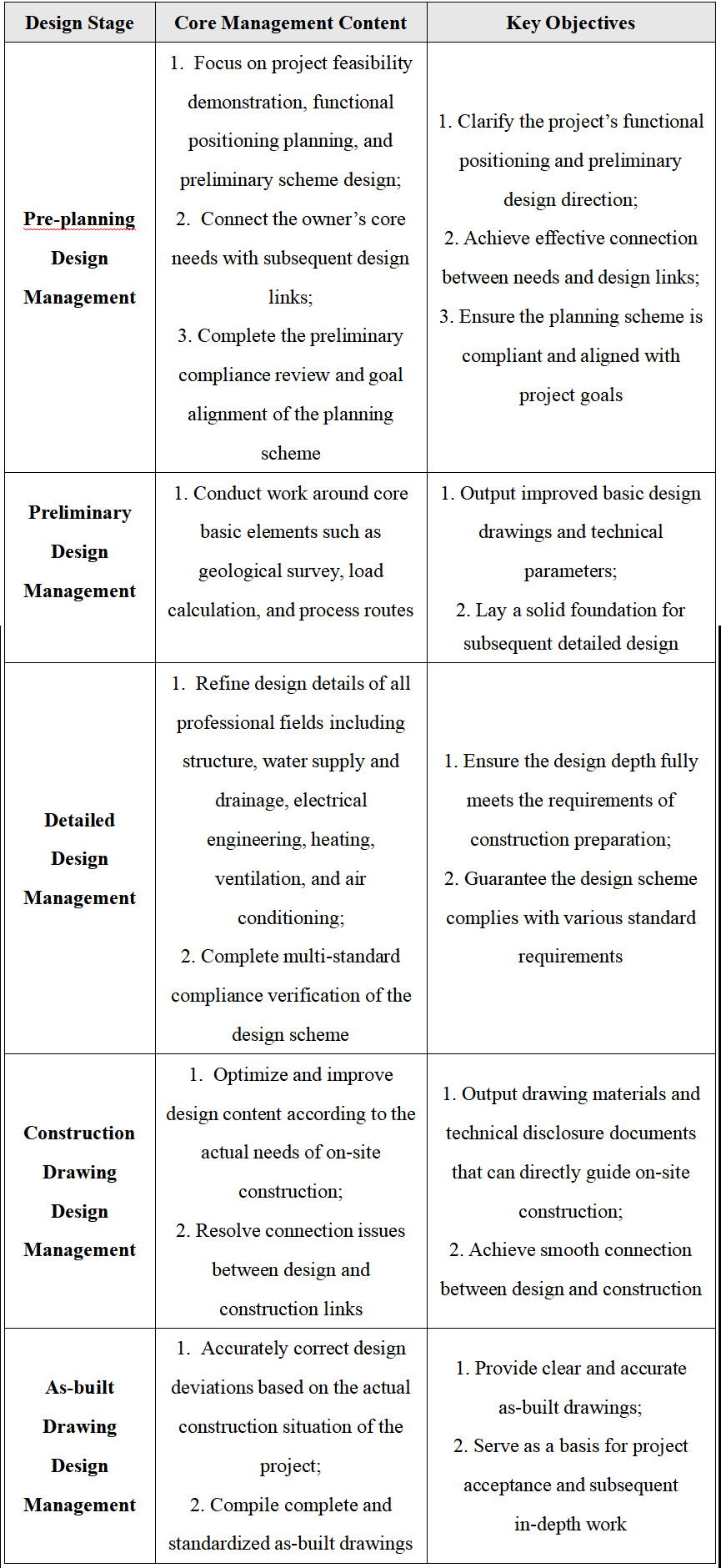
2.2.1 Classification by Design Stages
In the EPC general contracting model, design management runs through the entire project lifecycle. It is a core link that coordinates technical implementation, connects work in various stages, and ensures the achievement of project goals. From pre-planning to completion and delivery, design management needs to be advanced and precisely controlled in phases, covering five core stages: pre-planning design management, preliminary design management, detailed design management, construction drawing design management, and as-built drawing design management. Each stage not only independently undertakes key technical output tasks but also connects with each other in a closed-loop manner, jointly realizing the whole-process technical support and compliance guarantee from demand to implementation and from plan to entity.
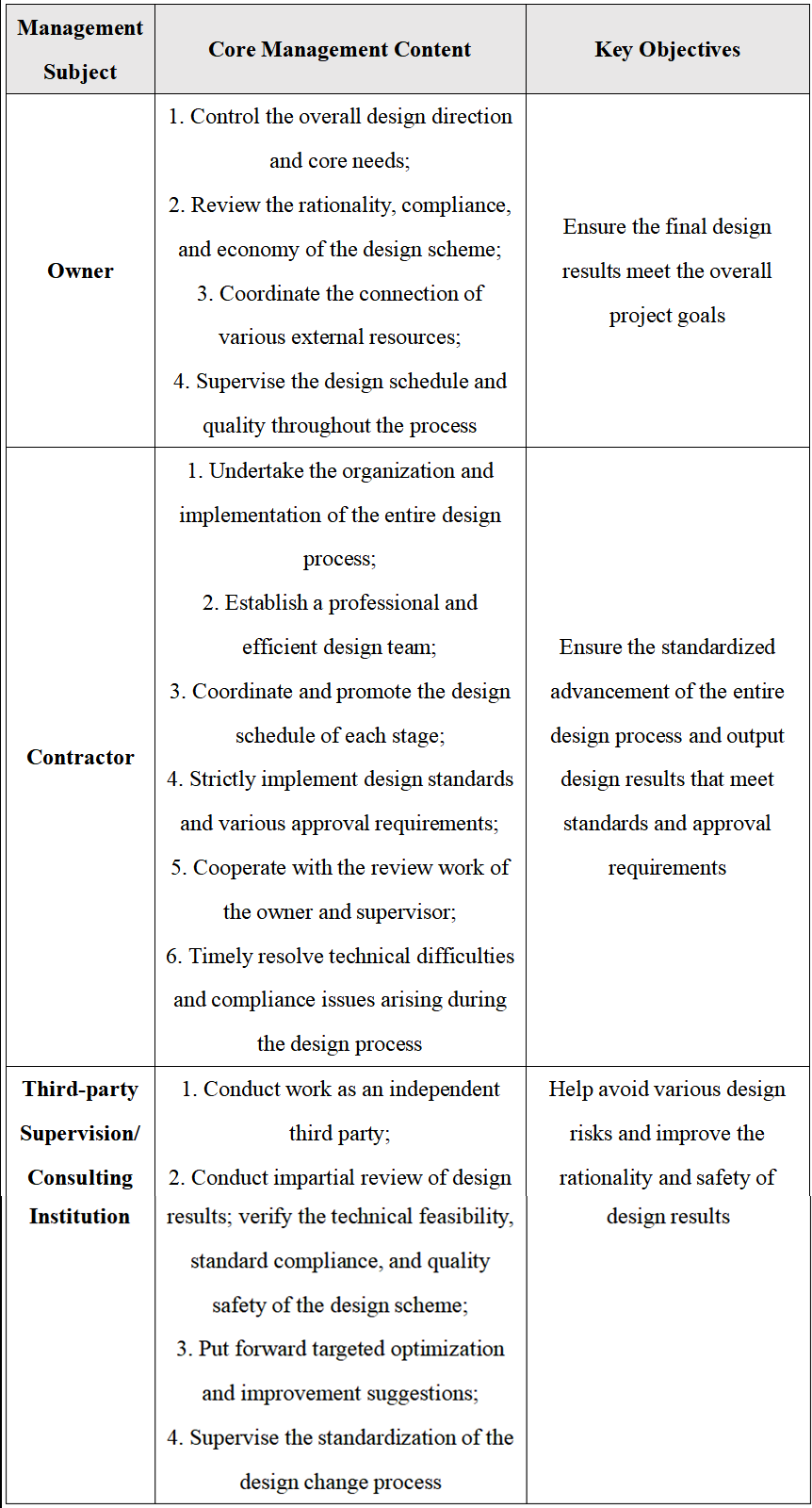
2.2.2 Classification by Management Subject
In the design management system of EPC general contracting projects, owners, contractors, and third-party supervision and consulting institutions form a management structure with clear rights and responsibilities and collaborative linkage based on their respective role positioning. The three parties perform their own duties, check and balance each other, and jointly ensure the orderly advancement of design work and the compliant delivery of design results.
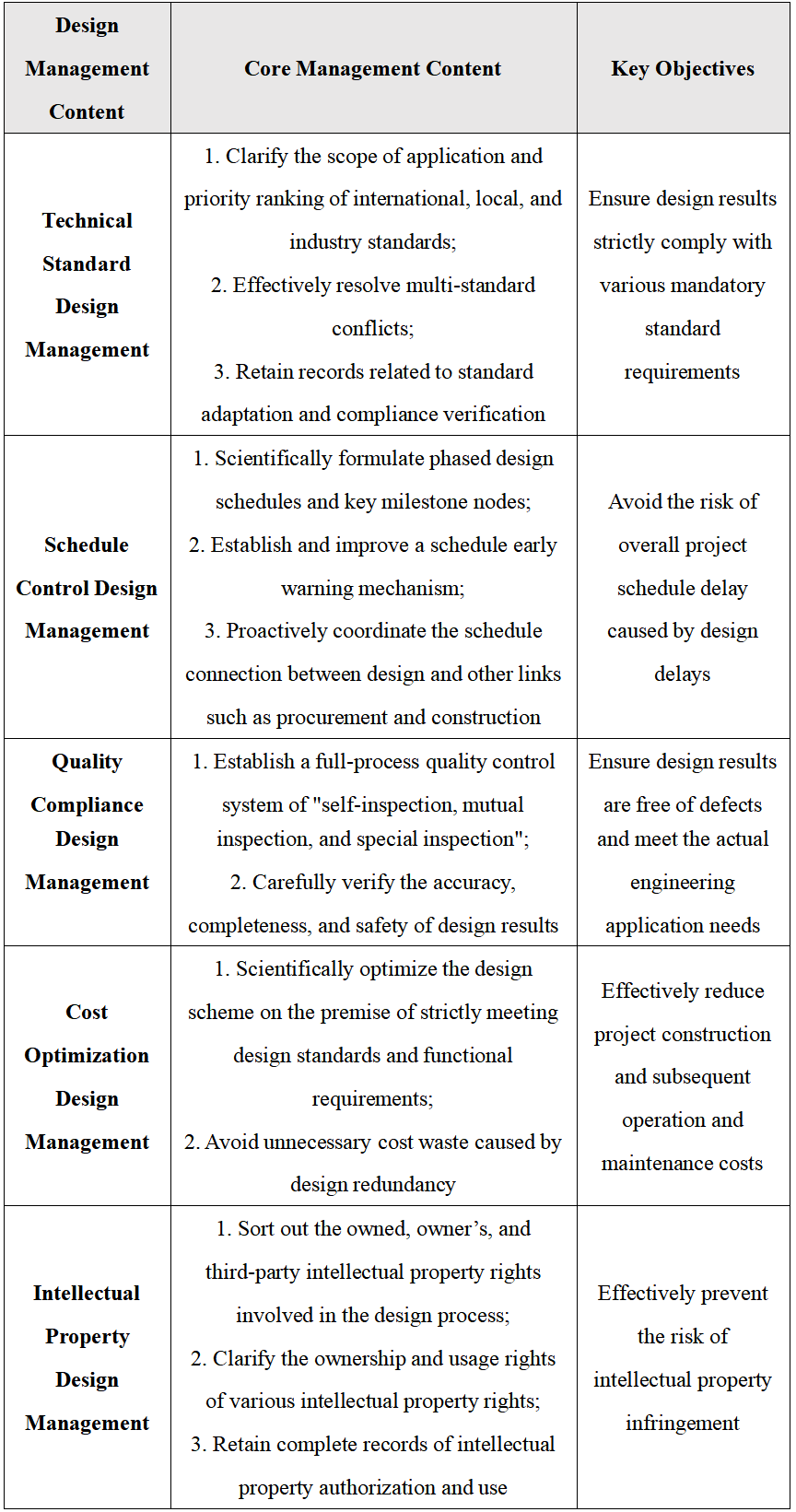
2.2.3 Classification by Management Content
Design management needs to implement systematic control from multiple dimensions such as technology, schedule, quality, cost, and intellectual property rights. Through the collaborative efforts of management functions in various dimensions, it ensures the standardized and efficient operation of the entire design process, and ultimately achieves the comprehensive goals of reliable technology, controllable schedule, qualified quality, optimized cost, and manageable risks for the project.
Source: DHH Research Institute
Author: Liu Junli (刘俊丽), Partner of DHH, Email: liujunli@deheheng.com