

Introduction
Faced with an increasingly complex geopolitical landscape, China has consistently strengthened its legislative framework concerning foreign-related national security in recent years. The National Security Law of the People's Republic of China ("National Security Law") established the basic framework of the holistic approach to national security. The Data Security Law of the People's Republic of China ("Data Security Law") and the Personal Information Protection Law of the People's Republic of China ("Personal Information Protection Law") further strengthened the legal safeguards for data security and personal information protection. The State Council’s newly issued Provisions on Industrial and Supply Chain Security ("Decree No. 834") aims to protect China's supply chain security and improve its national security legal system.
At the same time, in response to the improper extraterritorial application of foreign discriminatory restrictive measures against China, China has continuously enriched its legal framework against foreign sanctions to enhance the protection of the legitimate rights and interests of Chinese enterprises. The Regulations of the People's Republic of China on Countering Improper Extraterritorial Jurisdiction by Foreign Countries ("Decree No. 835") established a protection mechanism against foreign improper extraterritorial jurisdiction measures. Together with the Law of the People's Republic of China on Countering Foreign Sanctions ("Anti-Foreign Sanctions Law") and the Measures on Blocking Improper Extraterritorial Application of Foreign Laws and Measures ("Blocking Measures"), they form a systematic countermeasure legal framework.
Notably, between April and May 2026, China's countermeasure toolbox experienced two major developments in close succession. On 2 May 2026, China’s Ministry of Commerce released Announcement No. 21 of 2026, issuing China's first-ever blocking order ("First Blocking Order") under the Blocking Measures, declaring that the U.S. sanctions measures imposed on five Chinese companies related to Iranian oil must not be recognized, executed, or complied with[1]. This marks China's first formal activation of the blocking legal mechanism, signifying a milestone as China's countermeasure toolbox moves from "paper rules" to "practical enforcement". Furthermore, on 23 April 2026, the EU Council included several Chinese companies in its 20th round of sanctions against Russia. The Chinese government promptly implemented reciprocal countermeasures the very next day. This article will provide a comprehensive analysis of Decrees No. 834 and No. 835, drawing on the practical insights from the First Blocking Order and the latest developments regarding EU sanctions, and offer compliance suggestions for affected enterprises.
01. Recent Countermeasure Practices: EU's 20th Round of Sanctions and the First Blocking Order
Before an in-depth analysis of the two new regulations, it is necessary to review China's recent significant cases of countermeasure practices to demonstrate the actual application of China's countermeasure toolbox.
1.The EU's 20th Round of Sanctions against Russia and the Chinese Government's Countermeasures
(1)Overview of the EU's 20th Round of Sanctions
On 23 April 2026 local time, the EU Council adopted the 20th round of sanctions against Russia, adding several Chinese companies to the list of entities subject to comprehensive financial sanctions (Annex I to Regulation (EU) No 269/2014) under the Council Implementing Regulation (EU) 2026/509. The EU's allegations against the Chinese companies primarily include: business scope covering dual-use items such as military chips; shipping dual-use products to Russia since the Russia-Ukraine conflict; products found in military equipment used by Russian armed forces in Ukraine; and the supply of key technologies to multiple Russian military-industrial enterprises that could enhance Russia's military capabilities.
(2)The Chinese Government's Position and Countermeasures
On 25 April 2026, a spokesperson for China's Ministry of Commerce responded to media inquiries regarding the EU's listing of Chinese companies in its 20th round of sanctions against Russia, stating clearly:
"Despite China's repeated representations and opposition, the EU arbitrarily listed Chinese companies in its 20th round of sanctions against Russia. China expresses strong dissatisfaction and firm opposition to this. China has repeatedly stressed its firm opposition to unilateral sanctions not authorized by the UN Security Council and firmly opposes the EU's so-called extraterritorial jurisdiction against Chinese enterprises and individuals...China will take necessary measures to resolutely safeguard the legitimate rights and interests of Chinese enterprises. All consequences arising therefrom shall be borne by the EU.[2]"
On 24 April 2026 (the day after the EU listing), China's Ministry of Commerce issued the Announcement No.20 of 2026, announcing the inclusion of seven EU entities - FN Herstal, HENSOLDT AG, OMNIPOL a.s., EXCALIBUR ARMY, SpaceKnow Czech Branch, Czech Aerospace Research and Test Institute, and FN Browning Group - into the export control list. It prohibits export operators from exporting dual-use items to the aforementioned seven entities and prohibits foreign organizations and individuals from transferring or supplying dual-use items originating from the People's Republic of China to these seven entities; ongoing related activities must be ceased immediately[3]. A spokesperson for the Ministry of Commerce stated on the same day that the relevant entities had participated in arms sales to Taiwan or colluded with Taiwan, and that this measure only targets dual-use items and does not affect normal China-EU economic and trade exchanges.
This swift countermeasure action demonstrates the Chinese government's capability and resolve to respond reciprocally within a short timeframe.
(3)Historical Precedent of Successful Countermeasures
In August 2025, China took reciprocal countermeasures against EU's sanctions on two Chinese financial institutions, listing two Lithuanian banks (UAB Urbo Bankas, AB Mano Bankas) on the countermeasure list. On 24 April 2026, the Ministry of Commerce issued Ministry Order No.1 of 2026, stating, "Given that the EU had announced the revocation of sanctions against two Chinese financial institutions on 23 April 2026, China has decided to cancel the relevant countermeasures against the UAB Urbo Bankas and AB Mano Bankas as stipulated in Ministry of Commerce Order No.5 of 2025, effective from 24 April 2026 Beijing Time, and remove them from the countermeasure list.[4]" This case demonstrates that reciprocal countermeasures can effectively prompt the sanctioning party to reassess its position.
(4)Statistics on the Anti-Foreign Sanctions List
Since the implementation of the Anti-Foreign Sanctions Law in 2021, China's countermeasure enforcement activities have become increasingly active. According to publicly available information, statistics as of the date below are as follows:
Table 1. Statistical data on Anti-Foreign Sanctions List (Statistics as of: 12 May 2026)
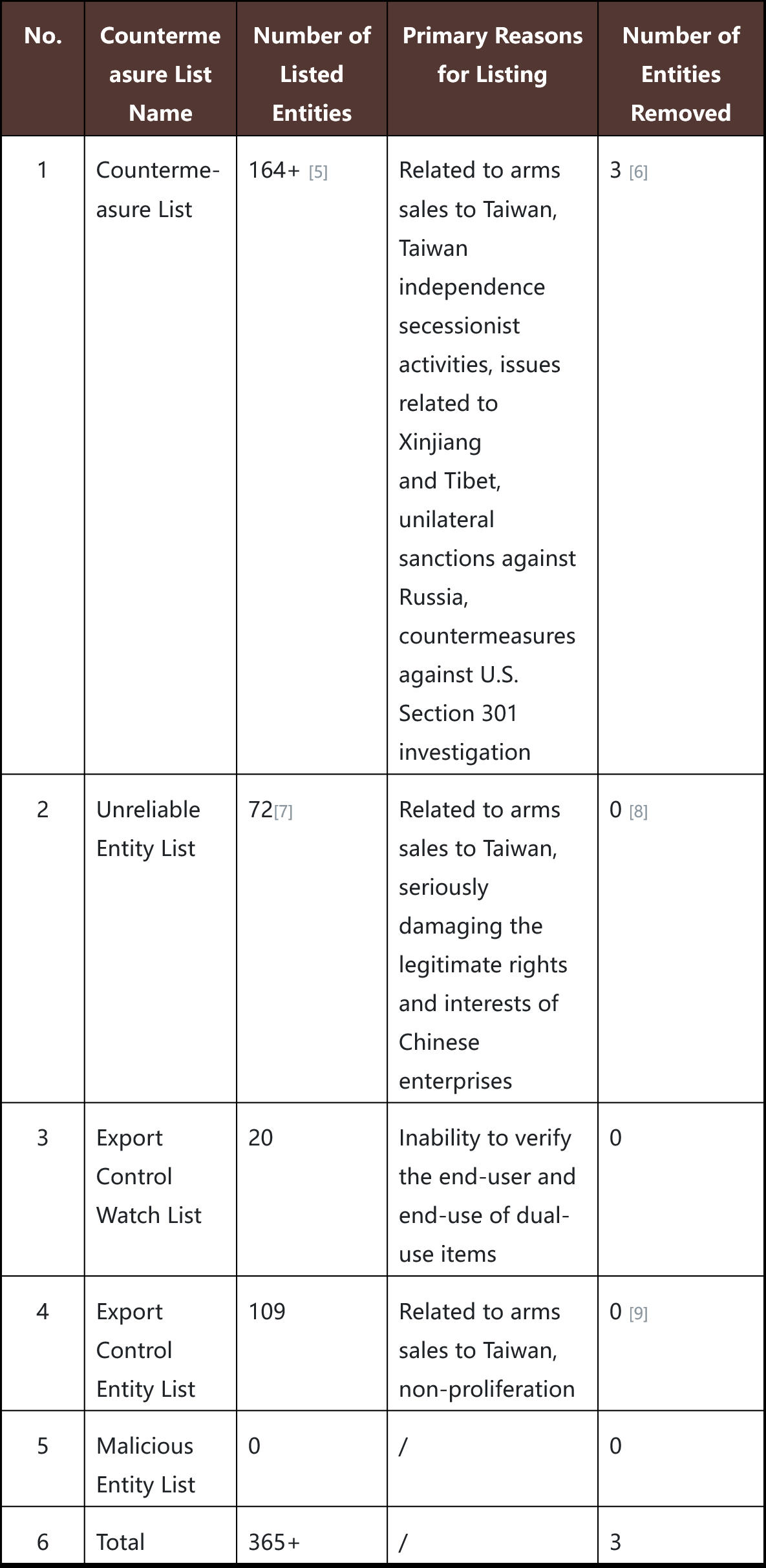
The above data indicates that China's countermeasure toolbox is moving from " having legal frameworks in place" to "normalized and routine implementation", with enforcement intensity and scope continuously expanding.
2. The First Blocking Order: A Milestone Practice for China's Countermeasure Toolbox
(1)Background of the Event
Since 2025, pursuant to Executive Order 13902, Executive Order 13846, and other regulations, the United States has listed Hengli Petrochemical (Dalian) Refining Co., Ltd., Shandong Shouguang Luqing Petrochemical Co., Ltd., Shandong Jincheng Petrochemical Group Co., Ltd., Hebei Xinhai Chemical Group Co., Ltd., Shandong Shengxing Chemical Co., Ltd., and other five Chinese companies on the Specially Designated Nationals and Blocked Persons List (SDN List) for allegedly participating in Iranian oil transactions, imposing sanctions measures such as asset freezes and transaction prohibitions.
(2)Content of the Order
On 2 May 2026, the Ministry of Commerce, pursuant to Articles 2, 4, 6 and 7 of the Blocking Measures and the decision of the working mechanism, issued a prohibition order, which prohibits the recognition, execution, or compliance with the sanctions imposed by the United States, based on Executive Order No. 13902, Executive Order No. 13846, and other regulations, on the aforementioned five Chinese enterprises for their involvement in Iranian petroleum transactions. These sanctions include designation on the SDN List, asset freezes, and transaction prohibitions. The prohibition order takes effect from the date of its promulgation[10].
(3)Legal Basis and Official Interpretation
The spokesperson for the Ministry of Commerce explicitly stated in response to press inquiries: "The aforementioned U.S. measures 'improperly prohibit or restrict normal economic, trade, and related activities between Chinese enterprises and third countries (regions) and their citizens, legal persons, or other organizations, violating international law and the basic norms of international relations'... The issuance of this prohibition order is a concrete action taken in accordance with the law to implement the Blocking Measures." The Ministry of Commerce also stated that it will continue to closely monitor the improper extraterritorial application of laws and measures by relevant countries. If circumstances specified in the Blocking Measures exist, it will carry out relevant work in accordance with the law[11].
(4)Milestone Significance
This marks China's first issuance of a blocking order based on the Blocking Measures, carrying milestone significance: First, the system moves from paper to practice. Since its promulgation in January 2021, the Blocking Measures have been applied for the first time in an actual case. Second, the countermeasure toolbox has been upgraded. It forms a complete closed loop of "identification - blocking - investigation - countermeasure - litigation" with Decree No. 834 and No. 835. Third, it demonstrates the government's determination to protect enterprises. The Chinese government firmly opposes unilateral sanctions lacking UN authorization and a basis in international law. Fourth, it provides compliance guidance for enterprises. It clearly informs enterprises how to respond legally and compliantly in the face of similar situations.
02. The Blocking Measures and Decree No. 835: Legal Coordination between Blocking and Countermeasures
Before discussing Decree No. 835, it is necessary to review the core provisions of the Blocking Measures to better understand the relationship between the two blocking regulations[12].
1. Core Provisions of the Blocking Measures
The Blocking Measures were promulgated and took effect on 9 January 2021. They are China's first specialized blocking legislation targeting the improper extraterritorial application of foreign laws and measures. Their core provisions include the following five aspects:
(1)Scope of Application
Article 2 of the Blocking Measures stipulates: "These Measures apply to situations where the extraterritorial application of foreign laws and measures violates international law and the basic norms of international relations, and improperly prohibits or restricts normal economic, trade, and related activities between Chinese citizens, legal persons, or other organizations and third countries (regions) and their citizens, legal persons, or other organizations." In order to understand this scope of application, three constituent elements should be taken into account: first, the extraterritorial application of foreign laws and measures violates international law and the basic norms of international relations; second, there is an improper prohibition or restriction; third, it involves normal economic, trade, and related activities between Chinese entities and entities from third countries (regions).
(2)Reporting Obligation
Article 5 of the Blocking Measures stipulates that Chinese citizens, legal persons, or other organizations encountering situations of improper extraterritorial application of foreign laws and measures shall truthfully report the relevant circumstances to the competent commerce department of the State Council within 30 days. This constitutes an important statutory obligation for enterprises.
(3)Assessment and Prohibition Order
Article 6 of the Blocking Measures stipulates four assessment factors: whether there is a violation of international law and the basic norms of international relations; the potential impact on China's national sovereignty, security, and development interests; the potential impact on the lawful rights and interests of Chinese citizens, legal persons, or other organizations; and other factors that should be considered.
Article 7 stipulates that if the working mechanism, upon assessment, confirms the existence of improper extraterritorial application, it may decide that the competent commerce department of the State Council issue a prohibition order against the recognition, execution, or compliance with the relevant foreign laws and measures.
(4)Remedial Measures
Article 9 of the Blocking Measures grants parties the right to litigate: If a party, by complying with foreign laws and measures within the scope of the prohibition order, infringes upon the lawful rights and interests of Chinese citizens, legal persons, or other organizations, the Chinese citizens, legal persons, or other organizations may file a lawsuit in a people's court in accordance with the law, demanding compensation for losses from that party. Article 11 further stipulates that if Chinese citizens, legal persons, or other organizations, in accordance with the prohibition order, fail to comply with the relevant foreign laws and measures and consequently suffer significant losses, relevant government departments may provide necessary support based on the specific circumstances.
(5)Exemption System
Article 8 of the Blocking Measures stipulates that Chinese citizens, legal persons, or other organizations may apply to the competent commerce department of the State Council for an exemption from complying with the prohibition order. The applicant shall submit a written application, stating the reasons for the exemption application and the scope of the requested exemption, and other contents. The competent department shall make a decision on whether to approve within 30 days from accepting the application; in urgent circumstances, a decision shall be made promptly.
2. Relationship between the Blocking Measures and Decree No. 835
Although the Blocking Measures and Decree No. 835 together constitute China's legal system in responding to improper foreign extraterritorial jurisdiction, they each have their own focus and complement each other[13], as detailed in the table below:
Table 2. Comparison Table of the Interrelationship between the Blocking Measures and Decree No. 835
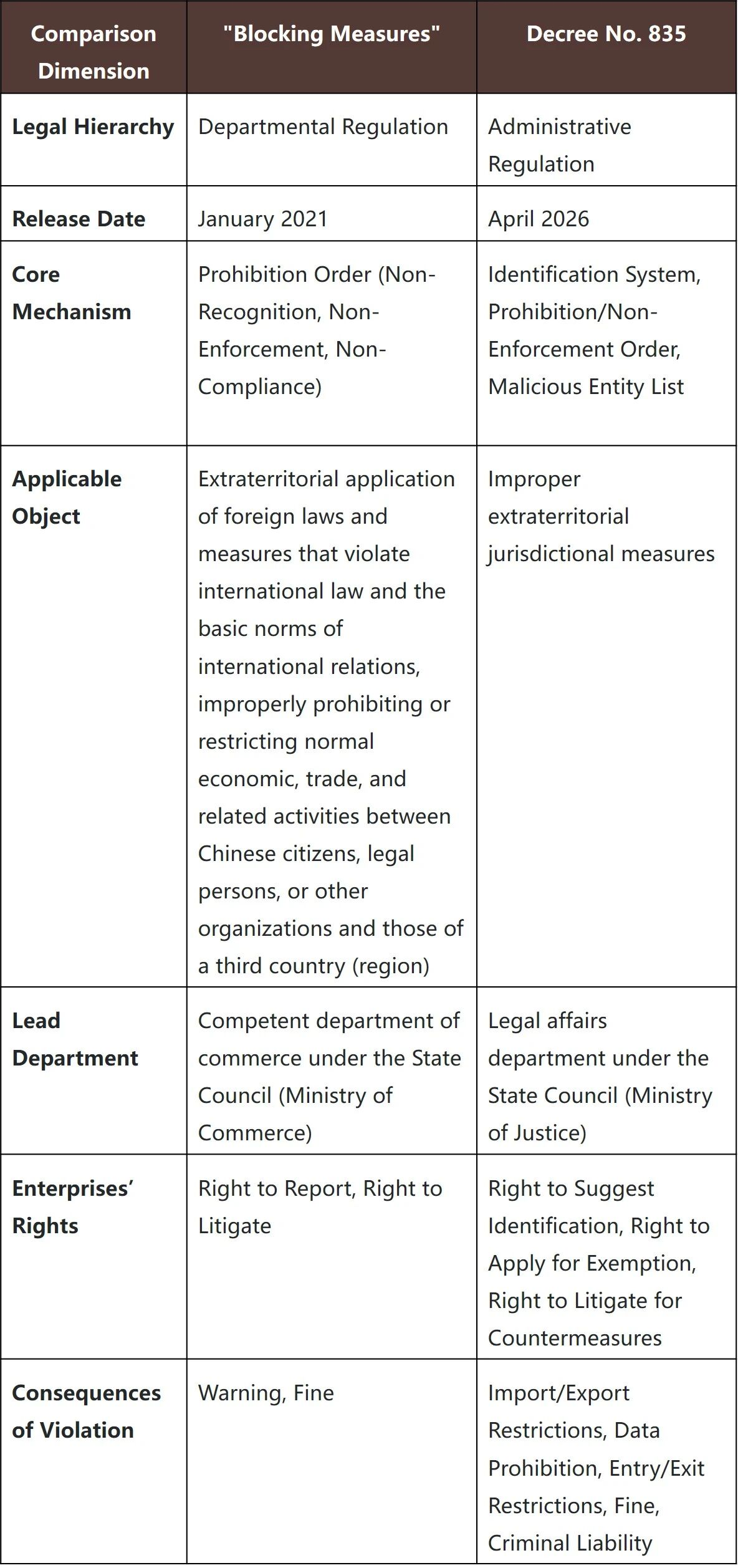
The Blocking Measures draw on the legislative experience of foreign laws such as the EU Blocking Statute[14], but feature a system designed with distinct Chinese characteristics. Their relationship can be summarized as follows: First, the Blocking Measures establish a basic process of " reporting — assessment — prohibition order — remedy" for the improper extraterritorial application of foreign laws and measures in specific situations. Second, Decree No. 835 represents a comprehensive upgrade, generally establishing and improving the working mechanisms and institutional tools for responding to improper foreign extraterritorial jurisdiction, including the identification system (Article 6), prohibition of enforcement orders (Article 13), the list of malicious entities (Article 8), etc. Third, there is cross-departmental division of labor and coordination. Paragraph 2 of Article 19 of Decree No. 835 stipulates that work concerning the response to foreign countries violating international law and the basic norms of international relations by improperly prohibiting or restricting normal economic, trade, and related activities between Chinese citizens or organizations and third countries (regions) and their citizens or organizations shall be governed by other state regulations, if any. This provision specifically addresses the circumstances in which the Blocking Measures apply. Therefore, we understand that in the situations referred to by this clause, the Blocking Measures remain applicable, and the Ministry of Commerce is responsible for the assessment and issuance of prohibition orders under these Measures in accordance with their provisions. Beyond this, for other situations involving improper extraterritorial jurisdiction, the Ministry of Justice, pursuant to Decree No. 835, leads the work of identification, prohibition of enforcement orders, exemptions, etc., under the Decree.
3. Practical Significance of the First Blocking Order
The First Blocking Order demonstrates the significant importance of the Blocking Measures in the practical protection of enterprises' rights:
- First, the initiation of the assessment procedure. The working mechanism conducted a comprehensive assessment of the U.S. sanctions measures, confirming "the existence of improper extraterritorial application ".
- Second, the issuance of the prohibition order. The Ministry of Commerce, in accordance with Article 7 of the Blocking Measures, issues a prohibition order, requiring non-recognition, non-enforcement, and non-compliance with U.S. sanctions measures.
- Third, the legal basis is diverse and multi-layered. The Ministry of Commerce cited multiple laws including the National Security Law, the Foreign Relations Law, the Anti-Foreign Sanctions Law and its implementing provisions, and the Blocking Measures, demonstrating the overall synergistic effect of the countermeasure legal framework.
The issuance of the First Blocking Order signifies that the Chinese government is providing institutional support to sanctioned enterprises through concrete actions, and offering relief and safeguards to enterprises through the "necessary support" stipulated in Article 11. This practice indicates that China's countermeasure toolbox is evolving from "having legal frameworks in place" to "having tools to use", and from "paper rules" to "practical implementation".
03. Interpretation of Decree No. 834
Before interpreting Decree No. 834, it is recommended to first focus on the following two guiding provisions:
- First, Article 1 of Decree No. 834 clearly provides: "These Provisions are formulated, in accordance with the National Security Law, the Foreign Relations Law, the Anti-Foreign Sanctions Law, the Foreign Trade Law and other relevant laws, for the purposes of preventing security risks relating to industrial and supply chains, enhancing the resilience and security of industrial and supply chains, and safeguarding economic and social stability as well as national security."
- Second, Article 2 further provides: "Work on industrial and supply chain security shall implement the holistic view of national security, coordinate development and security, coordinate domestic and international considerations, promote high-standard opening-up, and foster the stability and smooth operation of global industrial and supply chains. "
These two provisions effectively serve as the "core framework" and "guiding principles" of Decree No. 834. They convey at least three key points. First, the legislative purpose is to prevent risks and enhance resilience. It is not about promoting economic closure, but about safeguarding security within the context of continued opening-up. Second, the legal basis is very clear and explicit. The National Security Law establishes the overarching policy framework; the Foreign Relations Law and the Anti-Foreign Sanctions Law provide the legal basis for external countermeasures, and the Foreign Trade Law incorporates investigative tools in the trade domain. This indicates that Decree No. 834 is not a completely new creation, but a systematic integration within the existing legal framework. Third, the working principles are also clearly articulated: coordinating development and security, and coordinating domestic and international considerations. In other words, the regime seeks to manage security risks without unduly impeding economic development or external engagement.
From a comparative perspective, many jurisdictions have already introduced legislation addressing supply chain security, with the United States and the European Union moving relatively early in this area. The United States enacted the Defense Production Act as early as 1950, authorizing the President to expand critical production capabilities and supplies during emergencies.[15] In recent years, the United States has also issued executive orders requiring reviews of four key supply chains including semiconductors, large-capacity batteries, and critical minerals. At the EU level, the EU Chips Act entered into force in 2023.[16] This was followed in 2024 by the adoption of the Critical Raw Materials Act.[17] Furthermore, on April 24, 2026, the United States and the European Union signed the Memorandum of Understanding for the U.S.-EU Strategic Partnership on Critical Minerals.[18] The parties also agreed to formulate an "United States-European Union Action Plan for Critical Minerals Supply Chain Resilience". This memorandum covers the entire value chain of critical minerals — including exploration, extraction, processing, refining, recycling and reuse, with the stated objective of reducing dependence on Chinese rare earths and other critical minerals.[19]
This indicates that the U.S. and EU are simultaneously advancing both legislative measures and bilateral strategic coordination to construct an exclusive critical minerals supply chain system. In contrast, China's Decree No. 834 takes a different path — it does not target specific countries or regions, but builds countermeasure capabilities within the broader framework of continued openness and international cooperation. In particular, Articles 15 and 16 establish investigative and countermeasure mechanisms addressing supply disruptions or discriminatory measures imposed by foreign entities, thereby providing domestic enterprises with a distinct form of legal protection.
1. Strengthening National Supply Chain Security Safeguards
Articles 1 to 12 of Decree No. 834 systematically construct the core institutional framework for strengthening national industrial and supply chain security. The Decree marks a transition in China's supply chain governance from fragmented and reactive management toward a more systematic and institutionalized rule-based regime.
(1)Industrial and Supply Chain Security Working Mechanism
Decree No. 834 stipulates that the State will establish and improve a national working mechanism for industrial and supply chain security to coordinate major matters at the national level. Relevant authorities under the State Council, including those responsible for foreign affairs, development and reform, industry and information technology, commerce, customs, and cyberspace administration, will undertake specific responsibilities within their respective areas of competence, thereby forming a cross-departmental coordinated regulatory framework. People's governments at the provincial, autonomous regional, and municipal levels are responsible for related work within their respective jurisdictions under the national coordination framework.
(2)Key Sectors List System and Information Sharing
The Key Sectors List is an institutional innovation introduced by Decree No. 834. Under the Decree, relevant authorities under the State Council will formulate and dynamically update a list of key sectors, focusing on areas related to economic and social stability and national security, with emphasis on ensuring the stable and continuous production and circulation of critical raw materials, technologies, equipment, products, and other essential resources.
In responding to media inquiries, a representative of the Ministry of Justice stated that the " The Decree adopts a targeted approach, focusing on sectors involving economic and social stability and national security, and establishes a Key Sectors List system. " The Decree further imposes several specific requirements with respect to sectors included on the list. First, promoting enhanced information sharing while ensuring data security; second, establishing and improving a risk monitoring and early warning mechanisms; third, establishing and improving a risk prevention mechanism, including the organization of physical reserves and capacity reserves for key sectors; fourth, establishing and improving an emergency management system.[20]
The scope of the list is not limited to end products but will extend to upstream raw materials, intermediate technologies and production equipment, reflecting a whole-of-chain approach to supply chain security. Although the specific list has not yet been released, sectors such as semiconductors, advanced manufacturing, energy, pharmaceuticals, and critical minerals are widely expected to fall within its scope. Therefore, it is recommended that enterprises closely monitor the release of the list and assess in advance whether their business operations may involve covered sectors.
(3)Risk Monitoring, Prevention, and Emergency Management Mechanisms
Decree No. 834 establishes a risk monitoring and early warning system for supply chain security in key sectors. Under this mechanism, authorities will assess and monitor the stability of supply channels in key sectors, identify security risks, and issue timely warning information where necessary.
Meanwhile, Decree No. 834 adopts a dual-track approach combining "reserves" and "capacity building." Physical reserves are intended to address short-term supply disruption risks, while capacity reserves, including technological research and development, are aimed at strengthening long-term self-sufficiency and controllability. Furthermore, the emergency management mechanism functions as the "last line of defense" under the Decree. Where enterprises identify circumstances that may affect industrial or supply chain security, they may report such matters to the relevant authorities at or above the county level, thereby seeking policy support or securing an early response under applicable emergency measures.
2. Restrictions Related to Supply Chain Data Collection
Article 13 of Decree No. 834 stipulates: "Where any organization or individual conducts investigations or other information collection activities relating to industrial or supply chains within the territory of China in violation of Chinese laws, administrative regulations, departmental rules, or relevant State provisions, the relevant authorities shall take corresponding measures in accordance with law."
In practice, the boundary between Article 13 and ordinary commercial operations conducted by enterprises has attracted significant attention. In recent years, a growing number of Western jurisdictions have strengthened supply chain regulatory requirements, resulting in increasing legal conflicts and compliance risks for domestic enterprises cooperating with overseas supply chain investigations or due diligence requests.
-
Issue for Discussion 1: What Are the Legal Risks of Submitting Traceability Materials After Goods Are Detained?
This is currently one of the most significant concerns for businesses. The issue may be analyzed under two separate scenarios.
Scenario One: Goods have been detained by U.S. Customs, and the enterprise submits traceability documents for customs clearance.
Since 2026, enforcement activities by U.S. Customs and Border Protection ("CBP") have intensified significantly. According to publicly available CBP data, the number of detentions under the so-called Uyghur Forced Labor Prevention Act ("UFLPA") reached approximately 22,000 shipments in 2025, representing a record high. CBP's review approach has also shifted from a formal examination based primarily on final export documentation to a substantive and highly penetrative review of the entire supply chain. Enterprises are now commonly required to provide full-chain traceability documentation covering all stages from raw materials to finished products.
The UFLPA adopts a "rebuttable presumption" rule — once detained, it is presumed that the product uses forced labor, and the enterprise must submit "clear and convincing evidence" to rebut the presumption, otherwise the goods cannot enter. According to CBP’s official best practice guidance, enterprises are generally required to provide, at a minimum: supply chain flowcharts; complete commercial documentation, including certificates of origin, packing lists, bills of lading, and manifests; raw material procurement contracts and payment records, such as bank remittance records and letters of credit; and employment and payroll records relating to the manufacturing process.
Key Issue: In Such Circumstances, Does the Enterprise Face Potential Liability Under Article 13?
View #1 (Higher-Risk Position): Clear Legal Risks Exist, and “Cooperation with Foreign Enforcement” Does Not Automatically Exempt Liability
The reasons are: CBP's traceability requirements often involve sensitive information within China (raw material sources, production capacity distribution, supply chain structure). Once provided, it may be deemed as "assisting in the implementation of improper foreign extraterritorial jurisdictional measures." Article 6 of Decree No. 835 explicitly stipulates "No organization or individual shall implement or assist in the implementation of improper foreign extraterritorial jurisdictional measures," and does not provide an exception for "cooperating with foreign enforcement." Some practical analyses point out that such requirements may constitute assistance in implementing improper foreign extraterritorial jurisdictional measures, and enterprises should carefully assess the situation. In addition, Articles 13 and 16 of Decree No. 834 may be understood as forming an integrated regulatory structure combining conduct regulation and mandatory obligations. Under this interpretation, enterprises should not assume that overseas compliance considerations automatically justify exemption from domestic regulatory requirements. Furthermore, Article 36 of the Data Security Law and Article 41 of the Personal Information Protection Law both clearly provide that without approval from the Chinese competent authorities, no organization or individual within China shall provide data or personal information stored within China to foreign judicial or law enforcement authorities upon their request.
View #2 (Lower-Risk Position): Good-Faith Compliance in Response to Foreign Enforcement May Present Relatively Manageable Risks
There are three reasons: First, the premise of Article 13 is "violation of Chinese laws, regulations, and relevant provisions." If the enterprise has exercised reasonable duty of care, only provides necessary commercial information, and the information does not involve state secrets, important data, or personal information, the basis for determining "illegal or non-compliant" is insufficient. Second, Article 6(4) of Decree No. 835 establishes an exemption mechanism, providing that where it is truly necessary to implement or assist in implementation due to special circumstances, it may be implemented within a specific scope after obtaining consent. Significant commercial losses arising from customs detention may constitute a reasonable basis for seeking such an exemption. Third, Article 13 itself does not create a new category of unlawful conduct, but incorporates relevant rules from the existing legal system through a referral mechanism. This means the determination of "illegal or non-compliant" still needs to be assessed under higher-level laws and regulations such as the Data Security Law, the National Security Law, and the Counter-Espionage Law, rather than through an overly expansive interpretation of Article 13 itself.
Scenario Two: Goods are not detained, but overseas customers require the provision of traceability documents.
This is the more common business scenario in practice. Overseas customers, particularly importers in the United States and Europe, frequently issue supply chain questionnaires to Chinese suppliers pursuant to compliance requirements under the Uyghur Forced Labor Prevention Act ("UFLPA"), the German Supply Chain Due Diligence Act, or the forthcoming Corporate Sustainability Due Diligence Directive ("CSDDD"). These questionnaires commonly request disclosure of information relating to raw material sourcing, labor records, production capacity, and related supply chain matters.
Key Issue: Does an Enterprise Violate Article 13 by Voluntarily Providing Such Information?
View #1 (Higher-Risk Position): Significant Risks May Exist and Strict Review Is Required
The reasons are: First, requests from overseas customers differ in nature from direct cooperation with foreign law enforcement authorities. The latter involves formal legal compulsion, whereas the former generally arises from contractual or commercial arrangements. Article 13 does not distinguish between "cooperating with enforcement" and "commercial due diligence." As long as it is "information collection activities related to industrial and supply chains" and "in violation of Chinese laws, regulations, and relevant provisions," it may be subject to regulation. Second, routine operations such as ESG audits, supply chain due diligence, and supplier assessments may now fall within the regulatory purview of Article 13. The issue is not the information collection itself, but the "purpose, method, and downstream use" of of the collected information. If the purpose of the information collection is "assisting overseas customers in meeting the sanctions compliance requirements of their home countries," it may touch a red line.
View #2 (Lower-Risk Position): Risks May Be Relatively Manageable if Sensitive Information Is Not Involved and Cross-Border Data Compliance Requirements Are Satisfied
Reasons: First, Article 13 applies only where conduct violates Chinese laws, regulations, or relevant State provisions. If the information provided by the enterprise does not involve state secrets or other regulated data, and the enterprise has fulfilled its compliance obligations under the Data Security Law and the Personal Information Protection Law (such as security assessments, standard contract filing), the threshold for determining "illegal or non-compliant" is relatively high. In this regard, it is recommended that enterprises establish an information classification management system — separate general business information that can be publicly disclosed from sensitive information involving critical supply chain data and core processes, and set internal approval and de-identification requirements for the latter. Second, there are currently no public enforcement cases indicating that providing routine information purely to meet the due diligence requirements of overseas commercial partners has resulted in penalties. The enforcement boundaries of Article 13 still await clarification through practice.
Our preliminary assessment is that no uniform conclusion has yet emerged on this issue. However, considering the various competing views, we are inclined to believe that, under the current legal framework, the level of legal risk should be assessed based on several key factors:
Table 3. Risk Assessment Factors for Providing Supply Chain Traceability Information Under PRC Law
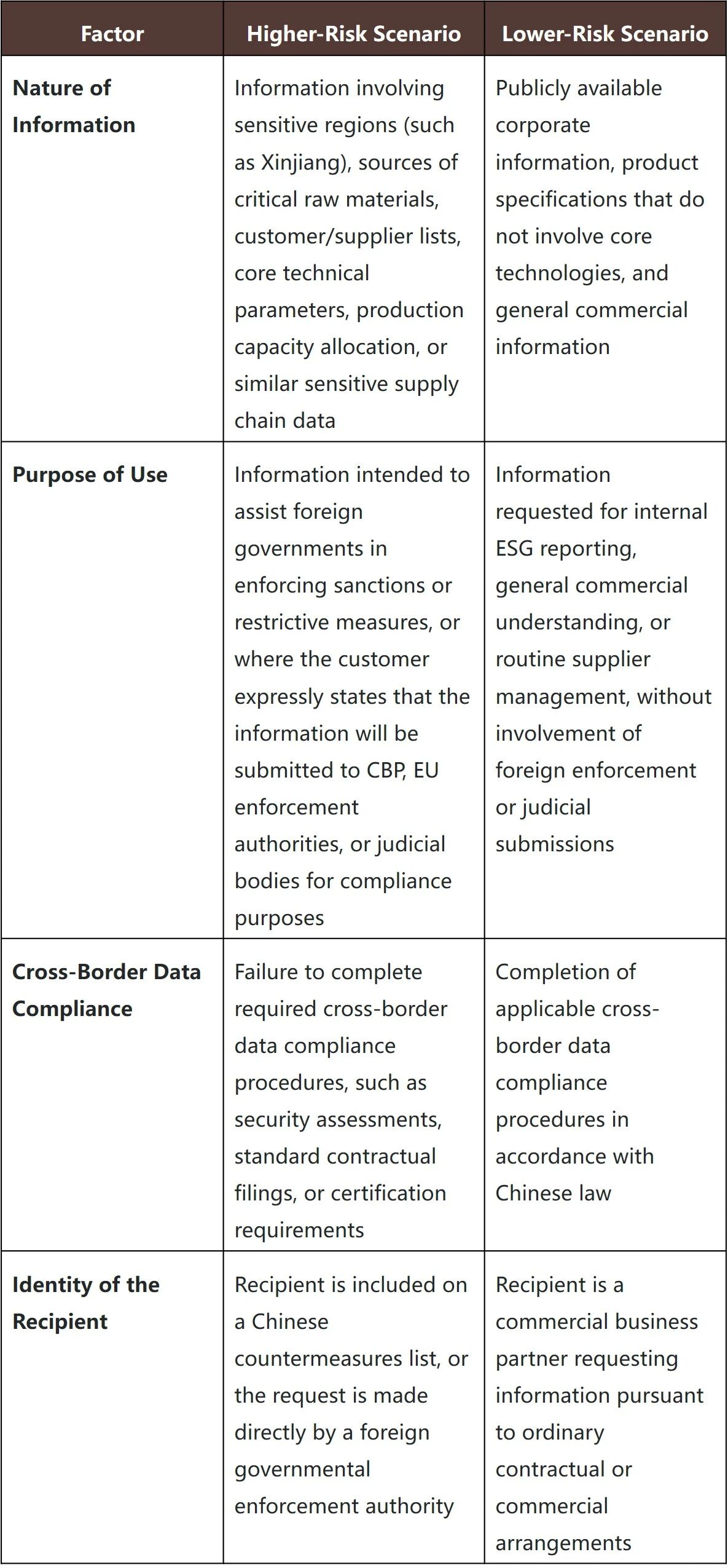
Additionally, there are two noteworthy points: First, Article 6 of Decree No. 835 grants enterprises the "right to propose identification" – if an enterprise believes a certain foreign requirement constitutes an "Improper Extraterritorial Application of Foreign Laws and Measures", it may submit an identification proposal to the State Council's legal affairs department (Ministry of Justice) requesting its announcement and blocking. Second, enterprises may also apply for relevant exemptions based on Article 6(4) 4 of Decree No. 835. Both methods provide enterprises with a channel to proactively seek legal certainty or obtain exemptions.
Based on the above analysis, we recommend that enterprises adopt the following tiered response strategy:
First, when goods are detained by CBP, an assessment should be conducted immediately. If the information involves State secrets or important data, it should not be disclosed, and the matter should promptly be reported to the competent authorities for guidance. Where the information is of relatively low sensitivity, enterprises may consider applying for an exemption pursuant to Article 6(4) of Decree No. 835 and, once approval is obtained, provide only the minimum necessary information within the permitted scope. Enterprises should also retain complete records of communications and internal approvals as evidence that reasonable care and compliance efforts were exercised.
Second, when overseas clients request supply chain traceability information, enterprises should establish a dedicated "PRC law compliance review" mechanism. Requested information should be categorized and reviewed on a case-by-case basis, distinguishing between information that may be disclosed, information requiring desensitization, and information that must not be disclosed. Contracts should include PRC law compliance clauses clearly defining the scope and limitations of information disclosure. In addition, where the transfer involves important data or personal information, enterprises should complete the applicable cross-border data compliance procedures. According to the Regulations on Promoting and Regulating Cross-Border Data Flow, there are currently three main compliance pathways for data outbound transfer in China: data export security assessments, filings for standard contracts for cross-border transfers of personal information, and personal information protection certification.
Third, for situations with unclear circumstances, enterprises may proactively exercise their right to submit a regulatory identification request. By submitting a proposal to the competent rule-of-law authority under the State Council, enterprises may seek clarification as to whether a specific foreign requirement constitutes an "Improper Extraterritorial Application of Foreign Laws and Measures," thereby shifting from a purely reactive posture to a more proactive effort to obtain legal certainty.
3. Industrial and Supply Chain Security Investigation
Decree No. 834 derives its authority from the superior laws, including the Foreign Trade Law and the Anti-Foreign Sanctions Law. Targeting the specific objective of safeguarding national industrial and supply chain security, it establishes a highly targeted "Industrial and Supply Chain Security Investigation" regime.
Article 15 provides that where foreign organizations or individuals violate normal market transaction principles by interrupting normal transactions with Chinese entities, adopting discriminatory measures against Chinese citizens or organizations, or engaging in other conduct that causes a "substantial injury or threat of substantial injury" to China’s industrial or supply chain security, the relevant authorities may initiate investigations and adopt countermeasures.
In responding to media inquiries, a representative of the Ministry of Justice expressly stated that Article 15 is intended to address circumstances in which "foreign organizations or individuals violate normal market transaction principles, interrupt normal transactions with Chinese citizens or organizations, adopt discriminatory measures against Chinese citizens or organizations, or engage in other conduct." This official interpretation indicates that the two newly issued regulations share a common underlying rationale, namely safeguarding national security, development interests, and the lawful rights and interests of enterprises. At the same time, enterprises should carefully assess the potentially broad scope of Article 15. Notably, the provision does not limit its application to conduct undertaken with subjective malice or discriminatory intent.
-
Issue for Discussion 2: What constitutes "disrupting normal transactions"?
As there is currently no clear legal definition, different understandings or opinions persist in both academic and practical discussions.:
View #1 (broad interpretation) holds that, where a foreign entity unilaterally suspends an existing commercial relationship with a Chinese counterparty without a contractual basis, such conduct may potentially trigger Article 15.
Typical scenarios may include multinational enterprises interrupting normal transactions with Chinese entities, imposing discriminatory supply restrictions, restricting technology access, or terminating procurement relationships due to home-country laws or instructions from overseas headquarters. Under this view, even where the enterprise lacks subjective malicious intent, the conduct may still trigger investigations or countermeasures. From a normative perspective, proponents of this interpretation emphasize that the institutional innovation of Article 15 lies in the fact that it does not require proof of subjective intent. Instead, the assessment focuses primarily on whether the conduct has caused, or may cause, "substantial injury" to industrial or supply chain security.
View #2 (more cautious interpretation) argues that not all commercial adjustments should be characterized as an "interruption of normal transactions."
According to this position, Article 15 expressly refers to conduct that "violates normal market transaction principles," suggesting that factors such as industry practice, contractual arrangements, and commercial reasonableness should be taken into account. Whether normal supply chain optimization or capacity relocation by multinational corporations, if compliant with commercial logic and allowing a reasonable transition period, constitutes "disrupting normal transactions" remains subject to interpretation. For example, if a foreign enterprise, based on its headquarters' global supply chain adjustment strategy, relocates production originally conducted in China to a third country, and this relocation leads to a substantive disruption of its existing transactional relationship with its Chinese partner, whether this act falls within the investigation scope depends on the competent authority's specific criteria for determining "normal market transaction principles" and "substantial damage".
Our preliminary view is that the official explanation provided by the Ministry of Justice suggests that Article 15 is intended to address conduct that violates normal market transaction principles, rather than ordinary commercial adjustments. Relevant factors in assessing potential exposure may include whether the termination or suspension has a contractual basis, whether a reasonable transition period was provided, and whether the conduct is discriminatory in nature, particularly where it specifically targets Chinese entities.
-
Issue for Discussion 3: What constitutes "substantial damage or threat of substantial damage"?
Although there is currently no clear legal definition, there is not significant divergence in the practical understanding of this issue. Most believe it can be judged and understood by referencing established standards developed in the trade remedies context.
In particular, Article 4 of the Provisions on Anti-Dumping Industry Injury Investigations defines a "threat of material injury" as a situation in which material injury has not yet occurred to the domestic industry, but there is evidence demonstrating that, absent responsive measures, material injury is clearly foreseeable and imminent. Article 8 of the same provisions further details the criteria: "Threat of material injury shall be determined based on clearly foreseeable and imminent circumstances, and material injury will occur if measures are not taken. Determination of threat of material injury shall be based on facts, and shall not be based solely on allegations, conjecture, or remote possibility." Accordingly, it is believed that the competent authority may conduct investigations and take countermeasures proactively when the actions of a foreign entity pose a "threat" of substantial damage to China's industrial and supply chain security. Meanwhile, for enterprises, where a foreign supplier suspends or restricts supply or procurement in a manner that creates a risk of production disruption, the threshold for a "threat of substantial injury" may potentially be satisfied even if actual losses have not yet occurred.
In summary, although the Provisions on Industry Injury Investigation in Anti-Dumping Cases targets "low-priced dumping of foreign products", its underlying legal logic may provide a useful reference for interpreting the "threat of substantial injury" standard under the industrial and supply chain security investigation regime established by Decree No. 834. Specifically: First, the two regimes perform similar protective functions. Anti-dumping investigations are designed to protect domestic industries, whereas Decree No. 834 is intended to safeguard domestic industrial and supply chain security. Second, both regimes incorporate a forward-looking "threat" standard intended to facilitate early intervention. In other words, the competent authorities need not wait until actual damage has occurred, such as factory shutdowns or complete supply chain disruption. Where the risk is "clearly foreseeable" and "imminent," investigations and countermeasures may be initiated proactively in order to prevent or mitigate potential harm more effectively.
-
Issue for Discussion 4: How Should Enterprises Report? To Whom Should Reports Be Submitted? What materials are required? Are there consequences for not reporting?
Article 9(2) of Decree No. 834 stipulates: "Where enterprises, industry associations, chambers of commerce, or other entities discover circumstances affecting industrial or supply chain security, they may report such circumstances to the relevant authorities of the people's governments at or above the county level." This provision establishes a relatively clear reporting mechanism. That is, it provides a formal channel for enterprises and industry organizations to participate in the governance of industrial and supply chain security, thereby forming a coordinated governance structure involving government authorities, market participants, and industry bodies.
Secondly, regarding which authority should receive such reports. Among the 15 departments listed in Article 3, the commerce department has the most mature experience in trade investigations and is expected to play a leading role in the industrial and supply chain security reporting and investigation mechanisms. It is recommended that affected enterprises prioritize reporting to the Ministry of Commerce or the local commerce authorities. Simultaneously, reporting through industry associations or chambers of commerce for unified submission can serve as a supplementary method.
Thirdly, regarding the content of the report materials, there is no explicit legal stipulation yet. However, it is recommended to closely align with the relevant keywords listed in Article 15 (violating normal market transaction principles, disrupting normal transactions with Chinese entities, adopting discriminatory measures against Chinese citizens or organizations or engaging in other acts, causing "substantial injury or threat of substantial injury" to China's industrial and supply chain security). Supporting materials may therefore include, among other things: supply cut-off notices or cooperation termination letters, contracts signed by both parties (proving the existence of a normal transactional relationship), evidence proving the connection between the transaction disruption and foreign sanctions requirements (e.g., the customer explicitly states "due to sanctions risks"), and an explanation of the impact of the disruption on the enterprise's production and operation (quantifying losses or estimating risks).
Finally, regarding the issue of whether reporting is mandatory. Article 9 uses the phrase "may report", indicating that the mechanism is permissive rather than mandatory in nature. This differs from the mandatory 30-day reporting obligation under Article 5 of the Rules on Counteracting Unjustified Extraterritorial Application of Foreign Legislation and Other Measures. Decree No. 834 does not stipulate penalties for non-reporting. However, enterprises that do not report may lose the opportunity to obtain regulatory support or protection through potential countermeasures and may instead bear the resulting commercial losses independently. Accordingly, our preliminary view is that, from a rights protection and risk management perspective, proactive reporting is generally advisable.
-
Issue for Discussion 5: What is the relationship between Article 15 and the "Unreliable Entity List"?
Our preliminary analysis suggests there is overlap and complementarity between the two, and enterprises should pay attention to both. Overall, Article 15 and the Provisions on the Unreliable Entity List overlap and complement each other in terms of the entities they regulate. The Provisions on the Unreliable Entity List primarily target foreign entities that endanger China's national sovereignty, security, and development interests, or that violate normal market transaction principles, disrupt normal transactions with Chinese enterprises, and seriously harm the legitimate rights and interests of Chinese enterprises. Meanwhile, Article 15 of Decree No. 834, while drawing on the criteria of the Provisions on the Unreliable Entity List, specifically focuses on the impact of foreign entities' relevant acts on China's industrial and supply chain security, and further lowers the triggering threshold to "substantial injury or threat of substantial injury". Accordingly, our preliminary view is that, in situations involving interruptions of transactions or other discriminatory conduct affecting industrial and supply chain security, particularly in key sectors, the industrial and supply chain security investigation mechanism under Article 15 of Decree No. 834 is likely to be more specifically targeted and comparatively easier to invoke than the Unreliable Entity List regime.
Taken together, the provisions of Decree No. 834 concerning supply chain information collection and industrial and supply chain security investigations suggest that the core of enterprise compliance should focus on the following three considerations.
First, enterprises should move from passive response to proactive identification. Whether dealing with overseas customs detention investigations or traceability requests from commercial counterparties, enterprises should first conduct an assessment under PRC law to determine whether the information request is lawful in nature and limited to a necessary scope, rather than responding automatically to all requests.
Second, enterprises should move from isolated compliance measures to whole-chain compliance management. Supply chain security risks are inherently transmissive, and improper disclosure at a single point in the chain may trigger broader compliance risks across the entire supply network. Compliance requirements should therefore be integrated throughout the full business process, including contract execution, supplier onboarding, and cross-border data transfers.
Third, enterprises should move from ad hoc responses to institutionalized safeguards. Enterprises are advised to establish standardized and traceable internal procedures covering evidence preservation, internal reporting, and applications for countermeasures in response to discriminatory foreign measures or transaction interruptions. Such mechanisms can help ensure that enterprises are able to respond promptly and in a structured manner when risks arise.
04. Interpretation of Decree No. 835
If Decree No. 834 addresses "how to safeguard supply chain security", then Decree No. 835 answers another question: What should enterprises do when foreign laws extend their reach into China? Its core essence can be summarized in three sentences: identify what constitutes improper jurisdiction, block the enforcement of improper jurisdiction, and counter the entities imposing improper jurisdiction. Together with the Rules on Counteracting Unjustified Extraterritorial Application of Foreign Legislation and Other Measures issued in 2021, Decree No. 835 establishes a dual-layer regulatory framework consisting of departmental rules and administrative regulations. Compared with the earlier regime, the new framework is more systematic in institutional design and adopts stronger enforcement mechanisms.
From a practical perspective, Decree No. 835 introduces several significant developments for enterprises. First, enterprises are now granted the right to submit requests for regulatory identification, allowing them to proactively seek a determination as to whether a particular foreign measure constitutes improper extraterritorial jurisdiction. Second, the regime introduces "prohibition orders," under which the authorities may directly prohibit the implementation or enforcement of certain foreign measures within China. Third, the Decree establishes a form of "malicious entity" mechanism, enabling targeted countermeasures against foreign entities that promote or implement improper extraterritorial measures. Fourth, the framework provides for "countermeasure litigation," allowing enterprises to bring claims directly before Chinese courts against parties whose conduct causes harm through the implementation of improper foreign measures.
The following sections examine several key issues in order to analyze the principal mechanisms established under the Decree.
1. The Principle of "Appropriate Connection"
Article 4(1) of Decree No. 835 explicitly stipulates that the Chinese government has the right to implement extraterritorial jurisdiction measures over acts that have an "appropriate connection" with China. The term "appropriate connection" can be interpreted with reference to Article 276 of the Civil Procedure Law of the People's Republic of China, which generally requires a connection that is "appropriate," "necessary," and "reasonable" in relation to China. This standard differs fundamentally from the "minimum contacts" approach adopted in certain Western jurisdictions, under which even relatively weak connections, such as email servers routing through a jurisdiction or the use of a particular settlement currency, may be considered sufficient to support jurisdictional claims. By contrast, the "appropriate connection" standard emphasizes substantive relevance, reasonableness, and necessity. That said, the precise scope and application of this standard remain to be clarified through future judicial and regulatory practice.
2. Identification of "Improper Foreign Extraterritorial Measures"
Identification is the logical starting point of the entire Decree No. 835. In a sense, if an enterprise cannot determine "what constitutes improper extraterritorial jurisdiction", subsequent blocking, countermeasures, and litigation would have no basis.
Article 6 establishes a dual-track mechanism consisting of "government-led identification" and "enterprise-initiated requests." On the one hand, the competent rule-of-law authority under the State Council, namely the Ministry of Justice, together with relevant authorities, may proactively conduct identification procedures. On the other hand, enterprises themselves may submit proposals requesting a determination as to whether a specific foreign measure constitutes an "improper extraterritorial measure." This is a notable institutional development. Enterprises are no longer limited to passively awaiting official announcements, but may instead proactively seek legal certainty through the identification mechanism.
So, what factors will the Ministry of Justice consider during identification? How can enterprises assess the risk level of a particular foreign measure? We will analyze these in detail through the following two discussion questions.
-
Issue for Discussion 6: How Can Enterprises Exercise the “Right to Submit Identification Requests”?
Article 6 grants enterprises the right to submit identification requests. Chinese citizens and organizations that are or may be affected by improper foreign extraterritorial measures may propose to the legal affairs department of the State Council (the Ministry of Justice) to initiate an identification procedure.
Key Issue: What Practical Effect Does Such a Request Have Once Submitted?
View #1 (More Optimistic Interpretation): The Right to Submit Identification Requests Is an Important Tool for Proactive Rights Protection
Under this view, the identification request mechanism provides enterprises with a meaningful avenue to proactively protect their interests. As the lead authority, the Ministry of Justice is expected to assess the relevant foreign measure by considering multiple factors. Once a foreign measure is formally identified and publicly announced as "improper," enterprises gain a clearer compliance basis under Chinese law. Thereafter, enterprises may be prohibited from implementing or assisting in the implementation of the relevant foreign measure, and violations may expose parties to legal liability.
From an institutional design perspective, this mechanism provides enterprises with a proactive legal pathway for seeking greater regulatory certainty.
View #2 (More Cautious Interpretation): The Practical Effect Depends on the Efficiency and Transparency of the Regulatory Mechanism
Currently, specific timelines for the announcement procedure and feedback mechanisms are not yet clear. As a result, where no clear response is issued for an extended period after a request is submitted, enterprises facing foreign enforcement pressure may still lack a sufficiently clear legal basis for decision-making. In addition, whether to issue a formal announcement remains within the discretion of the competent authorities; submission of a request does not necessarily guarantee that an announcement will follow.
Our Preliminary View: the identification request mechanism constitutes a valuable institutional tool, particularly in the following circumstances: first, when an enterprise receives a direct request from a foreign enforcement agency to provide information or cooperate with an investigation; second, when foreign sanctions have caused or threaten to cause substantial harm to the enterprise; third, when the enterprise needs a clear compliance basis to reject foreign demands; fourth, the proposal right cannot replace specific case-by-case remedies (such as applying for exemptions or filing lawsuits), but it can be part of an overall rights protection strategy.
At the same time, the identification request mechanism should not be viewed as a substitute for case-specific remedies, such as exemption applications or litigation. Rather, it should be understood as one component of a broader response framework.
-
The written proposal should include: basic information about the foreign measure, an explanation of the impact on the enterprise, and reasons for deeming it "improper" (referencing the four factors);
-
Submit the proposal through formal channels and retain submission records;
-
If it involves an urgent situation, state the urgency simultaneously;
-
Continuously follow up on progress after submission, and if necessary, seek support through industry associations or chambers of commerce to facilitate follow-up engagement.
-
Issue for Discussion 7: Which foreign measures are most likely to be identified as "improper"?
Based on the four assessment factors in Article 6 and current international practice, we tend to believe that the following three types of situations carry a relatively high risk of being identified as "improper extraterritorial measures":
First, Secondary Sanctions. Secondary sanctions or mandatory transaction restrictions that require Chinese entities to cease normal transactions with third countries or third parties. The first blocking order has confirmed that U.S. sanctions on 5 Chinese enterprises related to Iranian oil constituted improper extraterritorial application. Practical analysis points out that the core issue with secondary sanctions is the lack of "appropriate connection" between the regulated conduct and the enforcing country—transactions between Chinese enterprises and Iran have no connection to the U.S., yet the U.S. sanctions Chinese enterprises on this basis. As mentioned above, secondary sanctions fall within the scope of the Rules on Counteracting Unjustified Extraterritorial Application of Foreign Legislation and Other Measures.
Second, Information Collection under Excessive Extraterritorial Jurisdiction. Requirements for enterprises to provide sensitive information about supply chains within China, customer information, production capacity layout, or technical data based on foreign domestic laws. Such requirements may simultaneously trigger Article 13 of Decree No. 834 (prohibiting illegal collection of supply chain information) and Article 6 of Decree No. 835 (prohibiting execution of improper extraterritorial measures), resulting in overlapping risks.
Third, Discriminatory Transaction Restrictions. Requiring enterprises to take discriminatory actions such as exclusion, suspension of supply, termination of services, refusal of settlement, or refusal of technical support against Chinese entities based on foreign domestic laws. Such behavior has been relatively common in past sanction practices, such as foreign companies unilaterally suspending contracts with Chinese enterprises on the basis of concerns regarding potential sanctions exposure.
Finally, it is important to note that the above analysis need to be considered on a case-by-case basis, and the final determination shall be subject to the announcement issued by the Ministry of Justice.
3. Countermeasures Based on "Improper Extraterritorial Measures"
Once a foreign measure has been identified as "improper," the next step under Decree No. 835 is the implementation of countermeasures. The countermeasures under Decree No. 835 operate at two levels: the national level and the entity level.
First, at the national level (Article 7), the measures are relatively broad in nature. China may adopt countermeasures or restrictive measures against states implementing improper extraterritorial jurisdiction, including measures relating to diplomacy, trade, investment, and foreign assistance. These are primarily matters of intergovernmental policy, although enterprises should remain aware of and comply with any resulting restrictions.
Second, the entity-level measures under Article 8 are of more direct relevance to enterprises. It establishes a "Malicious Entity List", targeting foreign organizations and individuals that promote or participate in implementing improper extraterritorial measures. The significance of this list lies in two respects. First, it is a new tool in China's countermeasure toolkit and, in functional terms, bears some resemblance to the U.S. SDN List, although its applicable standards and piercing rules differ in important respects. Second, it provides enterprises with a clear compliance basis (listed entities), prohibiting them from engaging in prohibited transactions with such entities.
The following section focuses on analyzing several key institutional points of the Malicious Entity List and its relationship with existing countermeasure-type lists.
(1)Countermeasures Targeting Foreign Countries
Article 7 stipulates that China may take countermeasures and restrictive measures against countries implementing improper extraterritorial measures. Such countermeasures may cover various fields such as diplomacy, trade, investment, and aid. These measures are decisions at the State level, and enterprises are generally expected to monitor and comply with them where applicable.
(2)Malicious Entity List
Article 8 establishes the Malicious Entity List, which is one of the core institutional tools of Decree No. 835. It is recommended that enterprises grasp it from the following four aspects:
First, scope of application. The List applies to foreign organizations and individuals that "promote the implementation or participate in the implementation" of improper extraterritorial measures by foreign countries. The term "promote the implementation" has a broad scope, covering actions such as planning, exerting pressure, financing, or otherwise facilitating implementation.
Second, Countermeasures. Article 8 provides for nine categories of countermeasures, including visa and entry restrictions, restrictions on stay within China, asset freezes, prohibitions on data provision, transaction restrictions, import and export restrictions, investment restrictions, restrictions relating to products and transportation tools, and fines.
Third, Piercing Effect. The measures may extend to the listed entity's "organizations that are actually controlled or involved in the establishment or operation". This aspect warrants particular attention because the provision does not establish any shareholding threshold. Compared with the U.S. SDN List's "50 Percent Rule," the scope of application may therefore be significantly broader. Certain commentators have observed that this substantially increases the difficulty of circumventing countermeasures through complex ownership structures.
Fourth, relationship with existing list-based regimes. China currently maintains three principal list systems in this area, excluding export control lists: the Countermeasure List (based on the Anti-Foreign Sanctions Law), the Unreliable Entity List (based on the Regulations on the Unreliable Entity List), and the Malicious Entity List (based on Decree No. 835). These three regimes differ in scope, applicable conduct, and available measures, and may operate concurrently. Accordingly, the same foreign entity could potentially be designated under multiple regimes based on different conduct, and enterprises should therefore conduct compliance screening across all applicable lists.
-
Issue for Discussion 8: What can an enterprise do after being listed on the Malicious Entity List?
Regarding this issue, Articles 9 and 11 of Decree No. 835 provide relief mechanisms for listed entities.
First, application for suspension, modification, or removal. The applicant must provide factual grounds and supporting reasons demonstrating that it has corrected the relevant conduct and taken measures to eliminate the consequences of such conduct. The competent authorities will then make a determination based on their assessment or review of the application materials. Practitioners have pointed out that the specific criteria for "correcting the conduct" and the burden of proof are currently unclear, and it is recommended to provide as detailed evidentiary materials as possible when applying.
Second, entities may apply for transaction-specific authorization. Where transactions with a sanctioned or listed entity are genuinely necessary due to special circumstances, the relevant party may apply to the Ministry of Justice for permission, explaining the reasons for the proposed transaction and the scope of the intended activities. Upon approval, the relevant activities may be conducted within the permitted scope.
Furthermore, for the counterparties of listed entities, the aforementioned relief channels are also worth noting—if it is indeed necessary to maintain essential business dealings with a listed entity, they may proactively apply for permission.
4. Prohibition on Implementation or Assistance in Implementation
The previous sections analyzed identification and countermeasures, but there is still a key unresolved issue: what happens if an enterprise or individual actually implements or assists in implementing improper extraterritorial measures?
To address this issue, Decree No. 835 establishes a comprehensive enforcement framework incorporating progressively escalating forms of liability, ranging from administrative supervision to potential criminal exposure. The framework reflects at least three notable features. First, the regime adopts a "compliance-first" approach. Authorities may initially conduct interviews and order rectification, thereby providing enterprises with an opportunity to voluntarily correct non-compliant conduct. Second, the available enforcement measures are broad and multi-dimensional. Administrative penalties may affect areas including import and export activities, data flows, and immigration or exit-entry matters. Third, the regime contains a criminal liability backstop. Serious violations may ultimately result in criminal liability under applicable law.
- Step One: Investigation Measures (Article 12)
-
Relevant authorities may take measures such as on-site inspections and reviewing/copying materials against entities "suspected of" implementing or assisting in implementation. This is the prerequisite for initiating subsequent procedures.
- Step Two: Summons for Talk and Rectification Orders (Article 13(1))
-
Where violations are confirmed following investigation, the authorities may first adopt relatively flexible enforcement measures, including conducting regulatory summons for talk and ordering rectification. This reflects the principle of proportionality in enforcement and provides enterprises with an opportunity to voluntarily remedy non-compliant conduct.
- Step Three: Formal Prohibition Orders ("Blocking Orders") (Article 13(2))
-
For entities implementing or assisting in implementing improper extraterritorial jurisdictional measures, the Ministry of Justice may issue a "Prohibition Order", explicitly prohibiting them from continuing to implement the relevant foreign measures. Certain practitioners have observed that these prohibition orders function in coordination with the prohibitory mechanisms under the Rules on Counteracting Unjustified Extraterritorial Application of Foreign Legislation and Other Measures. The key distinction is that the prohibitions under the blocking rules are directed at the foreign laws or measures themselves, whereas the prohibition orders under Decree No. 835 target the conduct of specific implementing parties.
- Step Four: Civil Remedies and Damages Claims (Article 14)
-
Chinese citizens or organizations whose rights and interests are harmed due to the implementation or assistance in implementation may file a lawsuit in a Chinese court, demanding cessation of infringement and compensation for losses. This is a legal weapon for enterprises to directly confront infringing parties.
- Step Five: Administrative Penalties (Article 17)
-
Violating a Prohibition Order may result in consequences such as import/export restrictions, data flow restrictions, entry/exit restrictions, fines, etc.
- Step Six: Criminal Liability (Article 18)
-
If a crime is constituted, criminal liability shall be pursued according to law. The specific offenses and sentencing standards shall be determined in accordance with the relevant provisions of the Criminal Law.
Combining the provisions of Decree No. 835 and recent practical developments, we propose the following five recommendations for enterprises:
First, enterprises should broaden the scope of counterparty screening. In addition to existing countermeasure and sanctions lists, the Malicious Entity List should be incorporated into routine compliance screening procedures. Screening should extend beyond direct counterparties to include shareholders, ultimate beneficial owners, actual controllers, and affiliated entities.
Second, enterprises should establish an internal assessment mechanism for foreign jurisdictional measures. For foreign sanctions or extraterritorial measures that have not yet been formally identified or announced by Chinese authorities, enterprises should proactively assess potential risks against the four factors set out in Article 6, with particular attention to the "appropriate connection" requirement. This can help avoid blindly implementing foreign measures that may later be characterized as improper extraterritorial jurisdiction. Where the legal position remains unclear, enterprises may consider exercising their right to submit an identification request.
Third, enterprises should proactively comply with reporting obligations and make effective use of available relief mechanisms. Under Article 5 of the Rules on Counteracting Unjustified Extraterritorial Application of Foreign Legislation and Other Measures, where an enterprise encounters improper extraterritorial application of foreign laws or measures, it should report the matter to the Ministry of Commerce of the People’s Republic of China within 30 days. In addition, entities included on relevant lists may apply under Article 9 for suspension or removal of measures, while parties requiring specific transactions may apply for authorization pursuant to Article 11.
Fourth, enterprises should actively utilize available legal remedies to protect their rights and interests. Where foreign customers, suppliers, or business partners are implementing or assisting in the implementation of improper foreign extraterritorial measures in a manner that directly harms the enterprise, the enterprise may consider applying for a prohibition order or initiating countermeasure litigation before Chinese courts. In addition, enterprises may consider seeking a blocking injunction under Article 7 of the Rules on Counteracting Unjustified Extraterritorial Application of Foreign Legislation and Other Measures.
Fifth, enterprises should integrate countermeasure compliance into their routine governance and operational processes. Enterprises are advised to establish mechanisms for monitoring announcements relating to improper extraterritorial measures and for implementing prohibition orders and countermeasures. Relevant compliance requirements should also be embedded into due diligence procedures and major business decision-making processes. At the same time, enterprises should conduct regular compliance training and scenario-based exercises, clarify responsibilities for key personnel, and ensure that the organization is capable of responding promptly and in a compliant manner when relevant situations arise.
Conclusion
The issuance of Decrees No. 834 and No. 835, together with the release of the first blocking injunction on May 2, 2026, marks an important shift in China's countermeasure framework from merely "having legal rules in place" to possessing operational enforcement tools capable of practical application.
At the institutional level, China has now established a relatively complete regulatory framework encompassing identification, blocking, investigation, countermeasures, exemptions, and litigation. From a practical perspective, both the rapid reciprocal response to the EU's 20th round of sanctions and the issuance of the first blocking injunction in response to U.S. secondary sanctions demonstrate that this framework is already capable of being deployed in practice.
The legislative intent of these two new regulations is not to create new compliance obstacles, but to provide a legal safeguard for national industrial and supply chain security and the legitimate rights and interests of enterprises against the backdrop of increasing external pressure. As Article 2 of Decree No. 834 emphasizes, the objective is to "coordinate development and security while advancing high-level opening-up." In this sense, strengthening security protections is not intended to close markets, but to support more stable and resilient international engagement. Decree No. 835, for its part, expressly opposes improper foreign extraterritorial jurisdiction and provides affected enterprises with multiple avenues of relief spanning both administrative and judicial mechanisms.
For enterprises, compliance pressure is indeed increasing. However, on the other hand, the means for safeguarding rights are also expanding. It is recommended that enterprises continuously monitor developments, proactively establish compliance systems, and implement risk prevention measures in advance.
In dealing with complex issues such as foreign sanctions, supply chain disruptions, and cross-border data compliance, professional legal support can often significantly improve the efficiency and effectiveness of enterprise responses. From conducting PRC law reviews of overseas due diligence requests, to assisting enterprises in applying for administrative countermeasures or pursuing countermeasure litigation following designation on relevant lists, to designing and implementing internal compliance frameworks, specialized sanctions and countermeasures counsel can assist enterprises in identifying risks, formulating response strategies, and protecting their lawful interests.
As each enterprise faces different supply chain structures, business models, and risk exposures, we are willing to engage in in-depth discussions with colleagues from various sectors on compliance challenges in specific scenarios through follow-up thematic seminars, internal corporate training, or case-specific exchanges, jointly exploring practical and feasible response plans, and providing legal support within our capacity for the steady development of enterprises.
Disclaimer:
This article is based on the publicly available texts of State Council Decree No. 834, the Provisions on Industrial and Supply Chain Security, and State Council Decree No. 835, the Regulations of the People’s Republic of China on Countering Improper Extraterritorial Jurisdiction by Foreign Countries. The discussion herein reflects practical analysis and academic exchange conducted with reference to current laws, regulations, and scholarly views, and does not constitute formal legal advice or a legal opinion. In the event of any inconsistency between this article and official interpretations, the latter shall prevail.
It should be particularly noted that both regulations were promulgated and came into effect in April 2026 and remain at an early stage of implementation. The specific standards of application, recognition criteria, and procedural mechanisms for certain provisions have yet to be further clarified through implementing rules, judicial interpretations, or enforcement practice by the legislature, relevant State Council authorities, and judicial organs.
The analyses and views set out in this article are based on the current legal texts and the limited publicly available information existing as of the date of writing. Such analyses and views may require adjustment as implementing rules are issued or enforcement practice further develops. Before making specific compliance decisions, enterprises are advised to assess their own circumstances carefully, consult qualified legal professionals, and rely on official interpretations and the latest regulatory and enforcement developments issued by competent authorities.
*Any reference to "Taiwan" in this article shall be construed as "Taiwan region of China".
Footnotes:
[1] Ministry of Commerce Announcement No. 21 of 2026 Announcing the Blocking Order Regarding US Sanctions Against 5 Chinese Enterprises Involving Iranian Petroleum Measures: http://www.mofcom.gov.cn:8080/zwgk/zcfb/art/2026/art_0ff88c45f1974962a539775085014888.html; Ministry of Commerce Spokesperson's Remarks on Blocking US Sanctions Against 5 Chinese Enterprises Involving Iranian Petroleum Measures in Response to Media Questions: https://www.mofcom.gov.cn/syxwfb/art/2026/art_a8eb0fb2d04f4096bdc64517c06108b4.html
[2] Ministry of Commerce Spokesperson's Remarks on the EU's 20th Round of Sanctions Against Russia Listing Chinese Enterprises in Response to Media Questions: https://www.mofcom.gov.cn/syxwfb/art/2026/art_e79e888bfa794d29b189baa7b68e796f.html
[3] Ministry of Commerce Announcement No. 20 of 2026 Announcing the Inclusion of 7 EU Entities on the Export Control List: https://xkzj.mofcom.gov.cn/tzgg/art/2026/art_d62863532667466481e1e3d861d68eb1.html
[4] Ministry of Commerce of the People's Republic of China Order No.1 of 2026 Decision on Repealing Countermeasures Against Two EU Financial Institutions: https://www.mofcom.gov.cn/zfxxgk/fdzdgknr/ztfl/blgg/art/2026/art_1e1a7a52399347a4aa85c15831401c9b.html
[5] Ministry of Foreign Affairs of the People's Republic of China Order No. 16 of December 27, 2024, "Decision on Taking Countermeasures Against US Military-Industrial Enterprises and Senior Executives" listed 7 US military-industrial enterprises and also included several related senior executives, the specific personnel list was not detailed.
[6] 5 entities have had countermeasures suspended for 1 year starting from November 10, 2025.
[7] If branches of foreign entities are included, the number is 81.
[8] 6 entities had relevant measures terminated starting from August 12, 2025; 11 entities had relevant measures terminated starting from November 10, 2025.
[9] 16 entities had relevant measures suspended for 1 year starting from November 10, 2025; 12 entities had relevant measures terminated starting from August 12, 2025; 15 entities had relevant measures terminated starting from November 10, 2025.
[10] Ministry of Commerce Announcement No. 21 of 2026 Announcing the Blocking Order Regarding US Sanctions Against 5 Chinese Enterprises Involving Iranian Petroleum Measures: http://www.mofcom.gov.cn:8080/zwgk/zcfb/art/2026/art_0ff88c45f1974962a539775085014888.html
[11] Ministry of Commerce Spokesperson's Remarks on Blocking US Sanctions Against 5 Chinese Enterprises Involving Iranian Petroleum Measures in Response to Media Questions: https://www.mofcom.gov.cn/syxwfb/art/2026/art_a8eb0fb2d04f4096bdc64517c06108b4.html
[12] King & Wood, Interpretation of the "Measures for Blocking Improper Extraterritorial Application of Foreign Laws and Measures": https://www.kingandwood.com/cn/zh/insights/latest-thinking/measures-for-blocking-improper-extraterritoria-application.html?cl_sr=%E6%96%AF%E5%A8%81%E5%A3%AB%E8%98%AD%E6%89%8B%E6%A9%9F%E5%AF%A6%E5%8D%A1%E3%80%90TG%E7%94%B5%E6%8A%A5%E2%88%B6%40AK6893%E3%80%91%E6%96%AF%E5%A8%81%E5%A3%AB%E8%98%AD%E6%89%8B%E6%A9%9F%E5%AF%A6%E5%8D%A1%E3%80%90TG%E7%94%B5%E6%8A%A5%E2%88%B6%40AK6893%E3%80%91w8x?redirect
[13] King & Wood, Interpretation of New Regulations on Industrial and Supply Chain Security and Countering Extraterritorial Jurisdiction and Corporate Response Practices: https://www.kingandwood.com/cn/zh/insights/latest-thinking/chinas-new-regulations-on-industrial-and-supply-chain-security-and-countering-foreign-improper-extraterritorial-jurisdiction.html
[14] The European Union's "Blocking Statute" (Blocking Statute, full name "Council Regulation (EC) No 2271/96 on protecting against the effects of the extra-territorial application of legislation adopted by a third country") was adopted in 1996 and is one of the world's earliest pieces of legislation to systematically block the extra-territorial application of foreign laws. The direct reason for the enactment of this regulation was to counter two U.S. sanction laws with extra-territorial effect: first, the Helms-Burton Act (Helms-Burton Act): targeting Cuba, allowing U.S. citizens to claim compensation from third-country companies doing business with Cuba for property confiscated in Cuba; second, the D'Amato Act (D'Amato Act): targeting Iran and Libya, sanctioning foreign companies investing in the energy sectors of these two countries. The EU considered the extra-territorial application of these laws to be "contrary to international law" and therefore enacted the Blocking Statute in response. Shortly after the regulation was passed, in 1997, the EU and the U.S. reached an agreement whereby the U.S. agreed to suspend the implementation of Title III of the Helms-Burton Act, and the EU suspended its lawsuit at the WTO. Consequently, the Blocking Statute remained in a "dormant state" for a long time. Subsequently, the regulation was reactivated in 2018. In May 2018, after the U.S. withdrew from the Iran nuclear deal and re-imposed sanctions on Iran, the EU updated the annex to the Blocking Statute in June, bringing more U.S. sanctions laws against Iran within its blocking scope. The regulation officially took effect on August 7. The Regulation establishes four core mechanisms: prohibition of compliance, non-recognition of foreign judgments, right to recovery, and exemption system. In terms of judicial practice, the "Bank Melli Iran v. Telekom Deutschland" case is the first case in which the European Court of Justice ruled on the specific application of the Blocking Statute, holding landmark significance (International Law Studies, Issue 1, 2022, Qi Tong, The Application Dilemma of the EU Blocking Statute and Its Implications for China: https://www.aisixiang.com/data/135806.html?_x_tr_sch=http ).
[15] https://files.gao.gov/reports/GAO-25-108497/index.html Reference
[16] https://gptkb.org/entity/EU_Chips_Act/ Reference
[17] Mining and Raw Materials Policy Department 31100, Critical Raw Materials Act, CRMA: https://mpo.gov.cz/en/construction-and-raw-materials/raw-material-policy/critical-raw-materials-crma/critical-raw-materials-act--crma--287155/#top-mpo Reference
[18] https://www.state.gov/releases/office-of-the-spokesperson/2026/04/secretary-of-state-marco-rubio-and-european-union-trade-commissioner-maros-sefcovic-at-the-signing-of-a-memorandum-of-understanding-for-the-u-s-eu-strategic-partnership-on-critical-minerals
[19] https://www.bernama.com/en/world/news.php?id=2549246 Reference
[20] Ministry of Justice Official Q&A Regarding the Provisions on Industrial and Supply Chain Security: https://www.gov.cn/zhengce/202604/content_7064912.htm Reference
Source: King & Wood Mallesons
Authors:
- Jing Yunfeng, Partner, Corporate & Commercial Group, jingyunfeng@cn.kingandwood.com; Areas of Practice:customs and import & export regulation, customs planning, entry-exit inspection and quarantine, and international trade compliance, etc
- Atticus Zhao, Partner, Corporate & Commercial Group, atticus.zhao@cn.kingandwood.com; Areas of Practice:M&A, foreign direct investment, corporate restructuring, data and privacy protection
- Li Zhenghao, Partner, International Projects Group, lizhenghao@cn.kingandwood.com; Areas of Practice:Chinese regulatory compliance in the technology, media & telecommunications (TMT) and other sectors, international trade law, commercial arbitration and litigation
- Hou Peng, Partner, Dispute Resolution Group, houpeng@cn.kingandwood.com; Areas of Practice:cross-border financial, investment and trade dispute resolution, covering complex civil and commercial litigation, international commercial and investment arbitration, cross-border bankruptcy reorganisation and liquidation
- Sun Xing, Partner, Corporate & Commercial Group, sunxing@cn.kingandwood.com; Areas of Practice:Mr. Sun specializes in the areas of Customs Law, Export Control Law, Cross-border E-commerce and International Trade Compliance.
- Dai Menghao, Partner, Regulatory & Compliance Group, daimenghao@cn.kingandwood.com; Areas of Practice:export control and sanctions, customs and trade compliance, cross-border investment and M&A, and trade remedies.
- Thanks to Shuhan Ma, Danni Sima, Xiaokun Yuan, Mengfei Jiang, Keyu Lin, Yang Zhang, and Zhenyu Lyu for their contributions to this article.