

On March 31, 2026 (local time), the U.S. Department of the Treasury's Office of Foreign Assets Control (OFAC) formally issued a significant sanctions guidance document—the Guidance on Sham Transactions and Sanctions Evasion (hereinafter referred to as the "Guidance"). [1] This document, for the first time, provides a systematic definition of sham transactions, explicitly identifies seven key risk indicators (red flags), and highlights the potential risks of trust-based legal structures being exploited to evade sanctions.
As of the latest available data, over 1,000 Chinese persons have been designated on U.S. sanctions lists. Against this backdrop, the Guidance sends a clear regulatory signal: any conduct aimed at circumventing U.S. sanctions through structural packaging, intermediary routing, nominee holdings, or other forms of "disguised" arrangements—regardless of how sophisticated the legal form may be—will be subject to the U.S. regulatory authorities' piercing, substantive review and stringent enforcement actions.
At the same time, China's countermeasure legal framework underwent a major upgrade in 2026. On May 2, 2026, China's Ministry of Commerce, for the first time, issued a blocking order pursuant to the Measures on Blocking Improper Extraterritorial Application of Foreign Laws and Measures (hereinafter referred to as the "Blocking Measures"), explicitly prohibiting the recognition, enforcement, or compliance with the secondary sanctions imposed by the United States on five Chinese companies on the grounds of "involvement in Iranian oil transactions." This marks a turning point where Chinese enterprises, when confronted with legal conflicts between Chinese and U.S. jurisdictions, can no longer rely exclusively on unilateral compliance but must instead seek a prudent balance under the dual legal red lines.
This article takes the core rules of the OFAC Guidance as a starting point, examines recent enforcement cases in key sanctions areas such as Iran and Russia, and outlines the regulatory logic and compliance red lines. Furthermore, based on Anti-foreign Sanctions Law of the People's Republic of China and the latest blocking practices, it provides Chinese enterprises with a systematic response pathway that accommodates dual compliance obligations under both U.S. and Chinese law.
01. Clarifying Two Key Concepts Under OFAC Sanctions
Before interpreting the Guidance, it is necessary to understand two fundamental rules—the "50 Percent Rule" and the "Statute of Limitations." Together, these two rules constitute the legal foundation of OFAC's piercing review and serve as the logical starting point for enterprises conducting due diligence.
1.The 50 Percent Rule: The Dual Trap of Ownership and Control
Pursuant to OFAC Frequently Asked Question 402 (FAQ 402),[2] where one or more blocked persons collectively hold, directly or indirectly, a 50 percent or greater ownership interest in an entity, that entity is automatically deemed to be a sanctioned person, regardless of whether it is itself listed on the SDN List. This means that merely verifying whether a counterparty is listed on the SDN List is insufficient; it is necessary to pierce upward to the ultimate beneficial owner. OFAC further clarified in FAQ 401[3] that "indirect" ownership refers to a situation where a blocked person holds an interest in an entity through one or more intermediate entities, and such intermediate entities are themselves 50 percent or more owned by the blocked person.
For example, if Blocked Person X owns 50 percent of Entity A, and Entity A owns 50 percent of Entity B, then Entity B is considered to be blocked because Blocked Person X owns, indirectly, 50% of Entity B, and Blocked Person X's 50 percent ownership of Entity A makes Entity A a blocked person.
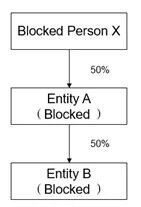
FAQ 402 further provides that if a blocked person divests its ownership stake to below 50 percent, and such transaction occurs entirely outside of U.S. jurisdiction and does not involve U.S. persons, the entity will no longer be considered automatically to be a blocked entity. However, OFAC expressly warns: "Sufficient due diligence should be conducted to determine that any purported divestment in fact occurred and that the transfer of ownership interests was not merely a sham transaction."
Risk Alert and Practical Guidance:
- The "50 Percent Rule" is a floor, not a ceiling: Recent enforcement actions demonstrate that even where the 50 percent ownership threshold is not met, OFAC may still determine that a "property interest" is retained if the blocked person maintains control through agents, agreements, or de facto means. As the Guidance emphasizes, "Because OFAC implements functional definitions of 'interest' and 'property interest' that look beyond legal formalities to underlying practical and economic realities, sham transactions do not terminate a blocked interest in property" [4]Accordingly, OFAC focuses on "practical and economic realities" rather than mere legal form.
- The Cautionary Tale of the 2025 Enforcement Cases: In the GVA Capital case (settlement amount of approximately $216 million)[5] and the IPI Partners case (settlement amount of approximately $11.5 million),[6] both entities had obtained legal opinions from external counsel concluding that the 50 percent ownership threshold was not met. Nevertheless, OFAC determined that violations had occurred, on the grounds that the entities "should have known" that the blocked person retained control and beneficial interests through agents.
2.The Statute of Limitations: Practical Implications of the Ten-Year Lookback Period
On April 24, 2024, then-U.S. President Joe Biden signed the 21st Century Peace through Strength Act into law.[7] Section 3111 of this Act extends the statute of limitations for civil and criminal violations of sanctions under theInternational Emergency Economic Powers Act (IEEPA) and the Trading with the Enemy Act (TWEA) from five years to ten years. This extension applies retroactively to violations occurring after April 24, 2019, and is enforceable by both the U.S. Department of the Treasury's OFAC and the U.S. Department of Justice.
Compliance Implications:
- Record retention periods must be extended: Transaction records, due diligence documentation, and correspondence related to U.S. sanctions compliance must be retained for a minimum of ten years.
- "The passage of time" is not a valid defense: OFAC retains the authority to investigate transactions dating back several years. Enterprises must ensure that their compliance documentation is capable of withstanding scrutiny over time.
02. Core of the Guidance—What Constitutes a "Sham Transaction"?
1.Official Definition of a Sham Transaction
In the Guidance, OFAC defines a sham transaction as "Sham transactions occur when blocked persons, often operating through proxies or other intermediaries, effectuate transfers or establish arrangements that conceal—rather than genuinely extinguish—a continuing interest in property. In other words, blocked persons give up their property on paper only, in an attempt to evade sanctions, while their interests in property remain unchanged."
As the core assessment standard, OFAC applies a "functional definition." Even if a blocked person's ownership percentage falls below 50%, if it retains de facto control, usage rights, or beneficial interests in the property, the transaction may still be deemed a sham transaction.
2.Typical Examples of Sham Transactions (Including OFAC Enforcement Cases)
The Guidance sets forth the following typical examples of sham transactions, along with recent enforcement actions:
(1)Trust Transfers Involving Private Aircraft
-
A blocked oligarch transferred ownership of his private jet to a trust, whose sole beneficiary was his unsanctioned wife, while the oligarch continued to use the jet for travel.
-
2025 Trustee Case: Although the trustee obtained external legal advice concluding that the trust was "not sanctioned," OFAC determined that the trustee "knew or should have known" that the sanctioned oligarch retained control through family members. The settlement amount was $1.092 million.[8]
(2)Trusts for Minor Children
-
A blocked person transferred millions of dollars of funds into trusts held for his minor children and then attempted to move these funds through U.S. banks.
-
2024 Sentimare Case: In December 2022, after the U.S. sanctioned Russian oligarch Potanin, he transferred ownership of Cyprus-based entity Sentimare to four Liechtenstein foundations, each with a single beneficiary of one of Potanin's four minor children. OFAC nevertheless concluded that he retained an interest in the foundations and prevented the foundations' funds from being transferred. In June 2024, OFAC designated Sentimare and the four foundations. [9] Even where beneficiaries are family members, if the funds originate from a blocked person who retains veto power or the right to give instructions, the trust structure offers no legal protection.
(3)Nominee Accounts Held by Spouses/Relatives
-
A designated narcotrafficker funded a bank account in his wife's name and continued to benefit through his wife's management of the account.
-
An investment advisor continued to manage property on behalf of a blocked oligarch through multiple intermediate companies under the oligarch's trust, which was managed by his nephew.
-
GVA Capital Case: The blocked oligarch Kerimov operated investments through his nephew (acting as an agent). The venture capital firm, knowing of this agency relationship, continued to manage assets for the oligarch, resulting in a penalty of approximately $216 million.[10]
(4)Reincorporation Under a New Identity to Resume Operations
-
Following its designation, a company sanctioned for narcotics trafficking was reincorporated under a different name with new nominal owners while continuing the blocked company's operations.
-
This practice is common in narcotics trafficking sanctions. OFAC will directly designate the new entity as an "alter ego" of the blocked entity, and a change in legal form will not shield it from sanctions liability.
03. Systemic Risks Posed by Trusts and Similar Legal Arrangements
1.The Systemic Warning on Trust Structures
In the Guidance, OFAC specifically notes that trusts are frequently exploited for sham transactions due to the opacity of their legal structure. The Guidance explicitly warns: "Although broadly used for legitimate purposes, trusts have at times been used in sham transactions to obscure links between blocked persons and their interests in property." Even where a trustee holds legal title nominally, the trust may still be deemed property of the sanctioned person if the trustee reasonably should have known that the sanctioned person controls trust decisions through an agent.
2.Trust Enforcement Settlement Case in December 2025
As aforementioned, the Guidance specifically cites a landmark enforcement case dating back to December 2025. OFAC reached an enforcement settlement agreement worth $1.092 million with an individual, who works as a lawyer and former U.S. government official. Serving as the trustee of a trust owned by a sanctioned Russian oligarch family, the individual continued to administer trust assets after the oligarch was sanctioned by OFAC. OFAC determined that the trustee reasonably should have known the sanctioned person exercised control over trust decisions through a family member. Though holding no official position in the trust, this family member maintained frequent communications with investors and the trustee, demonstrating that the oligarch retained proprietary interests in the trust.
Notably, the trustee obtained external legal counsel asserting that the trust assets were not subject to freezing. Nevertheless, OFAC stated that such advice stemmed from a mistaken belief that the agent exerted no substantial influence over trust administration and operations. This case sends a clear signal that legal opinions relying on nominal ownership while ignoring substantive control relations cannot serve as grounds for exemption.
3. Heritage Trust Case and Kerimov-Related Enforcement Actions
The Guidance also elaborates on a series of enforcement actions targeting Russian oligarch Suleiman Kerimov:
-
June 2022: OFAC issued a Notification of Blocked Property to Heritage Trust, a Delaware-based trust. It ruled that Kerimov used a series of legal structures and front persons to obscure his continuing interest in Heritage Trust, the funds of which first entered the U.S. financial system through two foreign Kerimov-controlled entities.
-
June 2025: OFAC imposed the maximum statutory penalty of $215,988,868 GVA Capital, a venture capital firm based in San Francisco. The firm knowingly managed investments for Kerimov by working through the oligarch's nephew, who GVA Capital knew served as a proxy for the blocked oligarch, and failed to comply with OFAC subpoena demands.
-
December 2025: OFAC entered into an enforcement settlement of $11,485,352 with IPI Partners, a Chicago-based private equity firm. The apparent violations arose from IPI's solicitation, receipt, and continued maintenance of investments from a sanctioned Russian oligarch for four years. IPI's senior leadership knew that the blocked person was the source of funds and had reason to know at the time the funds were committed that the blocked person ultimately made relevant investment decisions.
OFAC emphasized in the GVA Capital case the risk that U.S. persons face when relying on formalistic ownership arrangements that obscure the true parties in interest behind an entity or investment, without sufficiently considering factors such as control or influence over that investment.
Compliance Insights
- External legal counsel does not equate to exemption. Lessons from the 2025 trustee case prove that legal advice based on a misjudgment of agents' roles cannot exempt parties from liabilities.
- De facto control prevails over legal ownership. When receiving funds from trusts or complex structures, enterprises must conduct thorough due diligence to identify the actual decision-makers and beneficiaries, rather than merely relying on third-party compliance undertakings.
04. Self-inspection of Seven High-Risk Behaviors—From Red Flags to Risk Scenarios
The seven red flags specified in the Guidance shall not be judged in isolation but require comprehensive evaluation. Combined with enterprises' actual business scenarios, this section provides a self-inspection reference framework and risk grading guidance.
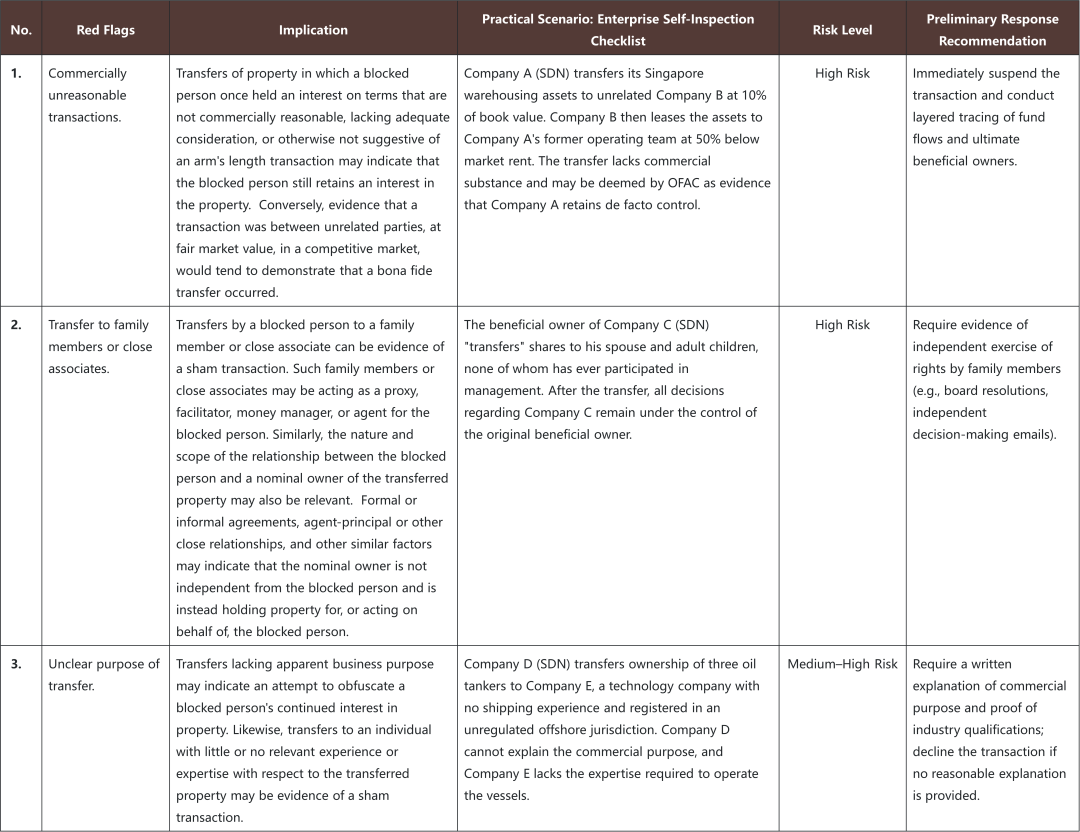
The Guidance also clarifies that a party seeking to act in compliance with OFAC sanctions may deal in property in which a blocked person previously held an interest but no longer does. OFAC does not seek to disturb legitimate dealings performed in good-faith compliance with OFAC sanctions involving property in which no blocked interest exists.
If persons encounter information indicating that a blocked person previously held an interest in property, OFAC recommends a review of available information to evaluate if any of the above-listed red flags are present. This review may guide analysis to determine if property previously held by blocked persons remains blocked. These red flags are not intended to convey a "one-size-fits-all" approach. Instead, persons evaluating whether property involved in a transaction raises U.S. sanctions concerns can apply these red flags, consistent with a risk-based approach, in situations where information suggests that a blocked person possessed a prior, documented interest in property.
Where information shows a blocked person retains an interest in property in the United States or within the possession or control of any U.S. person, the property must be blocked and reported to OFAC. If the property is not in the United States and is not within the possession or control of any U.S. person, persons required to comply with U.S. sanctions should refrain from directly or indirectly dealing in the property absent authorization from OFAC.
05. OFAC Sanctions Evasion Enforcement Landscape
OFAC's crackdown on sanctions evasion operates in coordination with the U.S. Department of Commerce's Bureau of Industry and Security (BIS) and the Department of Justice (DOJ), forming a tri-agency enforcement framework covering all sectors. In particular, OFAC has recently issued a series of targeted compliance guidance documents addressing scenarios such as Iranian oil shipping, Russian sanctions evasion through third-party intermediaries, and sanctions evasion in the maritime industry.
1.Tri-Agency Coordination Against Evasion
On March 2, 2023, the U.S. Department of Commerce, Department of the Treasury, and Department of Justice jointly issued the Compliance Note: Cracking Down on Third-Party Intermediaries Used to Evade Russia-Related Sanctions and Export Controls (hereinafter referred to as the "Compliance Note"). [11]It explicitly identifies the use of third-party intermediaries as the "most common tactic" for evading Russia-related sanctions, warning that the U.S. government will not hesitate to pursue criminal prosecutions, administrative enforcement actions, or additional designations. This marked the launch of an unprecedented coordinated enforcement regime among the three agencies.
The Compliance Note states that one of the most prevalent tactics for evading Russia-related sanctions and export controls is "the use of third-party intermediaries or transshipment points to circumvent restrictions, disguise the involvement of Specially Designated Nationals and Blocked Persons (SDNs) or parties on the Entity List in transactions, and obscure the true identities of Russian end users." It also cautions that, given the growing body of sanctions and export controls imposed on Russia, multinational corporations must heighten compliance vigilance and closely monitor conduct that may evade U.S. laws. The U.S. government has a variety of tools to crack down on evasion efforts and will not hesitate to pursue criminal prosecutions, administrative enforcement actions, or additional designations as necessary. Businesses of all stripes should act responsibly by implementing rigorous compliance controls, or they or their business partners risk being the targets of regulatory action, administrative enforcement action, or criminal investigation.
2.Crackdown on Iranian Oil Sanctions Evasion
On April 28, 2026, OFAC issued a targeted alert, Sanctions Risks of Dealing with Teapot Oil Refineries,[12] which for the first time directly targeted independent refineries in Shandong Province, China, requiring financial institutions to conduct enhanced due diligence. OFAC explicitly directed financial institutions to implement risk-based controls, refrain from facilitating transactions involving sanctioned teapot refineries or other teapot refineries potentially importing Iranian oil, conduct enhanced due diligence on transactions with Chinese refineries, primarily in Shandong Province, and clearly communicate sanctions compliance requirements to correspondent banks.
On May 11, 2026, the Financial Crimes Enforcement Network (FinCEN) of the U.S. Department of the Treasury issued an Alert on the Use of Front Companies, Financial Facilitators, and Digital Asset Infrastructure by Iran's Islamic Revolutionary Guard Corps to Evade Sanctions and Launder Proceeds.[13] The FinCEN alert provides red flags related to the Islamic Revolutionary Guard Corps (IRGC) oil smuggling, the abuse of shell companies, and the use of digital assets, designed to help financial institutions detect and report suspicious activity to identify and disrupt financial and procurement networks supporting the IRGC.
3.Disclosure of Common Evasion Tactics
OFAC also outlined prevalent sanctions evasion methods in Iranian oil trade, including the use of front companies and brokerage intermediaries in Asia and the United Arab Emirates to facilitate transactions, as well as deceptive maritime practices such as ship-to-ship transfers via "shadow fleets," falsifying shipping documents, and manipulating vessel identity and positioning data. In some transactions, Iranian oil is blended with oil from third countries to obscure its origin, or relabeled with forged documents as the product of another jurisdiction, most commonly as "Malaysian blend." Certain sanctioned Iranian vessels also conceal their identity by reporting identification details of non-sanctioned or decommissioned vessels.
OFAC explicitly warns that foreign financial institutions and other non-U.S. entities risk exposure to U.S. sanctions for engaging in certain transactions or activities involving designated teapot refineries or other actors operating in the Iranian petroleum sector. The U.S. Department of the Treasury stands ready to impose secondary sanctions on foreign financial institutions that continue to support Iran-related activities. OFAC will continue to target main revenue-generating sectors of the Iranian regime, in particular its petroleum and petrochemical sectors, under Executive Order 13902 and other sanctions authorities.
4.Summary Table of Sanctions Evasion Red Flags
(1)Red Flags Issued by OFAC
In guidance documents issued under various sanctions programs, OFAC has enumerated red flags for identifying evasive conduct. Below is a systematic consolidated table of red flags covering Russian sanctions evasion via third‑party intermediaries, Iranian oil shipping evasion, and general maritime evasion.
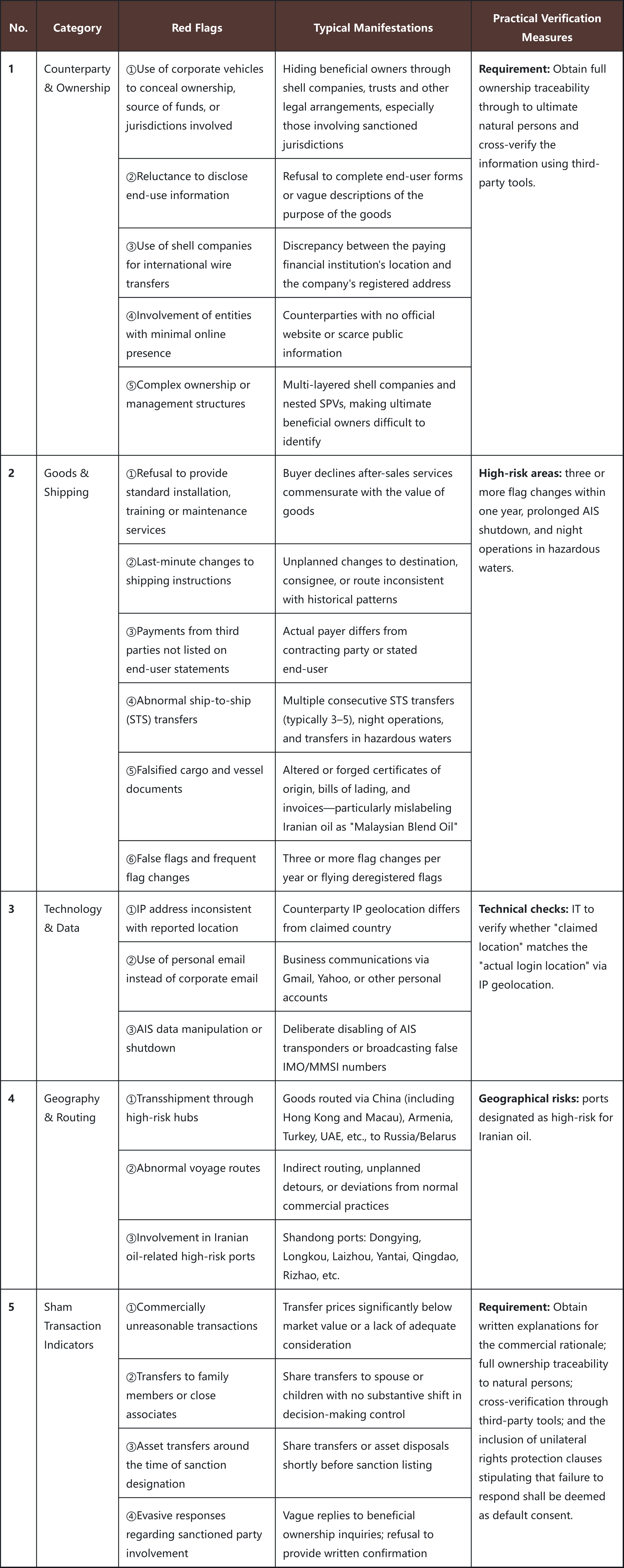
(2)Red Flags Issued by FinCEN
The latest FinCEN Alert explicitly sets forth the following red flags to assist financial institutions in identifying, preventing, and reporting potential suspicious activities related to Iranian sanctions evasion and other illicit conduct.
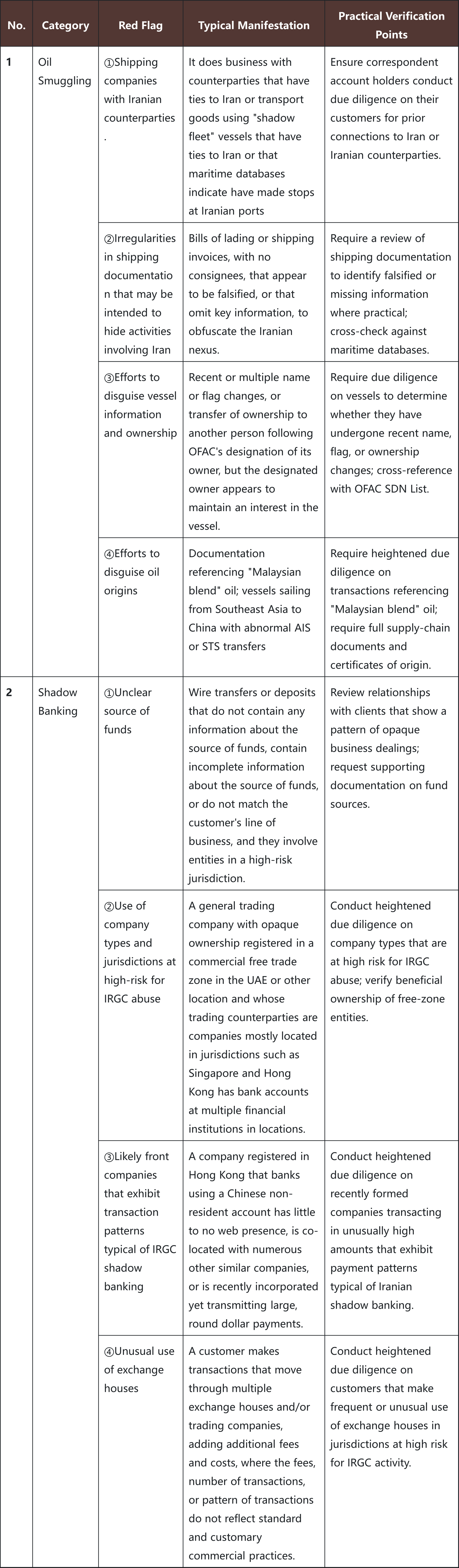
Practical Takeaways
The unique value of this FinCEN Alert lies in its coverage of both traditional red flags for oil smuggling and, for the first time, a systematic mapping of evasion patterns in shadow banking and digital assets. Chinese enterprises engaged in cross-border payments, digital currency business, or trade with companies based in the UAE, Hong Kong, and similar jurisdictions should pay close attention to indicators such as unidentified stablecoin payment sources and typical payment patterns of shell companies, and incorporate them into the rulesets of anti‑money laundering monitoring systems.
06. Enterprise Compliance Recommendations: A “Four‑Dimensional Integrated” Practical Framework
Sanctions lists issued by the U.S. Department of the Treasury's OFAC are administrative control measures, not direct findings of legal liability. The key threshold for escalation from administrative action to criminal liability is scienter (knowledge). The U.S. standard for "knowledge" in economic sanctions cases follows the International Emergency Economic Powers Act (IEEPA) and federal case law. Based on enforcement practices of OFAC and the DOJ, the following scenarios are highly likely to cross the line from civil to criminal liability:
①Designing evasive structures: Intentionally setting up trusts, shell companies, or nominee arrangements to "sever" the apparent link between a sanctioned person and the property.
②Concealing transaction information: Deleting or altering information related to sanctioned persons in transaction documents or information systems.
③Facilitating fund transfers: Providing payment channels via non‑U.S. accounts or cryptocurrencies to transfer funds, while knowing the counterparty or ultimate beneficiary is on the SDN List.
In the newly issued Guidance, OFAC clearly sets the regulatory bottom line: for any transaction structures or commercial arrangements deliberately designed to evade sanctions, regulators may conduct substantive look‑through reviews, disregard formal legal structures, determine the true nature of the transaction, and impose severe penalties on violators—regardless of whether the external legal form appears compliant or how sophisticated the structure is. For Chinese enterprises with overseas operations, a critical compliance principle must be understood: being listed on a sanctions list does not itself constitute a direct finding of illegality or liability, but voluntary and intentional evasion through restructuring, disguise, or circumvention is the primary trigger for substantial civil fines and even criminal prosecution.
In light of the Guidance's requirements and the U.S. trend toward aggressive look‑through enforcement, Chinese enterprises should strengthen risk identification and end‑to‑end sanctions compliance controls across transaction structures, counterparty due diligence, contractual safeguards, and internal screening, with the following specific measures:
1.Look‑Through Review of Transaction Structures to Identify Sham or Non‑Compliant Arrangements
-
Review existing business: Conduct a retrospective audit of current cross‑border structures; trace through equity, agreements, and intermediaries layer by layer to identify shell entities, nominee holdings, and sham transfers.
-
Substance over form: Reject the misconception that complex structures automatically avoid scrutiny. Focus on who exercises actual control and who enjoys the ultimate economic benefit.
-
Proactively dismantle non‑compliant structures: Where sham transaction features are identified, unwind arrangements voluntarily before a U.S. investigation and maintain a complete audit trail demonstrating good‑faith exit.
2. Strengthen Counterparty Due Diligence and Verify Ultimate Beneficial Ownership
-
Elevate due diligence standards: For counterparties registered in offshore financial centers, with complex equity structures, or opaque business backgrounds, mandate full ownership tracing, proof of identity of beneficial owners, and a written beneficial ownership compliance declaration.
-
Cross‑reference screening: Match entity information against the SDN List, 48 sanctions programs, the BIS Entity List, and other watchlists to uncover hidden links.
-
Leverage technology: Consider third‑party due diligence databases to improve the efficiency and accuracy of look‑through reviews.
3. Add Compliance Safeguards in Contracts to Enforce Legal Accountability
-
Anti‑evasion representations: Include clauses such as: "The counterparty represents that it, its affiliates, and beneficial owners are not on any sanctions list, and that it does not assist sanctioned persons by holding assets, transshipping goods, or providing payment channels."
-
Explicit liability for breach: Reserve the right to terminate the agreement unilaterally and recover all damages and compliance costs for breach of representations.
-
Align with Chinese anti‑sanctions laws: Add a governing law clause: "If performance involves obligations under China's Anti‑Foreign Sanctions Law and blocking prohibitions, the parties shall prioritize compliance with Chinese law and mutually adjust performance accordingly."
4.Develop an Internal Red Flag List and Tiered Screening Mechanism
Internal red flag inventory: Systematically compile risk indicators from the seven red flags in the Guidance, the Iranian oil alert, and the tri‑agency Compliance Note to create an internal violation scenario library.
Tiered response:
- 1–2 red flags triggered: Initiate enhanced due diligence and require written explanations.
- 3+ red flags triggered: Classify as high risk, escalate to the compliance committee; apply one‑vote veto if reasonable suspicion cannot be ruled out.
- Sanction‑period transfers, family nominee holdings, continuing involvement: Treat as hard red lines and terminate the business relationship immediately.
07. Comply with Domestic Anti‑Sanctions Laws and Honor Dual Legal Boundaries
On May 2, 2026, China's Ministry of Commerce issued its first blocking order under the Blocking Measures, marking China's anti‑sanctions regime moving from legislation to active enforcement.
1.The obligation of "Non‑Recognition, Non‑Execution, Non‑Compliance" under Chinese law
MOFCOM Announcement No. 21 of 2026 explicitly prohibits recognition, execution, or compliance with U.S. SDN designations, asset freezes, and transaction bans imposed on five Chinese entities for alleged involvement in Iranian oil trade.[14]
-
No "follow‑suit" supply cuts: A Chinese enterprise (not among the five sanctioned entities) receiving a global compliance directive from a U.S. parent to sever ties with a sanctioned Chinese firm may violate China's blocking order if the sole or primary reason is compliance with U.S. sanctions.
-
No refusal to settle on "sanctions‑related" grounds: Financial institutions may not refuse RMB cross‑border settlement solely because a payer or beneficiary is on the SDN List.
-
Right to sue for damages: Under Article 9 of the Blocking Measures, Chinese enterprises may file civil claims in Chinese courts against foreign entities (e.g., European banks) that terminate transactions due to U.S. sanctions and cause losses.
2.Overlapping Application of the Anti‑Foreign Sanctions Law and the Regulations of the People's Republic of China on Countering Improper Extraterritorial Jurisdiction by Foreign Countries
On April 13, 2026, the Regulations of the People's Republic of China on Countering Improper Extraterritorial Jurisdiction by Foreign Countries entered into force. As an administrative regulation issued by the State Council, it supersedes the Blocking Measures (departmental rules) and establishes:
-
Prohibition of Execution Orders: The State Council may directly issue orders to prohibit organizations or individuals from executing or assisting in executing an improper extraterritorial jurisdiction measure of a foreign country; violators will face multiple penalties, including exclusion from government procurement, restrictions on imports and exports, limitations on cross-border data flows, and entry bans.
-
Malicious Entity List: Foreign organizations or individuals that actively drive or participate in the imposition of inappropriate extraterritorial jurisdiction measures of foreign countries may face nine countermeasures, including asset freezes, transaction bans, and entry bans—with liability extended to entities they control or establish.
3.Enterprise Practical Guide: Achieving "Dual Compliance" in the Context of U.S.–China Legal Conflicts
Step 1: Distinguish between primary sanctions and secondary sanctions scenarios
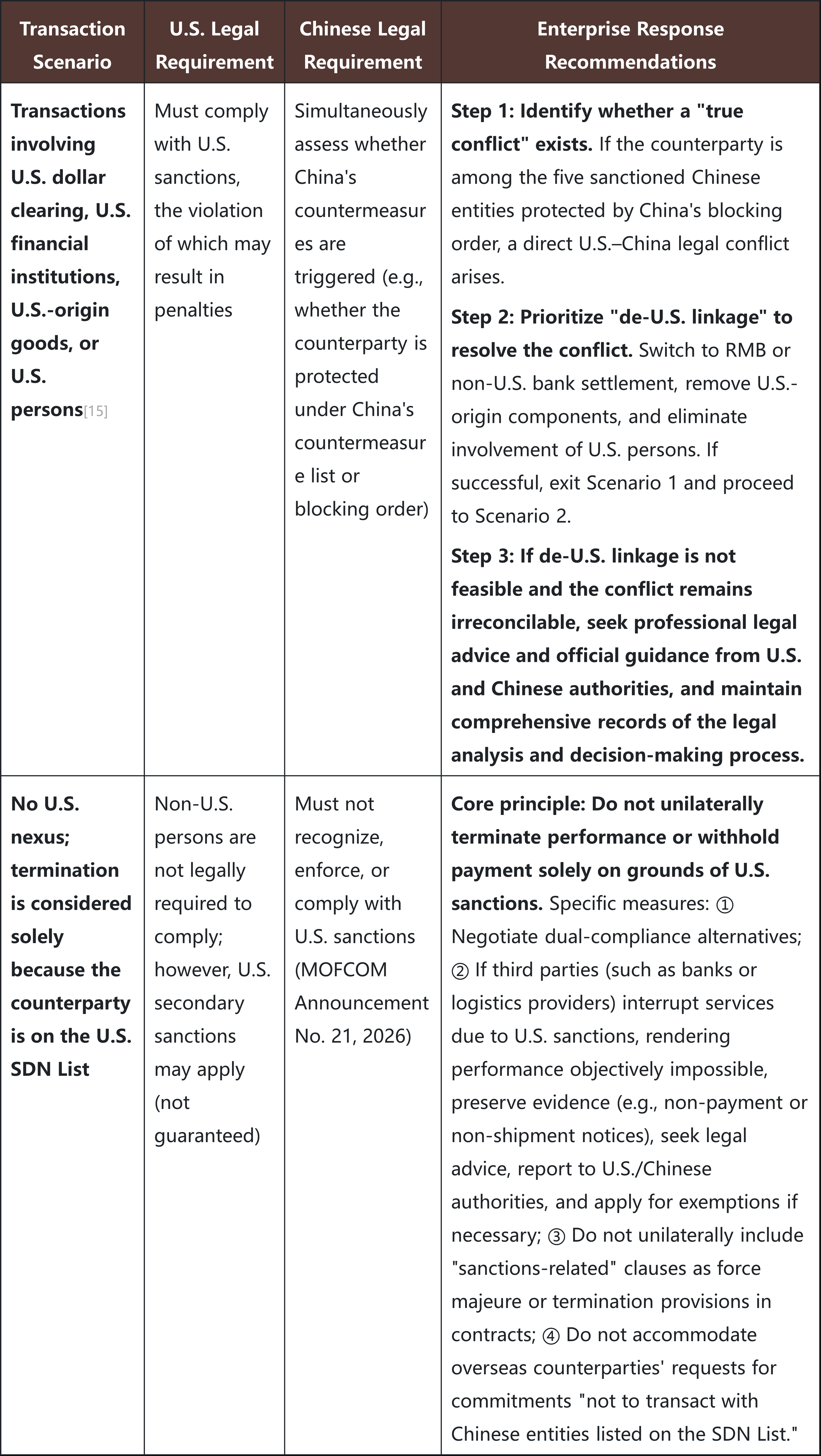
Step 2: "Three Nos" for Transactions with Chinese Entities Subject to U.S. Sanctions
-
No voluntary supply cuts: Do not unilaterally terminate normal performance solely because the counterparty has been added to the SDN List.
-
No passive compliance: Do not accept overseas counterparties' contractual clauses requiring a commitment not to transact with Chinese entities listed on the SDN List.
-
No sanctions-based exemption: Do not cite "sanctions reasons" as grounds for exemption or termination. If necessary, report to both Chinese and U.S. regulatory authorities and apply for required exemptions or licenses.
-
Establish a "Dual Compliance" Review Process
Integrate risk checks for China's anti-sanctions and foreign-related national security laws in parallel with your existing U.S. Sanctions Compliance Program (SCP) screening:
-
Stage 1 (Transaction Initiation): Verify whether the counterparty is listed on China's Countermeasure List or Unreliable Entity List. If so, suspend the transaction immediately and report to competent authorities.
-
Stage 2 (Contract Review): Check for clauses requiring compliance with foreign sanctions or commitments not to transact with sanctioned persons. Remove such clauses, or add a proviso stating: "In the event of conflict with Chinese law, Chinese law shall prevail."
-
Stage 3 (Performance Impediments): If third parties (such as banks, logistics providers, insurers) disrupt performance citing U.S. sanctions, preserve evidence (e.g., written refusal notices) within 24 hours, report to commerce authorities, and apply for exemptions where available.
Conclusion: From "One-Sided Compliance" to "Two-Way Balance"
Amid complex geopolitics and growing U.S.–China legal conflicts, Chinese enterprises operating overseas can no longer adopt a compliance approach that adheres solely to U.S. rules. OFAC's look-through scrutiny is intensifying, while China's Anti-Foreign Sanctions Law and blocking regime are now fully operational.
For Chinese enterprises, true compliance capability is no longer defined by "better implementation of U.S. sanctions." It lies in identifying lawful, stable, sustainable business pathways within the dual legal red lines imposed by China and the U.S. This requires legal and compliance teams to:
①Precisely distinguish legal risks between primary and secondary sanctions;
②Dynamically track regulatory updates and enforcement cases in both countries;
③Prudently utilize China's blocking mechanisms and exemption channels;
④In complex cross-border transactions with ambiguous boundaries, proactively seek advice from professionals with practical experience in both Chinese and U.S. law, and formally report to regulators in both jurisdictions to request exemptions, licenses, or intergovernmental consultations, as appropriate.
Dual compliance is not merely a slogan; it constitutes the foundational capability that determines whether enterprises can survive and thrive in cross-border markets in 2026 and beyond.
*Any reference to "Hong Kong" or "Hong Kong SAR" and "Macao" or "Macao SAR" shall be construed as a reference to "Hong Kong Special Administrative Region of the People's Republic of China" and "Macao Special Administrative Region of the People's Republic of China".
Footnotes:
[1] Publication of Sanctions Advisory: Guidance on Sham Transactions and Sanctions Evasion,See:https://ofac.treasury.gov/recent-actions/20260331_33 。
[2] FAQ 402,See:https://ofac.treasury.gov/faqs/402。
[3] FAQ 401,See:https://ofac.treasury.gov/faqs/401。
[4] Guidance on Sham Transactions and Sanctions Evasion, See:https://ofac.treasury.gov/media/935441/download?inline。
[5] OFAC Imposes $215,988,868 Penalty on GVA Capital Ltd. for Violating Ukraine/Russia Related Sanctions and Reporting Obligations,See:https://ofac.treasury.gov/media/934366/download?inline。
[6] IPI Partners, LLC Settles with OFAC for $11,485,352 Related to Apparent Violations of Ukraine-/Russia-Related Sanctions,See:https://ofac.treasury.gov/media/934786/download?inline。
[7] H.R.815 - Making emergency supplemental appropriations for the fiscal year ending September 30, 2024, and for other purposes, See:https://www.congress.gov/bill/118th-congress/house-bill/815。
[8] OFAC Settles with an Individual for $1,092,000 Related to Apparent Violations of Ukraine-/Russia-Related Sanctions, See:https://ofac.treasury.gov/media/934806/download?inline。
[9] Taking Additional Measures to Degrade Russia’s Wartime Economy Fact Sheet, See:https://2021-2025.state.gov/taking-additional-measures-to-degrade-russias-wartime-economy/。
[10] OFAC Imposes $215,988,868 Penalty on GVA Capital Ltd. for Violating Ukraine/Russia Related Sanctions and Reporting Obligations,See:https://ofac.treasury.gov/media/934366/download?inline。
[11] Cracking Down on Third-Party Intermediaries Used to Evade Russia-Related Sanctions and Export Controls, See:https://ofac.treasury.gov/media/931471/download?inline。
[12] Sanctions Risk of Dealing with Teapot Oil Refineries,See:https://ofac.treasury.gov/media/935546/download?inline
[13] FinCEN Alert on the Use of Front Companies, Financial Facilitators, and Digital Asset Infrastructure by Iran's Islamic Revolutionary Guard Corps to Evade Sanctions and Launder Proceeds, See:https://www.fincen.gov/system/files/2026-05/FinCEN-Alert-IRGC.pdf。
[14] Announcement No. 21 of 2026 of the Ministry of Commerce: Blocking Order Regarding the United States' Sanctions Measures Involving Iranian Oil Imposed on Five Chinese Enterprises, See:https://www.mofcom.gov.cn/zwgk/zcfb/art/2026/art_0ff88c45f1974962a539775085014888.html
[15] Includes foreign nationals holding U.S. lawful permanent resident status and entities located in the United States.
Source: King & Wood Mallesons
Authors:
- Jing Yunfeng, Partner, Corporate & Commercial Group, jingyunfeng@cn.kingandwood.com; Areas of Practice:customs and import & export regulation, customs planning, entry-exit inspection and quarantine, and international trade compliance, etc
- Li Zhenghao, Partner, International Projects Group, lizhenghao@cn.kingandwood.com; Areas of Practice:Chinese regulatory compliance in the technology, media & telecommunications (TMT) and other sectors, international trade law, commercial arbitration and litigation
- Dai Menghao, Partner, Compliance & Regulatory Group, daimenghao@cn.kingandwood.com; Areas of Practice:export control and sanctions, customs and trade compliance, cross-border investment and M&A, and trade remedies.
- Hou Peng, Partner, Dispute Resolution Group, houpeng@cn.kingandwood.com; Areas of Practice:cross-border financial, investment and trade dispute resolution, covering complex civil and commercial litigation, international commercial and investment arbitration, cross-border bankruptcy reorganisation and liquidation
- Atticus Zhao, Partner, Corporate & Commercial Group, atticus.zhao@cn.kingandwood.com; Areas of Practice:M&A, foreign direct investment, corporate restructuring, data and privacy protection,
- Sun Xing, Partner, Corporate & Commercial Group, sunxing@cn.kingandwood.com; Areas of Practice:Mr. Sun specializes in the areas of Customs Law, Export Control Law, Cross-border E-commerce and International Trade Compliance.
- Thanks to Yan Lu and intern Wang Xi for their contributions to this article.