

Source: Chance Bridge Law Firm
Since China placed legislation to combat cross-border corruption on its agenda, the idea of a ‘Chinese FCPA’ has attracted considerable attention. The comparison with the US Foreign Corrupt Practices Act (FCPA) captures some of the proposed law’s functions. It does not fully explain how China will organise its own approach to cross-border corruption. In our earlier article, ‘Navigating Deeper Waters: A Look Ahead at China’s Anti-Cross-Border Corruption Law’ Insights | Into Deeper Waters: China's Anti-Cross-Border Corruption Law(the ‘earlier article’), contended that China’s institutions, legal framework, and legislative objectives constitute the fundamental prerequisites for understanding this legislation.
On 25 August 2026, the Draft Anti-Cross-Border Corruption Law of the People’s Republic of China (the ‘Draft’) was submitted to the Standing Committee of the National People’s Congress for its first reading. It comprises six chapters and 47 articles. [1]The published text reinforces our earlier assessment. The Draft affirms the leadership of the Communist Party of China. It emphasises governance in accordance with law and a coordinated approach to tackling corruption. It also requires equal protection of the lawful rights and interests of all types of businesses (Articles 2 and 5). The Draft brings domestic anti-corruption efforts, corporate cross-border compliance, international enforcement cooperation and the protection of national sovereignty into a single framework.
The author (Will WU) addressed the Draft in an interview with the South China Morning Post, published on 13 September. [2]The report examined cross-border anti-corruption cooperation, sovereignty over enforcement, and the resulting challenges for investigations and data compliance. It offers an international perspective on the Draft: how will China’s framework apply to specific cross-border facts, and how will it interact with companies’ global governance arrangements and proceedings in other jurisdictions?
This article follows five themes: the governance framework, its scope, corporate obligations, investigations and cooperation, and practical responses. It first examines how the Draft organises cross-border governance and defines its reach. It then considers how corporate obligations interact with investigations and international cooperation, before addressing what companies can do now and what the final legislation still needs to clarify.
Ⅰ. The Governance Framework
Bringing Existing Rules Together
The first question is what the Draft adds to the existing framework.
As the earlier article explained, China already has substantive rules addressing cross-border corruption. Article 164 of the Criminal Law prohibits bribing foreign public officials or officials of public international organisations to obtain improper commercial benefits. It also provides for criminal liability for entities. [3]Article 35 of the Draft retains the requirement that conduct must constitute an offence under the Criminal Law before criminal liability can arise. It does not create new criminal offences.
Beyond these substantive rules, dedicated legislation can fill gaps in the mechanisms for implementation and connect them more effectively. Relevant provisions have been dispersed across the Criminal Law, Criminal Procedure Law, Extradition Law, International Criminal Judicial Assistance Law and Anti-Money Laundering Law. How to make this framework more coherent and responsive to cross-border corruption has long been a subject of research. [4]There is real value in addressing institutional arrangements, substantive rules and procedures together. [5]This is where the Draft can make a difference: it brings existing rules, corporate obligations and enforcement cooperation into a framework designed to work as a whole.
That framework has four elements. First, institutional coordination: Article 8 gives the National Commission of Supervision the lead role, with other authorities contributing within their respective remits. Second, detection: Articles 13 to 15 provide channels for referring leads identified through anti-money laundering monitoring, audits, fiscal oversight, tax administration and financial regulation. They also require the use of big data and other tools to analyse and assess information. Third, prevention: Chapter IV requires companies to identify risks, investigate and address breaches, and strengthen compliance management. Fourth, cooperation: Chapter III addresses international cooperation in investigations, evidence gathering, the pursuit of fugitives and asset recovery. The National Commission of Supervision coordinates this work; each authority continues to exercise its own statutory functions.
Of these elements, corporate compliance is the most amenable to cross-jurisdictional comparison, yet also the most prone to misinterpretation. The FCPA contains both anti-bribery provisions and books-and-records and internal accounting controls requirements for issuers. Section 7 of the UK Bribery Act creates an offence where a commercial organisation fails to prevent bribery by an associated person, with a defence based on ‘adequate procedures’ to prevent bribery. [6]Article 32 of the Draft requires accounting information to be accurate and complete. Article 45 enforces compliance obligations through orders to rectify deficiencies within a specified period, followed by business and licensing measures if a company refuses to comply. These regimes differ in who they cover, what establishes liability and how they are enforced. Foreign offences or defences should therefore not be imported directly into the analysis.
The Draft’s distinctive features extend beyond its compliance mechanisms. Arguably, its defining feature is the way it connects oversight of public officials, protection of state-owned assets, corporate integrity, international cooperation and national sovereignty. This reflects a valuable argument in the academic literature: China should build on its own anti-corruption institutions while addressing both cross-border corruption by public officials and bribery of foreign public officials. [7]Article 3 covers both. Article 5 requires the protection of orderly cross-border business activity and equal protection of all types of businesses. Implementation that is lawful, stable and predictable is therefore integral to the framework’s success.
Protecting State Assets Overseas
The protection of state-owned assets overseas illustrates how this framework can operate across prevention, detection, investigation and recovery.
At the prevention stage, Article 31(2) requires state-owned enterprises (SOEs) to strengthen controls over integrity risks in key overseas roles, substantial funds and major projects. In accordance with the relevant rules, measures include directly appointing heads of finance to overseas operations, rotating personnel posted abroad and requiring recusal where conflicts of interest arise. The accounting and third-party management obligations in Articles 32 and 33 reinforce controls over funds and transactions.
As concerns emerge, corporate reports and internal reviews can connect with leads referred by anti-money laundering, audit and other authorities. An unusual consultancy payment, for example, may raise several questions. Were the services genuine? Was the payment properly approved? Who ultimately benefited? Did overseas managers discharge their duties? Bringing these facts together can reveal a possible improper transfer of benefits behind otherwise isolated financial anomalies.
At the investigation and accountability stage, these processes can connect with Chapter III’s mechanisms for gathering evidence overseas and locating, preserving, confiscating and returning assets. A lead from an overseas subsidiary, joint venture or intermediary may then support an assistance request abroad and help recover assets within a more complete legal framework.
Whether this works depends on effective coordination in China and compatibility with procedures abroad. The Chinese authority must have the power to make the request, explain how identified assets relate to suspected illicit proceeds, and meet the receiving jurisdiction’s evidential and procedural requirements. Bona fide third parties need avenues to object and seek remedies. Freezing, confiscation and return must each satisfy the conditions applicable at that stage. Article 25(2) provides a basis for cooperation on asset return and sharing, but the detailed mechanisms need further development. Clarifying these steps would help China recover assets lawfully and enable overseas counterparts to understand and act on its requests.
Ⅱ. The Scope of The Framework
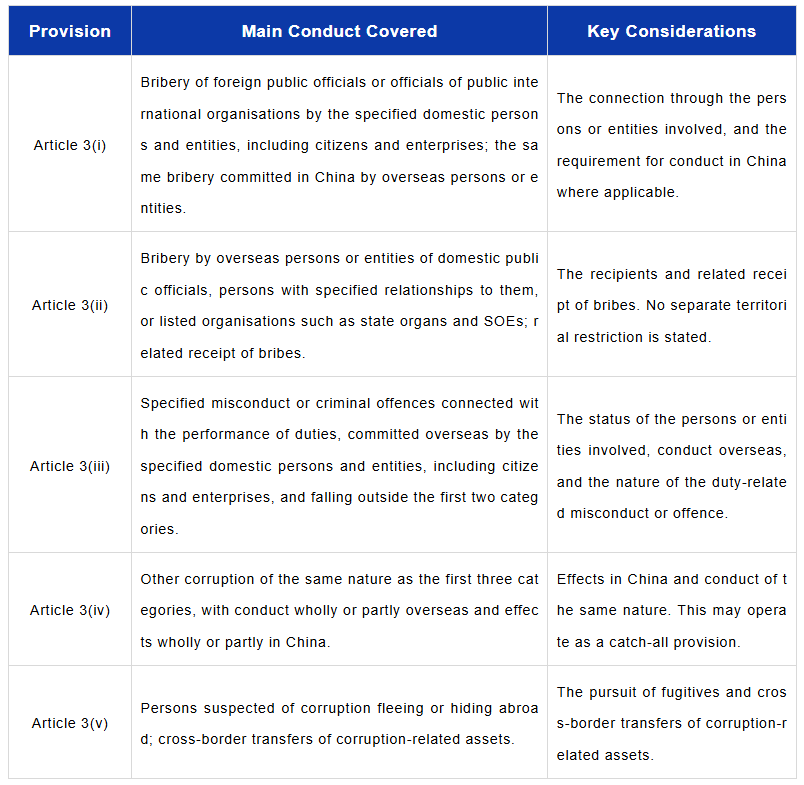
The next question is what conduct the Draft covers. Article 3 provides the answer.
Five Categories of Cross-Border Corruption
Article 3 defines five categories of ‘cross-border corruption’ by reference to who is involved, who or what the conduct concerns, where it occurs, its effects in China, and cross-border movements of people and assets. The table summarises the structure. The precise persons, entities and conditions covered remain those specified in the provision.
The Limits of Article 3(iv)
Companies should pay particular attention to Article 3(iv). Open-ended terms such as ‘effects partly in China’ and ‘of the same nature’ give it a catch-all function and leave considerable room for interpretation in enforcement. The current text does not specify what constitutes an effect in China, how close the causal link must be, or how similarity in nature should be assessed.
These questions have attracted attention from academics and practitioners. Some research suggests examining the connection between the effects of corruption and domestic interests when deciding whether conduct is ‘cross-border’. It also advocates limits on jurisdictional expansion based on a genuine connection, international comity and proportionality. [8]This is a useful approach. It does not mean that an overseas transaction automatically falls within Article 3(iv) whenever it harms a Chinese company’s interests. Each statutory condition, including effects in China and conduct of the same nature, must still be assessed.
By comparison, some bases of jurisdiction under the FCPA’s anti-bribery provisions require the use of US mails or a means or instrumentality of ‘interstate commerce’ in furtherance of bribery. That statutory concept includes communications and transfers of funds between the United States and other countries. Conduct occurring mainly abroad may therefore come within US jurisdiction through relevant mail, communications or banking transactions. Whether it does so still depends on the category of person or entity, the conduct and the applicable statutory conditions. A technical connection is not invariably sufficient. [9]
Article 3 of the Draft instead defines its scope by reference to matters such as the status of the persons or entities involved, conduct in China and effects in China. It does not separately identify these technical connections as a basis for its reach. Article 3(iv), however, still leaves room for interpretation, and its limits require further clarification.
Article 3(iii) also uses undefined terms, including ‘using public power for private gain’ and ‘wasting state funds or assets’. Their application must still satisfy the requirements governing who can commit the relevant duty-related misconduct or offence and what conduct is covered. These broad terms alone cannot establish liability. Foreign companies dealing with Chinese SOEs should pay particular attention to the counterparty’s status, the nature of its functions and the specific transaction arrangements.
It is notable that companies assessing whether an overseas arrangement may have a sufficient connection with China should consider several factors. Does it affect public decision-making in China? Does it involve losses to state-owned assets in China? Is it linked to obtaining approvals, funds or benefits in China? These are examples for practical risk screening, not an exhaustive statutory test. Data storage, technical payment clearing or inclusion in consolidated group accounts may not, on their own, be sufficient. Combined with other substantive factors, they may lead to a different legal assessment. Companies should therefore not exclude Chinese law from their analysis simply because a contract was signed, or payment made, overseas.
Ultimately, legislation and guidance must supply the applicable tests. The final text, or guidance authorised by Article 7, should provide reasonably settled criteria for the materiality of effects, causation and ‘the same nature’. Article 5’s requirements for lawful governance and equal protection should guide interpretation. Companies should screen broadly for risk. Any attribution of liability, however, requires a basis in substantive law and supporting evidence, consistently with Articles 35 and 41 and the underlying laws.
Ⅲ. Corporate Compliance
Once the scope of covered conduct is understood, companies need to consider the compliance obligations in Chapter IV. Existing instruments, including the Guidelines on Compliance Management for Enterprises’ Overseas Operations and the Guidelines on Integrity and Compliance in Overseas Operations, already set out relevant requirements. Certain businesses, including centrally administered SOEs, also have compliance management and accountability regimes. [10]
The Draft’s contribution is to bring anti-corruption compliance obligations for the enterprises it covers into a single, dedicated law. Article 45 specifies the consequences of non-compliance, directly connecting preventive requirements with regulatory measures. Articles 30 to 34 also require domestic enterprises engaged in cross-border business to manage their overseas operations in specified ways. SOEs must meet the additional requirements in Article 31(2). As I noted in the South China Morning Post interview, compliance requirements for Chinese companies operating overseas will become more direct and specific. [11]
The main obligations are to establish compliance systems suited to the company’s size and business, promptly investigate and address breaches, assess risks, improve reporting channels, maintain accurate and complete accounting information, manage third parties and educate employees. The discussion below focuses on who is covered, reporting, third-party management and the consequences of non-compliance.
Who Is Covered
Article 29(2) defines ‘enterprises engaged in cross-border business’ by specifying two categories: domestic enterprises that establish branches or subsidiaries, or undertake investment activities, overseas; and branches or subsidiaries established in China by overseas enterprises. This definition applies wherever the term appears in the Draft. In particular, it determines who is subject to Chapter IV and the consequences under Article 45. On the wording, the key question is whether the specified organisational presence or investment activity exists. Three situations can be distinguished.
First, businesses clearly within the definition. A domestic enterprise with an overseas branch, subsidiary or investment falls within the first category. A foreign group’s branches and subsidiaries in China fall within the second. Primarily serving the Chinese market does not exclude them. The text expressly identifies the particular establishment or entity in China. Whether a foreign parent or another overseas affiliate has obligations or related liability must be assessed separately, by reference to its organisational form, conduct and other applicable laws. A group’s presence in China does not, by itself, bring all its members worldwide within Chapter IV.
Second, businesses outside the current wording. A domestic enterprise engaged only in exports or cross-border services, with no overseas establishment or investment, does not meet the Article 29 definition as currently drafted. A foreign enterprise selling into China solely through an independent distributor, with no branch or subsidiary in China, likewise does not fall within the definition merely because of that distribution relationship.
Third, cases that remain unclear. The Draft does not define ‘investment activities’. The State Council’s Provisions on Outbound Investment, which took effect in 2026, define outbound investment by reference to the direct or indirect acquisition of overseas interests, including interests in enterprises or assets. Such acquisitions may involve contributions of assets or rights, or the provision of financing or guarantees. The 2018 Guidelines on Compliance Management for Enterprises’ Overseas Operations distinguish foreign trade from overseas investment. [12]These instruments offer context, but do not constitute a legally authoritative interpretation of Article 29. Nor does the Draft require an investment to confer control or involve participation in management. A small shareholding or a passive investment is therefore not, by itself, enough to rule out Article 29.
For now, Article 29’s boundaries rest mainly on its wording. Two points deserve attention. First, the final text should clarify whether Chapter IV covers pure trading, cross-border e-commerce and other business models that involve no overseas establishment or investment. It should also clarify whether ‘investment activities’ include passive shareholdings. This would reduce the uncertainty companies face in interpreting the provision for themselves.
Second, falling outside this definition does not exempt a company’s conduct from liability. Article 29 determines who bears compliance obligations; Article 3 defines cross-border corruption. They address different questions. Conduct by an enterprise outside Article 29 may still fall within Article 3 and engage the underlying rules on misconduct or criminal offences, cooperation with investigations or asset recovery. An independent distributor, for example, does not become a foreign enterprise’s establishment in China simply through the distribution relationship. Whether its conduct can be attributed to that enterprise remains a separate question, informed by facts such as its authority to act on the enterprise’s behalf and actual control.
Reporting Obligations
Article 31 distinguishes two types of finding. Where a company identifies general integrity risks, it must promptly issue warnings, address the risks appropriately and improve its systems. Where it identifies suspected cross-border corruption, it must report the matter, in accordance with law, to the supervisory authorities, public security authorities or other relevant authorities. The latter requirement raises three questions.
First, is reporting mandatory? The wording requires a company that identifies suspected cross-border corruption to report it ‘in accordance with law’. Read within the wider framework of corporate compliance obligations, the stronger interpretation is that this is a binding requirement. Companies should not treat reporting as entirely discretionary. The precise trigger and the manner of reporting still require clarification.
Second, when must a report be made? Receiving an allegation, identifying a red flag and identifying suspected misconduct need not occur at the same time. Nor should ‘suspected’ be read as requiring an internal investigation to have proved misconduct or a criminal offence. The current text does not specify the extent of preliminary checks, reporting deadlines, how reports will be received and routed, required content or procedures for supplementary reports. Companies need processes for preliminary assessment, timely escalation and continuing review. They should record the known facts, outstanding questions and the basis for their next assessment.
Third, who makes the assessment? Global whistleblowing platforms make this a practical issue for multinational businesses. If a complaint concerning China reaches overseas headquarters first, when is the China entity deemed to have ‘identified’ the issue? How should it be referred to a team authorised to assess it? The current text does not answer these questions. If the matter remains solely within headquarters’ global investigation process, the appropriate point for assessing Chinese law may be missed.
How, then, do reporting and cooperation relate to leniency? Article 43 allows lighter or reduced administrative penalties and disciplinary sanctions in circumstances such as voluntary surrender with a truthful account, active cooperation with an investigation, or remedial action. Criminal liability and any leniency remain governed by the Criminal Law and other applicable provisions. Article 43 does not expressly make a pre-existing effective compliance programme an independent ground for leniency. Nor does it create a compliance defence.
Academic proposals to link the effectiveness of compliance remediation with the assessment of liability have practical value. [13]Even so, prevention before misconduct, remediation afterwards and cooperation with an investigation should be assessed separately. Policy documents or compliance certification alone do not establish an entitlement to exemption or leniency. Clearer reporting thresholds, protection for good-faith reporting, and procedures to supplement or correct reports would help companies comply promptly and accurately.
Third-Party Management
Article 33 sets out three requirements. Companies must conduct due diligence on, and supervise, the third parties they engage. They must require third parties acting on their behalf to follow their compliance codes of conduct. They must not use third parties to commit cross-border corruption. Domestic enterprises must also require their overseas branches and subsidiaries to apply the same third-party management systems.
Third parties matter because agency fees, consultancy fees, discounts, market development fees and payment collection arrangements are frequent sources of cross-border corruption risk. The controls a company applies to these arrangements in its daily operations will be important evidence of whether it has met Article 33.
A third-party problem may expose a company to three distinct types of consequence. The first concerns compliance obligations: inadequate due diligence or supervision may trigger the rectification process under Article 45. The second concerns liability for the underlying conduct. A company that participates in, jointly commits, instigates or assists cross-border corruption may incur liability under Article 41 and the relevant substantive law. The third concerns assets. Where a third party is used to transfer corruption-related assets across borders, those assets may become subject to lawful investigation, preservation and recovery under Article 3(v) and Chapter III.
As I explained in the South China Morning Post interview, a parent company is not automatically liable for misconduct by an overseas agent. Deficiencies in third-party oversight may, however, expose the company to compliance liability. Together with other evidence, they may also be relevant to whether the company participated in the bribery. [14]An oversight failure alone does not automatically establish liability for the underlying corruption. Assets must also be dealt with according to their nature and the applicable procedural conditions.
In daily operations, companies need to answer four questions. Who actually provided which services? Was the remuneration commercially justified? Who ultimately received the benefit? What did the company do when red flags appeared? Continuing to verify these facts helps improve prevention, internal investigations and subsequent remediation.
Consequences of Non-Compliance
Article 45 provides an escalating enforcement process. If a company fails to meet its compliance obligations, the relevant authorities must order it to rectify the deficiencies within a specified period. If it refuses, they may order it to suspend the relevant business, suspend operations for rectification, or revoke the relevant business permit. Two limits matter. Further measures depend on a refusal to rectify. The article itself does not impose fines or permit the immediate revocation of a company’s general business licence merely because a compliance deficiency has been identified. Conduct that also breaches other laws or regulations remains subject to liability under those rules.
The trigger is central. If the current Draft is enacted and takes effect, a rectification order need not wait for a specific bribe to be proved. Failure to establish or effectively operate a legally required compliance system may itself justify regulatory intervention. Boards therefore need to be able to explain how resources are allocated, serious concerns are escalated and remediation is implemented—and whether those arrangements work in practice.
Global policies, training records and certification can provide a foundation. Records showing how the system actually operates offer stronger evidence of compliance. Effective compliance management helps companies discharge the obligations enforced through Article 45. Investigative work, cooperation and remedial steps documented through that system may also support a claim to leniency under Article 43. Neither effective management nor those steps automatically secures an exemption or leniency.
Ⅳ. Investigations and Cooperation
Corporate reports or leads referred by authorities may, following lawful verification, lead to an investigation. The Draft may affect this stage in two main ways: Chinese authorities may become involved earlier, and establishing cross-border facts may require greater assistance from overseas.
Earlier Involvement by Chinese Authorities
The earlier article observed that foreign enforcement outcomes had seldom directly prompted parallel or subsequent action in China. The Draft provides concrete reasons to revisit that experience. [15]It links referrals of leads under Articles 13 and 14, reports under Article 17 and corporate reporting under Article 31. This may enable Chinese authorities to become involved earlier, without waiting for foreign authorities to announce their findings. A suspicious transaction, an audit finding or an employee report could be the starting point.
I also noted in the interview that multinationals with a connection to China may face a greater risk of parallel enforcement. They should coordinate fact-finding, the handling of materials, disclosures and remediation across jurisdictions from an early stage. [16]This is an assessment of how the Draft’s mechanisms may operate. The frequency and approach of actual intervention remain to be seen.
Investigation planning should therefore consider Chinese procedures from the outset. Which facts should be checked first? Which materials can lawfully be preserved? Who may receive and use them? These questions need to be assessed alongside the requirements of other jurisdictions.
Chinese procedures may shape investigation planning in three main respects.
First, Articles 26 and 18 address investigations into China from overseas and investigations by China extending abroad, respectively. Article 26 is particularly significant for investigation design. Without the consent of the relevant Chinese authorities, overseas institutions, organisations and individuals may not conduct enforcement activities in China, including investigations into cross-border corruption, either themselves or through others. Nor may domestic institutions, organisations or individuals provide evidence or other related assistance to overseas institutions, organisations or individuals.
Article 26 should not be read as a blanket prohibition on corporate internal investigations: Article 30 also requires companies to investigate and address breaches promptly. What needs clarification is the relationship between the two parts of Article 26. The recipients named in the second part are broader than ‘foreign judicial or law enforcement authorities’. How does that part relate to the ‘enforcement activities’ in the first? How should the provision apply to internal reviews, the involvement of overseas counsel and investigations conducted with a view to disclosure to foreign authorities?
Article 18(2), in turn, allows the relevant Chinese authorities handling major cross-border corruption cases to require foreign enterprises and other organisations to cooperate, in accordance with law and on a reciprocal basis. The content of that cooperation, how reciprocity would operate, and how a requirement would reach a foreign enterprise’s overseas headquarters remain unclear. This paragraph alone does not mean that a headquarters’ refusal to cooperate would automatically make its China subsidiary liable.
Second, each type of investigation requires its own assessment of the lawful procedure. An internal review for corporate governance purposes, a review in anticipation of disclosure to foreign authorities, and evidence gathering led by foreign authorities may differ in nature and procedural requirements. Evidence gathering in China directed or requested by a foreign enforcement authority particularly requires prior assessment of the statutory channels and consent procedures. Even a company’s own internal review must be assessed against the rules on data, personal information, state secrets, trade secrets and other relevant matters.
Existing law already requires approval from the competent authorities before data or personal information stored in China is provided to foreign judicial or law enforcement authorities. These requirements appear in Article 36 of the Data Security Law and Article 41 of the Personal Information Protection Law. [17]Ordinary arrangements for transferring data overseas, employee consent and confidentiality agreements cannot replace that approval. The availability and effect of legal professional privilege under foreign law must be assessed separately in each relevant jurisdiction.
Third, Article 6 does not provide a general basis for avoiding liability in response to foreign investigations. It addresses foreign state conduct meeting specified conditions. The conduct must violate international law and the basic norms of international relations. It involves using anti-corruption as a pretext, or improperly applying domestic law extraterritorially, to contain or suppress China. It also involves discriminatory restrictions or other improper measures against Chinese citizens, enterprises or other organisations, harming China’s sovereignty, security or development interests.
Any countermeasures or blocking measures must be taken under the Anti-Foreign Sanctions Law and other applicable national rules. A company cannot invoke Article 6 on its own to reject every overseas investigation request. Implementing rules should clarify how applicability is assessed, the proportionality of measures, and lawful routes to exemptions or remedies. These are questions about the framework’s further development. They should be distinguished from the consent procedures for investigations and assistance under Article 26.
Cooperation in Practice with Singapore
Cross-border investigations ultimately depend on access to evidence and assets abroad. Where the same facts connect China and Singapore, how would a Chinese request for investigation, evidence gathering or asset recovery be implemented locally? The South China Morning Post report of 13 September examined this question through Singapore. Local cooperation practices also featured repeatedly in the author’s discussions with the reporter. This article uses the same example for three reasons.
First, the Draft does not single out any country. Article 3 defines its scope by reference to persons, entities, conduct and their connections. Article 4 opposes providing a ‘safe haven’ for corrupt individuals or assets under any pretext. Neither provision targets a particular country. Singapore provides a concrete setting for examining cross-border cooperation; similar questions may arise in other jurisdictions.
Second, Singapore is a major Asia-Pacific hub. Chinese companies’ regional management, treasury arrangements, holding structures and related intermediary services may bring local data and assets within the scope of cross-border investigations. [18]In the author’s experience, Singapore is also among the jurisdictions that often attract attention in efforts to locate fugitives and recover assets. Once regional management functions, third-party relationships, business records or relevant assets are located there, the interaction between legal procedures has a direct bearing on day-to-day corporate decisions.
Third, China and Singapore already have experience of cooperation. In an overseas corruption case reported in 2021, Singapore’s Corrupt Practices Investigation Bureau recorded its cooperation with the former Shanghai Zhabei District People’s Procuratorate. The assistance included bank records and help with interviews and questioning. [19]The Li Huabo case provides another example. Although the two countries had not then concluded bilateral extradition or criminal mutual legal assistance treaties, judicial and law enforcement cooperation could still support efforts to secure his return and recover assets. This worked alongside Singapore’s domestic criminal and immigration procedures. Li was repatriated to China in May 2015. [20]
Dedicated legislation could strengthen the legal basis for Chinese requests, bring together leads and improve institutional coordination. That could make cooperation more systematic and more effective in practice.
Whether a request can be implemented also depends on Singapore law. Suppose an overseas project of a Chinese company involves unusual agency fees. Contracts and bank records are in Singapore, while relevant decisions or funding have a connection with China. The Draft may encourage a more systematic Chinese inquiry and assistance request. Searches, evidence gathering or asset freezing in Singapore would still require a basis in Singapore law. The Attorney-General’s Chambers is Singapore’s central authority for formal criminal mutual legal assistance requests under the Mutual Assistance in Criminal Matters Act and applicable treaties. Evidence gathering, search and seizure, and enforcement of foreign confiscation orders must meet the relevant local requirements. [21]
Existing cooperation provides a foundation, but Singapore’s competent authorities must still assess each request under local law. Matters requiring a court order must also go through the local judicial process. Companies should focus on three points of interaction. For data disclosure, how can a Chinese cooperation requirement be reconciled with Singapore’s confidentiality, privacy and regulatory obligations? For restrictions on assets, how can local conditions for freezing or confiscation be met? For parallel investigations, how might the two countries differ in their legal characterisation of the same transaction or their approach to prosecution?
Parallel investigations also highlight the need for supporting rules. Article 27 allows the relevant Chinese authorities to refuse assistance in certain circumstances, including where China has already handled, or is handling, a case. The Draft does not yet provide a complete framework for coordinating concurrent assertions of jurisdiction. Article 42(5) of the United Nations Convention against Corruption, which provides for consultation between relevant authorities as appropriate to coordinate their actions, could inform future arrangements. [22]Further clarity is needed on when consultation should begin, how investigative tasks should be allocated, and how to avoid unnecessary duplication while ensuring accountability under the law.
These issues ultimately turn on the request itself. Can it identify specific assets and their connection to illicit proceeds? Is the evidence sufficient? Have any required local court procedures been completed? How will third-party rights, privilege and the permitted use of materials be addressed? The better an overseas counterpart understands the request’s legal basis, facts and procedures, the better placed it will be to provide effective assistance in accordance with law.
This also explains the common principle behind Article 26’s protection of sovereignty and Chapter III’s international cooperation provisions. Cross-border cooperation should use lawful channels and respect the powers and procedures of the jurisdictions concerned. China requires overseas authorities to cooperate lawfully within China. Its own requests must likewise meet the receiving jurisdiction’s legal conditions.
Companies should therefore coordinate evidence collection, disclosure and remediation when designing an investigation. This can prevent teams in different jurisdictions from making conflicting decisions before the facts are established. It is also the basis for the practical recommendations below.
Ⅴ. Practical Responses and Further Clarification
Six Steps Companies Can Take Now
The Draft awaits further legislative consideration. Existing obligations concerning bribery, accounting and data continue to apply. Companies can already reflect the changes identified above in their processes, responsibilities and records.
First, map obligations by entity and risks by matter. Identify the group entities that may fall within Article 29. Distinguish domestic enterprises’ obligations to manage overseas operations from the additional requirements for SOEs. For significant projects, transactions and reports, apply Article 3 to examine the persons or entities involved, the recipients or targets of the conduct, its location and effects, and movements of people and assets.
Second, bring leads into a common process and check the substance of transactions. Whistleblowing reports, financial anomalies, audit findings, anti-money laundering leads and third-party red flags should feed into a single process for assessing and prioritising concerns. Select high-risk agency fees, consultancy fees and market development arrangements. Cross-check contracts, approvals, actual performance, accounting records, beneficial owners and ultimate recipients to identify inconsistencies.
Third, set clear but adaptable internal response benchmarks. Where resources permit, companies could aim to complete conflict checks, necessary evidence preservation and initial triage within 24 hours. Within 72 hours, they could aim for an initial written assessment of scope, reporting triggers and the lawful route for investigation. Matters requiring immediate action, including urgent preservation or statutory reporting, must be addressed at once. These figures are internal management reference points, not statutory deadlines, grace periods or safe harbours. They do not imply that a full investigation must be completed within those periods. Timelines should be calibrated to the risk and the organisation’s capabilities.
Fourth, establish the lawful route before an investigation begins. Define the respective roles of counsel in China and other relevant jurisdictions. Before interviews, electronic evidence gathering or the provision of materials in China, establish who is giving instructions and who actually controls the investigation. Identify where the materials are held, who will receive them and for what purpose. In light of the issues raised by Article 26, assess the existing rules on data, personal information, state secrets, trade secrets, privilege and other relevant matters.
Fifth, coordinate parallel proceedings and remediation. A team with decision-making authority should coordinate fact-finding, employee arrangements, regulatory communications, the sequence of disclosures and remedial measures. It should continuously assess how action in one jurisdiction affects others. Where necessary, assess procedural risks under existing law, including exit restrictions on persons suspected of corruption. Article 19 also expressly requires such measures to comply with statutory conditions and procedures. They should not be conflated with routine arrangements for witnesses or employees.
Sixth, give management evidence that the system works. Board oversight, resourcing, independent reporting channels, termination of third-party relationships, the conduct and resolution of investigations and remediation reviews should show how the company identifies problems, makes decisions and follows through on improvements. These arrangements can be integrated into existing global compliance systems, with additions to address China’s substantive obligations, reporting requirements and procedural rules.
What the Final Legislation Should Clarify
Companies can act now by translating their assessments into steps that can be implemented and reviewed. The final legislation and the guidance contemplated by Article 7 should, in turn, prioritise:
-
The tests for applying Articles 3(iv) and 29. -
The threshold, timing and mechanisms for receiving reports under Article 31. -
The consent procedure under Article 26. -
Whether Article 43 should provide a route to leniency for pre-existing compliance programmes. -
How rectification under Article 45 will be assessed, the proportionality of measures and available remedies. -
Who may make requests for overseas assistance, how specific assets must be identified, the evidential requirements and protection for bona fide third parties. These rules should enable investigation, freezing, confiscation and return to proceed in an orderly sequence.
Conclusion
From the institutional outlook in our earlier article to the text now available, one point has become clearer. China’s legislation to combat cross-border corruption is translating its own governance experience into a framework that connects prevention, investigation, accountability and international cooperation. The opening discussion of a ‘Chinese FCPA’ therefore leads to a more substantive question: how can China develop rules rooted in its own institutions that work effectively in complex cross-border cases?
For Chinese lawyers who have long worked on cross-border compliance and investigations, the framework’s value lies in more than its ability to punish corruption. Can companies use it to make sound decisions? Can enforcement authorities act within clearly defined powers? Can overseas counterparts understand and lawfully respond to Chinese requests? The influence of China’s legal framework envisaged in our earlier article will develop through these practical interactions. ‘Navigating deeper waters’ ultimately means turning China’s institutional approach into rules that cross-border businesses can follow and a legal framework they can trust.
This article analyses the first-reading Draft Anti-Cross-Border Corruption Law of the People’s Republic of China, released for public consultation in August 2026. All references to its articles are to that version. The article also draws on published academic and media discussion. Interpretations and recommendations for companies are the author’s views. The Draft remains subject to the legislative process and should not be treated as imposing new obligations already in force. This article does not constitute legal advice on any specific matter.
References: