

On October 16, 2026, China’s Ministry of Commerce (“MOFCOM”) and Ministry of Science and Technology (“MOST”) issued Announcement No. 48 of 2026 (the “Announcement”), seeking public comments on the revision of the Catalogue of Technologies Prohibited or Restricted from Export in China (the “Catalogue”), and at the same time introducing pre-export registration for the technologies concerned.
1. Proposed Revisions
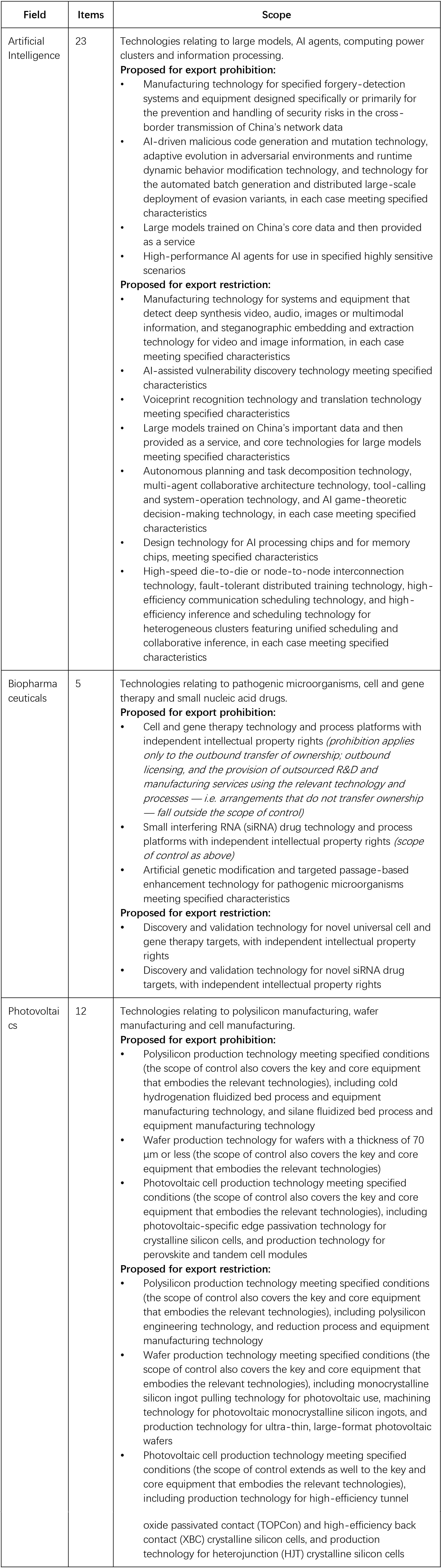
The Announcement proposes to add 40 technologies across three fields, artificial intelligence, biopharmaceuticals and photovoltaics, including 14 technologies proposed for export prohibition and 26 technologies proposed for export restriction.
The artificial intelligence field covers 23 technologies relating to large models, AI agents, computing power clusters and information processing; technologies that have entered the public domain by way of open-sourcing, publication of academic papers or other means are not subject to control.
The biopharmaceutical field covers 5 technologies relating to cell and gene therapy, small nucleic acid drugs and pathogenic microorganisms; for outbound licensing models that do not involve a transfer of ownership, facilitation measures such as automatic licensing apply.
The photovoltaic field covers 12 technologies relating to polysilicon manufacturing, wafer manufacturing and cell manufacturing; the scope of control also extends to the key and core equipment that embodies the relevant technologies.
The Announcement also sets out a wide range of facilitation measures and circumstances that fall outside the scope of control.
On the one hand, it identifies various export scenarios to which facilitation measures are intended to apply, for example:
-
technology exports in scenarios such as the open-sourcing of AI technologies, Chinese companies building and operating their own computing power centers abroad, conducting chip tape-out and manufacturing abroad, carrying out joint R&D using overseas resources, and participating in the development of international standards;
-
technology exports in scenarios such as public health emergencies, humanitarian relief, joint R&D using overseas resources, and outbound licensing.
-
On the other hand, it clarifies a number of circumstances that do not fall within the scope of technology export control, for example:
-
For the AI technologies proposed for addition: (1) technologies that have entered the public domain by way of open-sourcing, publication of academic papers or other means are not intended to be subject to control; (2) where an enterprise uses a restricted large model to provide overseas parties with API calls, APP or web-page interaction, SaaS applications, lightweight on-device local deployment and the like, such use does not fall within the scope of control over the export of large model technology; and (3) by contrast, overseas localized deployment of AI technologies that are subject to restriction does fall within the scope of control, but where deployment takes place in circumstances with relatively controllable risk, such as on the enterprise’s own overseas cloud, facilitation measures such as automatic licensing may apply.
-
For the biopharmaceutical technologies proposed for addition: where the relevant technology and process platforms with independent intellectual property rights are licensed to overseas parties, or are used to provide outsourced R&D and manufacturing services, such export scenarios do not fall within the scope of control.
The proposed revisions are currently at the public consultation stage, and the consultation period runs from October 16 to November 15, 2026, during which members of the public may submit comments on the scope of the newly added technologies, the technical parameters, the control policies, the facilitation measures and other related matters.
2.Interim Measures Already in Effect
The Announcement further provides that, from the date of its issuance until the date on which the revised Catalogue formally takes effect, a technology export operator must, before exporting any technology listed in the Announcement, complete registration through the Technology Trade Management Information Application on MOFCOM’s Unified Platform for Business Systems. Export operators must determine for themselves whether the technology they intend to export falls within the scope of the interim registration requirements.
It should be noted that the registration obligation takes effect at a different point in time from the Catalogue itself. The list remains under public consultation, yet the registration obligation for the transitional period has already taken effect as of October 16, 2026, and its scope expressly extends to exports that have already commenced but have not yet been completed.
Under Announcement No. 48, there are four types of export scenario requiring registration:
- transfer of ownership of technology to an overseas party (e.g. assignment of intellectual property);
- licensing of domestic technology for use overseas (e.g. licensing of intellectual property);
- change of the owner or person with actual control of domestic technology to an overseas entity; and
- other circumstances that MOFCOM expressly requires to be registered by notice or other means.
The third category merits particular attention. It is not only the transfer and licensing of technology that constitute technology exports. A change of control over the entity holding the technology may itself constitute a registrable technology export. Equity transactions, joint venture arrangements, offshore restructuring and even adjustments to shareholding structures within a group may trigger the registration obligation, provided they involve the transfer of ownership of, or actual control over, technologies listed in the annex to the Announcement to an overseas entity. This provision links corporate transactions directly to export controls, with implications that go far beyond “export” activity in the traditional sense.
The information to be registered mainly includes: (1) basic information on the technology export operator, the technology owner and the technology importer, and the destination country or region; (2) particulars of the technology to be exported, namely its category, name, code, classification level, technical parameters and industry category, the form and purpose of the export, and the user and intended use of the technology; and (3) other circumstances requiring registration, such as whether the technology is covered by independent intellectual property rights and the estimated export value (subject to the requirements of the Technology Trade Management Information Application on MOFCOM’s Unified Platform for Business Systems). Where multiple technologies are to be exported to the same recipient at one time, a single consolidated registration form may be completed; in other cases, separate forms should in principle be completed.
3. Significance and Implications of the Revisions
First, the scope of control over “technology” and “knowledge” is further expanded. In the fields covered by these measures, the control point previously lay mainly with items and entities; these revisions move the control point upstream to the technology itself, including models, process platforms, targets, engineering capabilities and know-how. The large AI models and AI agents proposed for addition, together with the cell and gene therapy technology and process platforms and the novel target discovery and validation technologies in the biopharmaceutical field, are precisely where this shift lands. The direct consequence of moving the control point upstream is that the methods companies commonly use to circumvent item-based controls — relocating production, adjusting supply chains, redesigning shareholding structures and the like — are largely ineffective against technology export controls. Technology has no country of origin, and no physical “customs border”.
Second, the object affected by the conflict expands from “goods” to “cooperation”. Outbound licensing, joint R&D, outsourced R&D and manufacturing, and overseas deployment, arrangements that multinational companies have typically adopted in response to China-US frictions, have now themselves become the target of technology export controls. By bringing scenarios such as “licensing of domestic technology for use overseas” and “change of the owner or person with actual control of domestic technology to an overseas entity” within pre-export registration, the Announcement shows that the conventional tools previously used to mitigate conflict risk may themselves become a new source of conflict.
Third, the revisions are structurally parallel to US rules, but should not be read simply as policy countermeasures. The US deemed export rules, technology transfer controls and the remote access controls currently under legislation all take technology, persons and services as their points of connection, and bring remote access to computing power within their purview; China’s revisions likewise take technology transfer as the point of connection. That both sides have, independently, shifted the control point from physical items to knowledge reflects an adjustment of the object of technology export control in response to changes in the form of technology. The objective result of this convergence may be that friction no longer arises only at ports and warehouses, but moves further upstream into laboratories, code repositories and license agreements.
References:
[1] Link to the original Announcement: https://aqygzj.mofcom.gov.cn/flzc/gzjgfxwj/art/2026/art_c99f95ca0cd043829ac9991495fc283c.html
[2] MOFCOM spokesperson’s answers to reporters’ questions on the revision of the Catalogue of Technologies Prohibited or Restricted from Export in China: https://www.mofcom.gov.cn/xwfb/xwfyrth/art/2026/art_d7661dbf62794345a221404f82a25959.html
Source: LLinks Law Offices
Authors:
- David Pan, Partner, david.pan@llinkslaw.com
- Sherry Wu, Associate
- Poppy Bi, Associate
- Lisa Mao, Associate