

As the previous article has analyzed the core characteristics of global new energy projects and the adaptability of construction models in Central Asia, Southeast Asia, and the Middle East, this article will further cover key regions such as Latin America and North Africa, and provide comprehensive practical recommendations for Chinese enterprises "going global".
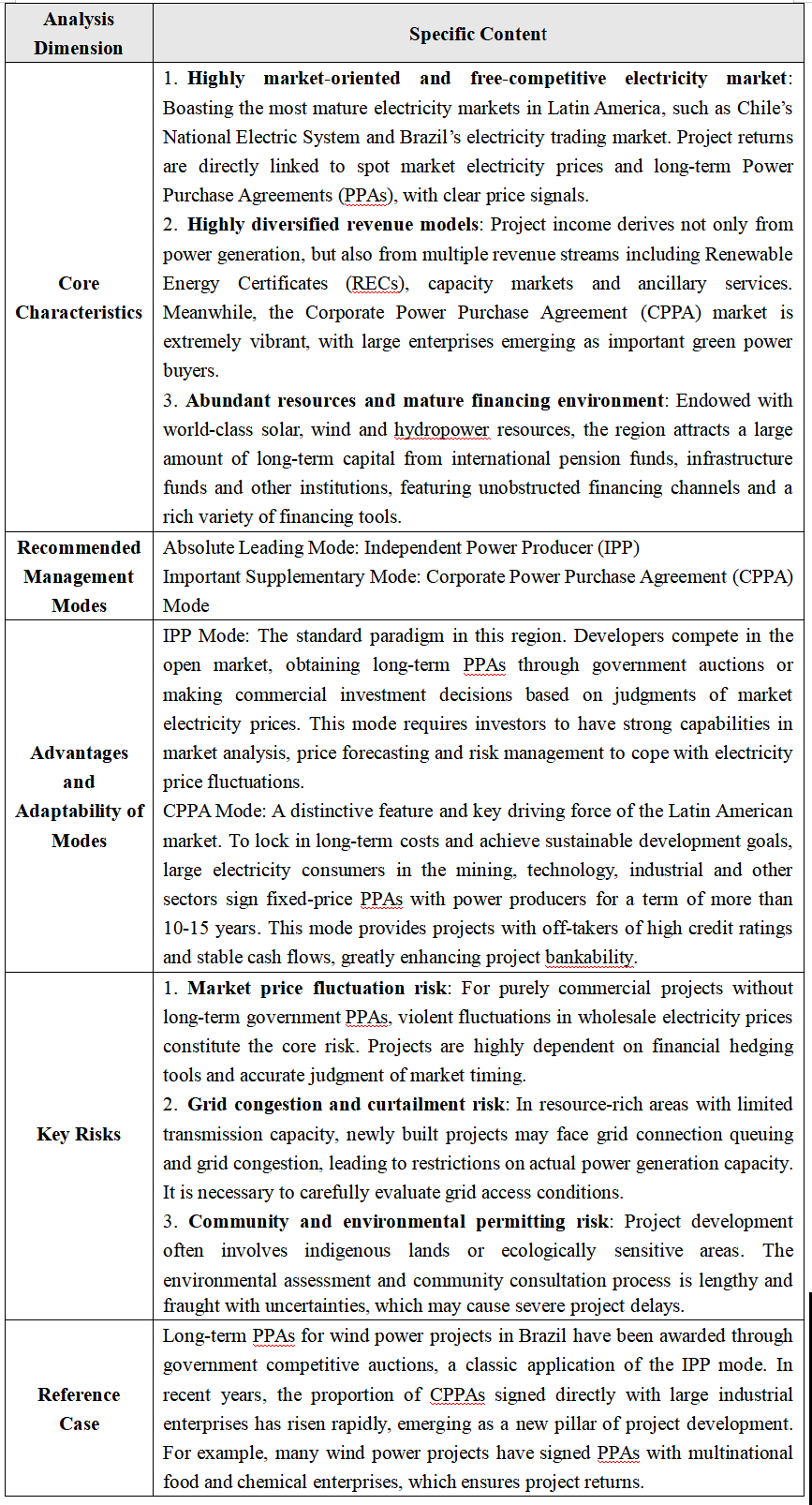
Latin America (represented by Chile and Brazil) is one of the most dynamic regions with the highest degree of marketization in global new energy development. The core logic behind its project management models lies in capturing long-term value amid price fluctuations through diversified business models and financial innovations in the world’s most mature and competitive markets.
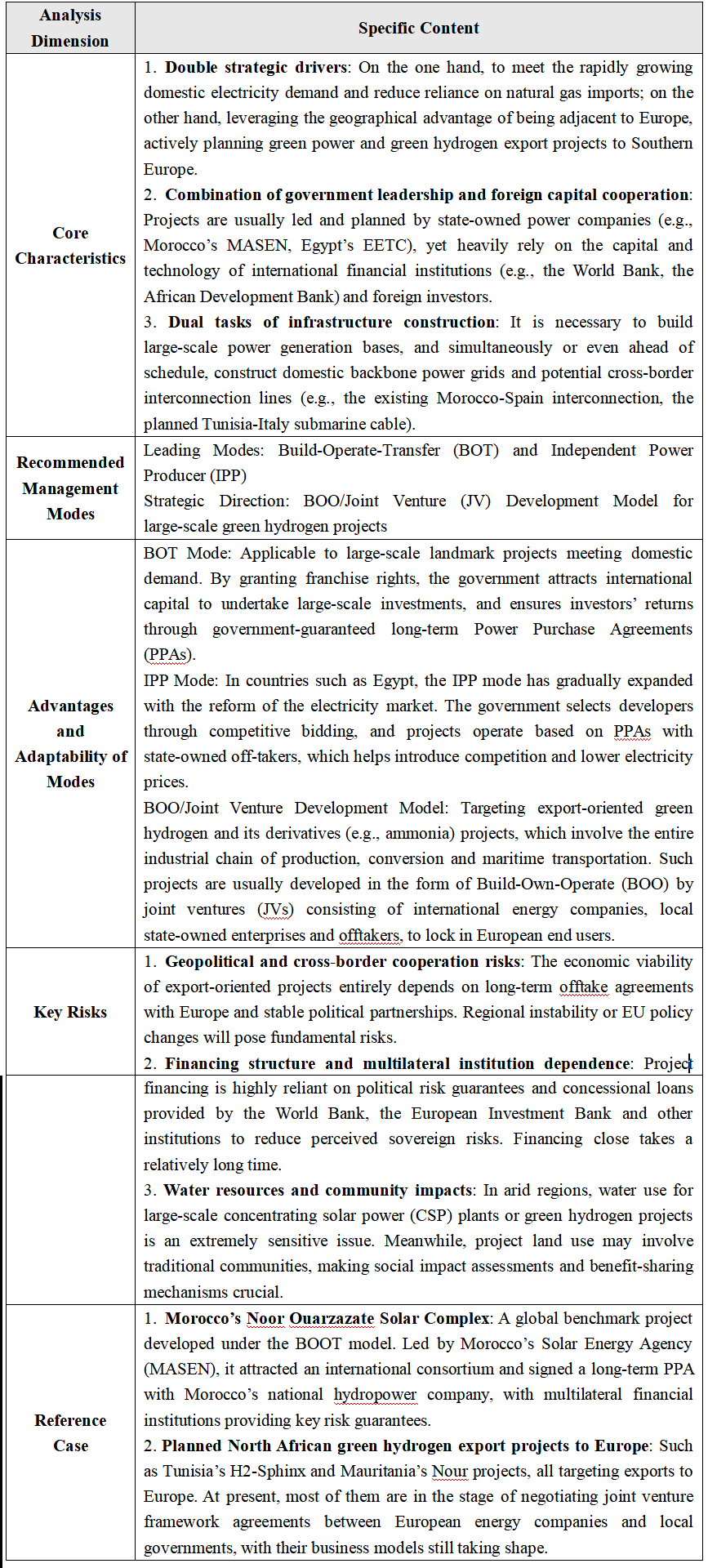
New energy development in North Africa (represented by Morocco and Egypt) stands at the intersection of two strategic goals: "meeting domestic energy security needs" and "building a green energy export hub for Europe." The core of selecting its project management models lies in balancing strong local demand, superior resource export potential, and complex geopolitical and economic relations.
In mature markets such as Western Europe, North America, and East Asia, new energy projects have become deeply financialized and standardized. The core of their management models has evolved into the precise pricing of risks and the securitization of long-term cash flows. Project development is no longer merely about engineering and construction, but rather systematic arbitrage across electricity markets, financial markets, and policy environments. Their cutting-edge explorations focus on complex business models such as virtual power plant (VPP) aggregation, distributed energy trading, and green power-carbon market linkage, with management priorities centered on the full-lifecycle optimization and appreciation of assets.
In frontier markets such as Sub-Saharan Africa, however, the development logic is entirely different. The core mission is to address energy access as a fundamental development issue, with business models highly dependent on non-commercial capital and extremely localized social innovation. The key to project success lies not in pursuing financial returns, but in building a sustainable micro-system encompassing payment mechanisms, operation and maintenance, and community governance—where social value takes precedence.
Additionally, markets with special industrial policies or geographical characteristics, such as Japan, South Korea, and Australia, demonstrate another path. They leverage new energy projects as strategic tools to achieve energy security, technological leadership, or industrial development. Consequently, their management models are often closely integrated with strict localization bundling requirements and technology transfer clauses. In essence, they exchange market access for industrial capabilities, forming a unique cooperation paradigm where national strategies and corporate commercial interests are deeply intertwined.
Based on the aforementioned systematic analysis of regional market characteristics and model adaptability, Chinese new energy enterprises' "going global" has entered a new phase requiring "meticulous cultivation and systematic success." To build sustainable competitive advantages in global competition, enterprises must transcend the mindset of mere engineering contracting or equipment export and achieve systematic upgrades from strategy and execution to risk control.
Enterprises should establish a dynamic country-specific research system to conduct in-depth assessments of host countries' political and economic trends as well as energy policy directions, translating macro insights into market opportunities. The core lies in promoting the development of "investment-construction-operation integration" capabilities, transforming from EPC contractors to comprehensive energy solution providers with project incubation, financing planning, and long-term asset operation capabilities. Meanwhile, differentiated regional strategies must be implemented: In the Middle East, position as a high-end manufacturing and technology partner, focusing on participating in benchmark projects and earnestly fulfilling localization commitments; In Southeast Asia and Latin America, act as highly market-oriented and efficient investors, specializing in PPA negotiations, electricity market analysis, and financial risk management; In Central Asia and North Africa, leverage the role of "strategic energy security partner," integrating new energy projects closely with infrastructure connectivity through bilateral cooperation frameworks.
True localization goes beyond meeting minimum legal requirements. Instead, enterprises should establish joint ventures with reputable local developers, engineering firms, and financial institutions to build a community of shared interests and risks, thereby effectively securing projects and avoiding market access barriers. Simultaneously, ESG (Environmental, Social, and Governance) standards must be elevated from promotional highlights to core prerequisites for project access and financing. Transparent practices exceeding local standards should be established in areas such as biodiversity conservation and community benefit-sharing to obtain the valuable "social license." Additionally, enterprises should proactively design and engage multilateral financial institutions such as the World Bank and AIIB, as well as policy-based insurance tools like Sinosure, to optimize financing structures through their credit enhancement and effectively hedge against political and payment risks in host countries.
This requires enterprises to establish specialized mechanisms to continuously assess the potential impact of geopolitical changes on strategic projects and pre-design risk mitigation plans in agreements. A full-chain compliance system covering investment access, taxation, data security, and anti-bribery must be established to address increasingly complex regulatory requirements globally, especially in European and American markets. Finally, enterprises should actively adopt digital tools such as digital twins and intelligent operation and maintenance platforms to achieve remote precision monitoring and predictive maintenance of overseas assets. Data analysis should be used to manage electricity market and exchange rate fluctuation risks, thereby enhancing the operational efficiency and value of long-term assets.
In summary, the global future of Chinese new energy enterprises depends on their ability to become creators of local value, proficient users of international rules, and outstanding managers of long-term risks. Only through strategic deep cultivation, in-depth integration, and systematic risk control can they shape lasting leadership and brand value amid the global energy transition.
Global new energy project construction has entered a new phase of profound complexity and high differentiation. Through systematic analysis of key regions including Central Asia, Southeast Asia, the Middle East, Latin America, and North Africa, this paper reveals that there is no universally applicable "optimal" management model—only the "most contextually adaptive" choice. The fundamental success of a project lies in striking a precise balance among multiple constraints: technical feasibility, commercial returns, geopolitics, socio-culture, and compliance frameworks. From the financialized operations in mature markets to localized innovation in frontier markets, and strategic bundling in resource-rich countries, each model represents an optimal solution tailored to its specific environment. This implies that simple replication of models or transplantation of experiences will inevitably encounter severe challenges; the core logic of decision-making must shift from "what we can do" to "how we should construct a governance structure here, for this project, and in collaboration with these partners."
Looking ahead, the global cooperation paradigm for new energy projects is undergoing profound restructuring. Its driving forces stem not only from technological progress and cost reduction, but also from geopolitical cooperation to address climate change, strategic games to ensure supply chain security, and social demands for a just transition. This signifies that project management has transcended traditional engineering and commercial boundaries, increasingly evolving into a complex systematic endeavor integrating international relations, financial innovation, community governance, and digital technology. For Chinese enterprises, the core competitiveness of "going global" is rapidly shifting from explicit capital and cost advantages to implicit capabilities: system integration, cross-cultural resource linking, and long-term resilience building. Only by deeply understanding and proactively adapting to this trend—through strategic deep cultivation, integration in execution, and resilience building against risks—can they navigate cycles and play an irreplaceable key role in the restructuring of the global energy system.
Reference:
I. Laws and Regulatory Documents
[1] The Paris Agreement
[2] Energy Charter Treaty (ECT)
[3] Foreign Investment Law of the People's Republic of China
II. Academic Journals
[4] Li Wei. On WTO Disputes Over New Energy Trade and China's Countermeasures[J]. Journal of Shanghai University of International Business and Economics, 2018(1).
[5] Wu Zhizhong. Japan's New Energy Policies and Laws and Their Implications for China[J]. Law Science Magazine, 2013(1).
III. Online Resources
[6]Global Energy Network Institute. Wind Energy in Turkmenistan [EB/OL]. [2026-01-21]. https://www.geni.org/globalenergy/library/renewable-energy-resources/world/asia/wind-asia/wind-turkmenistan.shtml.
[7]Saudipedia. National Renewable Energy Program [EB/OL]. [2026-01-21]. https://saudipedia.com/en/article/908/government-and-politics/national-renewable-energy-program.
[8]UAE Renewable Energy Strategy [EB/OL]. [2026-01-23]. https://www.moccae.gov.ae/en/about-us/irena/strategies
[9]Electric power auctions - Biomass[EB/OL]. [2026-01-23]. https://www.iea.org/policies/6550-chile-energy-auctions
[10]Chile energy auctions[EB/OL]. [2026-01-23] https://www.iea.org/policies/6550-chile-energy-auctions
[11]Accelerating Renewables Growth in ASEAN[EB/OL]. [2026-01-23] https://www.iea.org/reports/accelerating-renewables-growth-in-asean
[12]Scaling Up Renewables in Europe and Central Asia | Barriers and Opportunities[EB/OL]. [2026-01-23] https://www.esmap.org/Scaling_Up_Renewables_in_Europe_and_Central_Asia_Barriers_and_Opportunities
[13]越南新能源市场现状与机遇[EB/OL]. [2026-01-23] https://www.tradesichuan.com/jmzx/2872.html
Source: DHH Research Institute
Author: Liu Junli, Partner of DHH, Email: liujunli@deheheng.com
READ MORE: Cross-Jurisdictional Adaptability and Selection of New Energy Construction Models (Ⅰ)