

Part One has clarified the core concepts and multi-dimensional classification system of international EPC design management, laying a foundational cognitive framework for project management. However, in cross-border engineering practice, it is necessary to further focus on the specific management needs of international scenarios and clarify the rights and responsibilities boundaries of all entities throughout the entire design process — this is not only the key to addressing special challenges such as cross-cultural differences and multiple parallel standards, but also the core prerequisite for preventing legal risks. The following will conduct an in-depth analysis focusing on international scenario-specific classifications and the division of design responsibilities, providing practical basis for subsequent risk control.
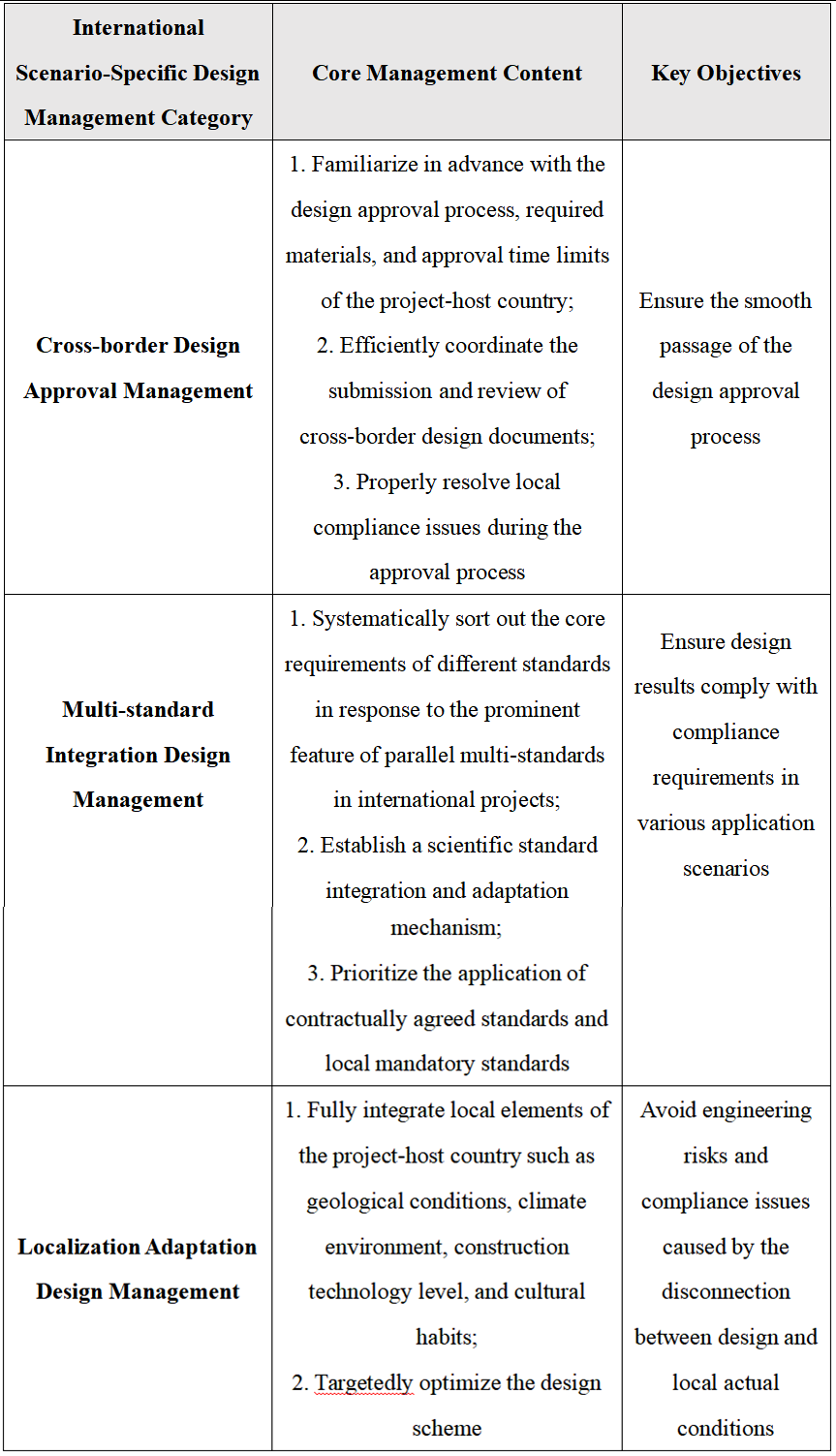
2.2.4 Classification by International Scenario-Specific Requirements
Design management of international EPC projects needs to focus on addressing the special challenges brought by the cross-border environment, carry out special management around approval processes, standard systems, and local characteristics. Through full-process cross-border collaboration, standard integration, and local adaptation, it ensures that design work meets the requirements of the project-host country and supports the smooth advancement of the project.
3. Division of Design Responsibilities in International EPC Turnkey Projects
3.1 Division of Design Scope Responsibilities
In terms of dividing design scope responsibilities, the owner’s core responsibilities include clarifying the project’s functional positioning and core needs, timely providing complete and accurate basic survey data (including key information such as geology, hydrology, and meteorology), clearly defining design boundary conditions, carefully reviewing the design scope list, and providing timely feedback.
The contractor shall, in accordance with the owner’s core needs and clear contractual agreements, fully complete the entire design process, ensure coverage of all technical details within the design scope, guarantee that the design content is consistent with the overall project goals, and actively cooperate with design scope changes resulting from the owner’s demand adjustments to promptly complete design optimization.
To effectively avoid disputes over responsibility boundaries, both parties shall clarify the definition standards of the design scope, refine the approval process for scope changes, and the method of responsibility bearing in the contract, ensuring clear rights and responsibilities for all work.
3.2 Division of Design Standard Responsibilities
The division of design standard responsibilities needs to balance standardization and adaptability. The owner shall clarify the international, local, and industry standards applicable to the project, provide a complete list of standards and compliance requirements, and carefully review the standard compliance of the design scheme and put forward clear review opinions.
The contractor shall carry out the design in strict accordance with the contractually agreed standards, proactively resolve multi-standard conflicts, clarify the priority order of standard application, complete standard conversion and adaptation, ensure that the design results fully comply with the mandatory clauses of various standards, and provide complete standard compliance explanation documents.
Both parties shall clarify the priority rules for standard application, the design adjustment responsibilities after standard updates, and the standard compliance acceptance standards in the contract to avoid disputes over standard application.
3.3 Division of Design Approval Responsibilities
The core of dividing design approval responsibilities is to ensure approval efficiency and compliance. The owner shall complete the review of design results at each stage on time, provide timely feedback and clear modification requirements, take the initiative to assist the contractor in handling cross-border or local design approval procedures, and provide relevant documents within the scope of its responsibilities.
The contractor shall submit complete and standardized design result documents as agreed, actively cooperate with the review work of the owner and local regulatory authorities, promptly revise and optimize the design according to the review opinions, and bear full responsibility for approval delays caused by its own design issues.
To ensure the orderly advancement of approval work, both parties shall clarify the approval time limit, the method of responsibility division for failed approval, and the written confirmation mechanism for the approval process, ensuring the approval process is traceable and responsibilities are verifiable.
3.4 Division of Design Quality and Performance Responsibilities
Design quality and performance responsibilities are directly related to the overall project effectiveness. The owner shall establish clear design quality acceptance standards, organize third-party institutions to conduct design reviews, promptly put forward rectification requirements for identified design quality issues, and bear design quality responsibilities caused by its own demand changes or provision of incorrect data.
The contractor shall bear full responsibility for the authenticity, accuracy, and completeness of the design results, be liable for compensation for engineering quality problems, safety accidents, and related economic losses caused by design defects, be responsible for completing the technical disclosure of design results and subsequent technical support work, and actively cooperate with project quality acceptance and promptly resolve design-related issues arising during the acceptance process.
Both parties shall clarify the identification standards for design quality defects, the scope of liability compensation, and exemption clauses (such as force majeure and the owner’s fault) in the contract, ensuring the fair and reasonable division of responsibilities with a basis for reference.
3.5 Division of Intellectual Property Responsibilities
The division of intellectual property responsibilities needs to focus on rights protection and risk avoidance. The owner shall clarify the ownership and scope of use of its own intellectual property rights, formally authorize the contractor to use the technical data and intellectual property rights provided by it, and legally enjoy the intellectual property rights of design results within the agreed scope, especially the relevant rights of customized design results.
The contractor shall ensure that the submitted design results do not infringe upon any third-party intellectual property rights, clarify the ownership of its own core technical intellectual property rights, authorize the owner to legally use the design results within the project scope, and bear full responsibility for legal liabilities and related losses caused by intellectual property infringement.
Both parties shall clarify the list of intellectual property ownership, the boundaries of usage rights, the method of liability bearing for infringement, and the subsequent intellectual property maintenance responsibilities in the contract to effectively protect the legitimate rights and interests of both parties.
Source: DHH Research Institute
Author: Liu Junli (刘俊丽), Partner of DHH, Email: liujunli@deheheng.com
READ MORE: Design Management of International EPC Projects (Ⅰ)